Jali Door Design: Modern and Traditional Patterns with Price Guide
Modern jali door designs cut geometric, floral or abstract openings into wood, CNC-cut plywood or MDF, or metal panels, so air and light pass through while privacy stays intact. Patterns, materials and rates differ for main doors, pooja rooms and kitchens.
Last updated: . Grades and standards checked against current BIS standards.
What Is a Jali Door Design?
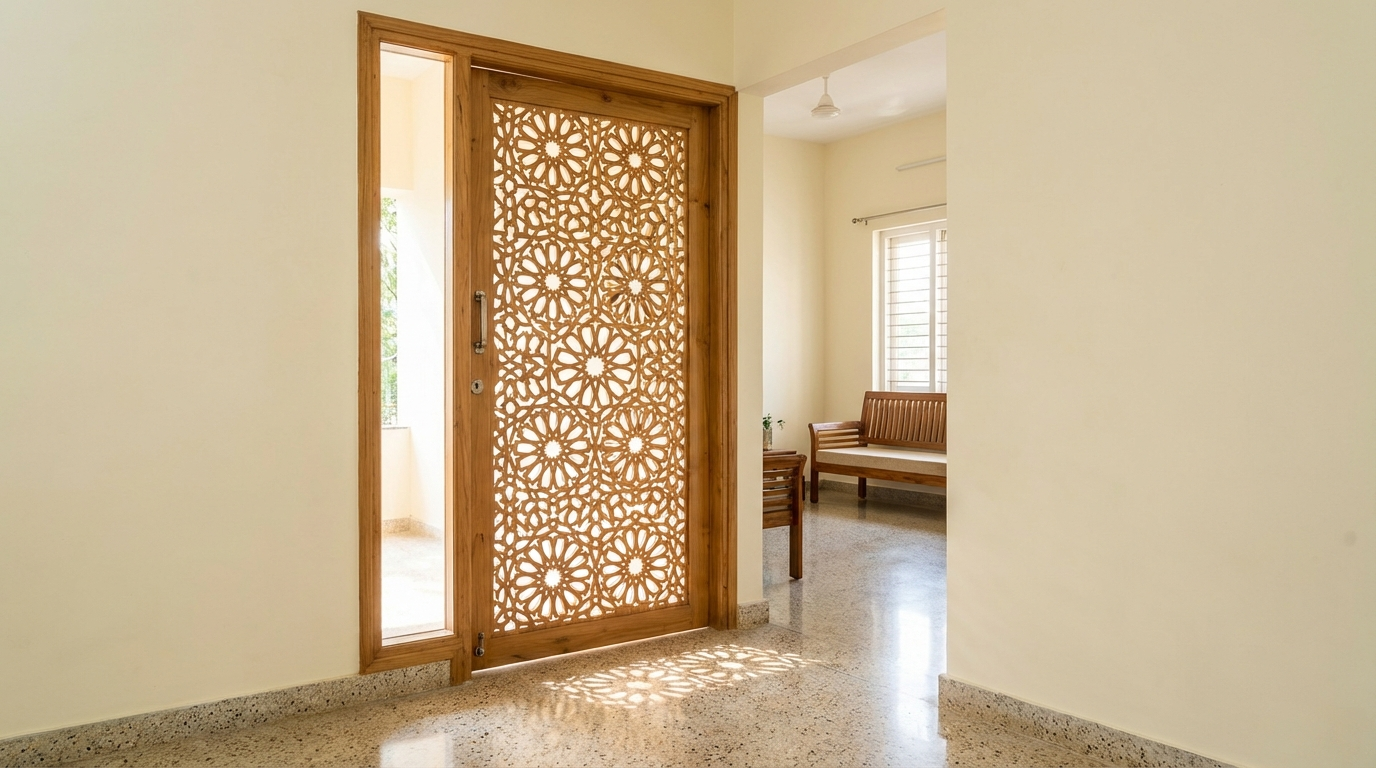
Jali door design refers to doors featuring perforated screens or lattice patterns that allow air and light to pass through while maintaining privacy and security. Jali doors stay popular in both traditional and contemporary Indian homes because they combine ventilation, looks and cultural meaning.
In simple terms, jali work involves creating intricate geometric, floral, or abstract patterns by cutting or carving openings into door panels. These designs originated from Mughal and Rajasthani architecture but have evolved significantly to include CNC-cut patterns, laser-etched designs, and modern minimalist interpretations suitable for urban apartments.
- Traditional wooden jali doors cost ₹8,000-25,000 per door depending on wood type and carving complexity
- CNC-cut MDF jali panels range from ₹150-400 per square foot
- Metal jali doors (MS/SS) typically cost ₹350-800 per square foot
- Plywood-based jali doors offer 40-60% cost savings over solid wood alternatives
- Modern composite jali designs combine multiple materials for enhanced durability
- Installation charges add ₹1,500-4,000 depending on door size and complexity
What Makes Jali Door Designs Unique in Indian Architecture?
Jali doors serve a dual functional and decorative purpose that no other door style achieves with equal effectiveness. The perforated design allows cross-ventilation critical in India's hot and humid climate while creating beautiful shadow patterns as sunlight filters through the openings.

The word "jali" originates from the Sanskrit term "jala" meaning net or mesh. Historically, jali screens adorned royal palaces, havelis, and mosques across North India, serving as privacy screens for zenana quarters while allowing women to observe activities without being seen. This architectural heritage translates beautifully into modern door applications.
Traditional Jali Patterns and Their Significance
Traditional Indian jali patterns carry deep cultural meaning beyond their visual appeal. Geometric patterns represent cosmic order and mathematical precision, while floral motifs symbolize prosperity and natural harmony. Star patterns often found in Mughal architecture signify divine light and guidance.
Regional variations distinguish different jali traditions. Rajasthani jali features intricate stone carving with detailed floral patterns. Gujarati jali emphasizes bold geometric shapes. South Indian temple jali incorporates mythological figures and religious symbols. Understanding these traditions helps homeowners select designs that resonate with their cultural background.
Types of Jali Door Designs Available in India
The Indian market offers jali doors in seven distinct categories, each suited to specific applications, budgets, and aesthetic preferences. Availability and pricing vary significantly with material choice and craftsmanship level.
| Jali Door Type | Best Application | Price Range (₹/sq ft) | Durability Rating | Maintenance Level |
|---|---|---|---|---|
| Solid Wood Carved Jali | Main entrance, pooja rooms | ₹400-1,200 | Excellent (20+ years) | Medium-High |
| CNC-Cut MDF Jali | Interior partitions, wardrobes | ₹150-350 | Good (8-12 years) | Low |
| Plywood Jali Doors | Bedrooms, kitchen entries | ₹200-450 | Very Good (12-15 years) | Low-Medium |
| Metal Jali (MS/SS) | Safety doors, main gates | ₹350-900 | Excellent (25+ years) | Low |
| Aluminium Jali | Balconies, external doors | ₹280-550 | Very Good (15-20 years) | Very Low |
| WPC Jali Panels | Bathrooms, wet areas | ₹220-400 | Good (10-15 years) | Very Low |
| Composite/Hybrid Jali | Modern interiors, feature walls | ₹300-600 | Good (10-12 years) | Low |
Wooden Jali Door Designs: Traditional Excellence
Solid wood jali doors represent the pinnacle of traditional Indian craftsmanship. Teak wood remains the preferred choice for main entrance jali doors due to its natural termite resistance and exceptional durability. Sheesham (Indian Rosewood) offers beautiful grain patterns at 30-40% lower cost than teak.
Carving techniques vary significantly across regions. Hand-carved jali from Saharanpur and Jodhpur commands premium prices (₹800-1,500 per square foot) but delivers unmatched artistic value. Semi-machine carved options provide consistent quality at ₹400-700 per square foot, suitable for most residential applications.
CNC-Cut Jali Patterns: Modern Precision
Computer Numerical Control (CNC) technology has revolutionized jali door manufacturing in India. CNC machines cut intricate patterns with 0.1mm precision, enabling complex geometric designs impossible to achieve through manual carving. This technology works excellently with MDF, plywood, and HDHMR boards.
CNC jali patterns offer unlimited design possibilities from traditional Moroccan-inspired motifs to contemporary abstract designs. Design files can be customized easily, allowing homeowners to create personalized patterns incorporating family initials, religious symbols, or unique geometric combinations.
Metal Jali Door Designs for Security
Metal jali doors combine aesthetic appeal with enhanced security, making them ideal for main entrances and safety door applications. Mild steel (MS) jali doors provide robust security at affordable prices (₹350-550 per square foot), while stainless steel options offer superior corrosion resistance for coastal areas (₹600-900 per square foot).
Powder coating finishes extend metal jali door lifespan significantly. Available in 200+ colour options, powder-coated finishes resist scratching, fading, and corrosion better than conventional paint. For homes in high-humidity regions like Kerala and coastal Karnataka, powder coating is essential.
Application-Wise Jali Door Recommendations
Different areas within Indian homes demand specific jali door characteristics based on usage patterns, moisture exposure, and security requirements. Match door specifications precisely to application needs to ensure optimal performance and longevity.
| Application | Recommended Material | Ideal Thickness | Pattern Recommendation | Budget Range (Complete Door) |
|---|---|---|---|---|
| Main Entrance | Teak/MS with glass inserts | 40-50mm | Traditional geometric, floral | ₹25,000-75,000 |
| Pooja Room | Solid wood/Carved MDF | 25-35mm | Temple motifs, lotus patterns | ₹12,000-35,000 |
| Bedroom Entry | Plywood/MDF with laminate | 30-35mm | Minimalist, contemporary | ₹8,000-18,000 |
| Kitchen Entry | BWR plywood/Aluminium | 25-30mm | Simple geometric | ₹6,000-15,000 |
| Bathroom | WPC/Marine plywood | 25-30mm | Minimal with ventilation | ₹5,000-12,000 |
| Room Partition | MDF/HDHMR panels | 18-25mm | Decorative, artistic | ₹150-350/sq ft |
| Balcony | Aluminium/SS | Frame-based | Weather-resistant patterns | ₹350-700/sq ft |
Main Entrance Jali Door Designs
Main entrance jali doors must balance aesthetic impact with security and weather resistance. Double-door configurations with central jali panels flanked by solid wood frames remain the most popular choice across North Indian metros. Single-door designs with full-height jali work suit modern apartments with space constraints.
For main doors, combining jali with safety features is essential. Many homeowners opt for a jali door positioned outside a solid wooden main door, creating a dual-layer entry system. This arrangement allows keeping the inner door open for ventilation while maintaining security through the locked jali door.
Pooja Room Jali Door Patterns
Pooja room jali doors hold special significance in Indian households, serving both functional and spiritual purposes. Traditional designs incorporate religious symbols including Om, Swastik, lotus flowers, and temple silhouettes. The jali pattern allows incense smoke and oil lamp aromas to circulate while maintaining the sanctity of the prayer space.
According to Vastu principles, pooja room doors should face east or north. Jali patterns for pooja rooms typically feature smaller, denser openings compared to other applications, creating a sense of privacy while allowing light and air. Gold or brass-finished hardware complements the sacred aesthetic.
Kitchen Jali Door Solutions
Kitchen jali doors must withstand humidity, cooking odours, and temperature fluctuations common in Indian cooking environments. BWR (Boiling Water Resistant) grade plywood forms the ideal base material, resisting moisture damage from steam and occasional water splashes. For grade details, see MR vs BWR vs BWP plywood.
Partial jali designs work better for kitchens than full-height patterns. A common configuration features solid panels on the lower two-thirds with jali work on the upper section, preventing splatter damage while allowing ventilation and visual connection to adjoining spaces.
Regional and Climate Considerations for Jali Doors
India's diverse climate zones demand different material choices and treatment approaches for jali doors. A design that performs excellently in dry Rajasthan may fail prematurely in humid Kerala. As a result, door longevity varies considerably from region to region.
North India: Extreme Temperature Variations
North Indian homes experience temperature swings from 5°C in winter to 45°C+ in summer. This thermal stress causes expansion and contraction in door materials. Solid wood with minimum 8% moisture content and proper seasoning handles these variations best. MDF and HDF panels may develop edge swelling or surface cracks in extreme conditions.
For cities like Delhi, Jaipur, and Lucknow, teak or sheesham jali doors with traditional joinery techniques outperform modern alternatives. The dry winter months are ideal for installation, allowing the wood to acclimatize before monsoon humidity arrives.
South India and Coastal Areas: Humidity Management
Coastal regions including Mumbai, Chennai, Kochi, and Mangalore experience year-round humidity exceeding 70%. Standard MDF jali panels deteriorate rapidly in such conditions, showing swelling, warping, and surface degradation within 3-5 years. Marine-grade plywood (IS:710 certified), aluminium, or stainless steel are essential for longevity.
Salt air in coastal areas accelerates corrosion of mild steel jali doors. SS 304 grade stainless steel or powder-coated aluminium provides superior performance. Budget-conscious homeowners can opt for MS jali with marine-grade epoxy coating, though this requires periodic maintenance recoating every 3-4 years.
Monsoon Impact on Jali Door Materials
The Indian monsoon season subjects doors to sustained high humidity, direct rain exposure (for external doors), and fungal growth risks. Pre-monsoon preparation includes checking for seal integrity, applying fresh waterproofing coatings, and ensuring proper drainage around door frames.
Post-monsoon, inspect jali doors for moisture damage, fungal growth, or termite activity. Wood components may require re-polishing after monsoon exposure. Metal jali should be checked for rust spots and treated immediately to prevent spreading.
Jali Door Material Comparison: Making the Right Choice
Selecting the appropriate base material for jali doors determines their longevity, maintenance requirements, and total cost of ownership. This comprehensive comparison helps homeowners match material properties to their specific requirements and local conditions.
| Property | Solid Wood | Plywood | MDF | Metal (MS/SS) | Aluminium | WPC |
|---|---|---|---|---|---|---|
| Water Resistance | Medium (with treatment) | Good (BWR/BWP grade) | Poor-Medium | Excellent (SS) | Excellent | Excellent |
| Termite Resistance | Variable by species | Treated options available | Good (no cellulose) | Excellent | Excellent | Excellent |
| Carving/CNC Suitability | Excellent | Good | Excellent | Limited | Limited | Moderate |
| Weight | Heavy | Medium | Medium | Heavy | Light | Light |
| Price (₹/sq ft) | ₹400-1,200 | ₹200-450 | ₹150-350 | ₹350-900 | ₹280-550 | ₹220-400 |
| Lifespan | 20-50 years | 12-20 years | 8-15 years | 25-40 years | 20-30 years | 15-20 years |
| Finish Options | Polish, paint, lacquer | Laminate, veneer, paint | Paint, laminate, PU | Powder coat, plating | Anodizing, powder coat | Paint, laminate |
Plywood vs MDF for Jali Door Panels
Plywood offers superior structural strength and screw-holding capacity compared to MDF, making it better suited for door applications where hinges and hardware must support significant weight. BWR grade plywood (IS:303 certified) provides adequate moisture resistance for most interior applications at ₹80-150 per square foot for the base material.
MDF excels in CNC machining applications where intricate patterns require clean, chip-free cutting. The homogeneous composition of MDF produces smoother edges than plywood, reducing finishing time and cost. However, MDF's poor moisture resistance limits its application to climate-controlled interiors. For material comparisons, see plywood vs MDF for furniture and HDHMR vs exterior MDF.
When to Choose Metal Jali Doors
Metal jali doors provide unmatched security and weather resistance, making them ideal for main entrances, safety doors, and external applications. MS (Mild Steel) jali offers excellent value for protected locations, while SS (Stainless Steel) justifies its premium pricing in corrosive environments.
The main disadvantage of metal jali is limited design flexibility compared to wood or MDF. While laser cutting enables intricate patterns, the hard metallic appearance may not suit traditional or warm interior themes. Combining metal jali frames with wooden or glass inserts creates hybrid designs that balance security with aesthetics.
Jali Door Price Guide: 2026 Market Rates
Jali door pricing in India varies significantly based on material, craftsmanship level, size, and regional market conditions. Metro cities typically command 15-25% premium over tier-2 towns due to higher overhead costs and material transportation expenses. The following ranges are indicative for major Indian cities.
Cost Breakdown by Component
Understanding the component-wise cost structure helps homeowners budget accurately and identify potential savings opportunities. Labour costs vary significantly between regions, with Rajasthani craftsmen commanding premium rates for traditional carving while CNC operations offer consistent pricing nationwide.
- Base material (plywood/MDF panel): 25-35% of total cost
- Jali cutting/carving: 30-45% of total cost
- Finishing (polish/laminate/paint): 15-25% of total cost
- Hardware (hinges, handles, locks): 5-10% of total cost
- Installation: 5-10% of total cost
Regional Price Variations
Material costs and labour rates create substantial regional price differences. Saharanpur (UP), a traditional wood carving hub, offers 20-30% lower prices for carved wooden jali compared to Delhi or Mumbai. Yamunanagar (Haryana) provides competitive plywood-based jali doors due to proximity to plywood manufacturing clusters.
Southern states including Tamil Nadu, Karnataka, and Kerala report higher metal jali door prices due to transportation costs from North Indian manufacturing hubs. Local WPC and aluminium alternatives often prove more economical in these regions while offering better climate suitability.
Quality Verification Without Lab Tests
Homeowners can assess jali door quality through visual inspection and simple physical tests without requiring laboratory analysis. These verification methods help identify substandard materials and workmanship before purchase, preventing costly replacements and safety issues.
Wood Quality Assessment
For wooden jali doors, examine the grain pattern consistency and look for knots, cracks, or colour variations indicating lower-grade timber. Properly seasoned wood sounds hollow when tapped, while unseasoned wood produces a dull thud. Check edge finishing for smoothness and absence of splinters.
Weight relative to size indicates wood density. Heavier panels typically indicate denser, more durable timber. Request documentation of wood species and origin. Legitimate dealers provide species certificates, especially for premium teak doors claiming specific origin (Burma teak, Nagpur teak, etc.).
Plywood and MDF Panel Inspection
Check for ISI certification marks on plywood panels. IS:303 indicates commercial grade suitable for interior applications, while IS:710 certifies marine grade boards for wet areas. Examine panel edges for core composition, layer bonding, and void presence in plywood.
MDF quality varies significantly across brands. Press firmly on the panel surface to check for consistent density. Uneven density indicates poor manufacturing. Edge swelling after exposure to humid conditions reveals moisture resistance quality. Premium MDF maintains edge integrity even in bathroom-adjacent applications.
Metal Jali Quality Checks
For MS jali doors, check for uniform thickness across all members using a vernier caliper. Welding quality significantly impacts door strength and appearance. Look for consistent, smooth welds without porosity, undercutting, or spatters. Powder coating should be even without runs, orange peel texture, or bare spots.
SS jali requires grade verification. SS 304 is standard for residential use, while SS 316 suits marine/coastal environments. Magnetic testing helps distinguish grades, though this method has limitations. Request material test certificates from reputable suppliers.
Top Brands Manufacturing Jali Doors in India
The Indian jali door market includes organized national brands, regional specialists, and local craftsmen. Brand selection should match project requirements, budget constraints, and after-sales service availability in your area.
Note: This is independent editorial content. Plyprice.com is not affiliated with any brand mentioned below. Please verify current specifications and prices with authorized dealers.
Major Plywood and Engineered Board Manufacturers
CenturyPly, Greenply, and Action TESA offer pre-designed jali door panels using their respective plywood and MDF products. These manufacturers provide consistent quality backed by brand warranties, though customization options may be limited compared to local fabricators.
Greenpanel and VIR Laminate (Rushil Decor) have introduced CNC-ready MDF panels specifically designed for intricate cutting applications. These products feature enhanced edge stability and surface smoothness required for clean jali patterns.
Specialized Jali Door Manufacturers
Regional specialists often deliver superior craftsmanship for traditional wooden jali work. Rajasthan-based manufacturers excel in stone and wood jali combining traditional techniques with modern finishing. Gujarat specialists produce excellent brass and copper inlay jali work.
Metal jali door specialists including organized players in Rajkot, Ahmedabad, and Delhi NCR offer extensive catalogue designs with customization services. These manufacturers typically provide powder coating in custom colours and can match specific design requirements.
Installation Guidelines and Best Practices
Proper installation ensures jali doors function correctly and achieve their expected lifespan. Poor installation is a common cause of premature door failure.
Frame Preparation
Door frames must be perfectly level and plumb before jali door installation. Even 2-3mm deviation causes binding, uneven gaps, and hardware stress. Wooden frames require moisture treatment, especially at floor contact points. Metal frames need anti-corrosion treatment before installation.
Frame dimensions should account for seasonal wood expansion. Allow 3-5mm clearance on sides and top, with 10-15mm at the bottom for floor clearance and movement accommodation. Coastal and high-humidity areas require larger clearances.
Hardware Selection
Jali doors, especially those with heavy carved panels, require heavy-duty hinges capable of supporting sustained load. Standard 4-inch butt hinges suit doors up to 25kg, while doors exceeding this weight need 5-inch heavy-duty or ball-bearing hinges.
Floor-mounted door stops prevent wall damage from jali door edges. Magnetic door catches hold jali doors open during ventilation hours without straining hinges. Select hardware finish matching overall door aesthetic, with brass, antique bronze, and matte black being popular choices for traditional jali designs.
Maintenance and Care for Longevity
Regular maintenance extends jali door lifespan significantly while preserving aesthetic appeal. Maintenance requirements vary by material, with wooden doors demanding more attention than metal or aluminium alternatives.
Wooden Jali Door Care
Dust wooden jali regularly using soft brushes that reach into intricate patterns. Accumulated dust combined with moisture promotes fungal growth and attracts termites. Deep clean every 3-6 months using appropriate wood cleaners followed by polish reapplication.
Annual termite inspection is essential for wooden doors across India. Even treated wood can develop termite issues if neighbouring untreated wood provides infestation pathways. Professional pest control treatment every 2-3 years provides effective protection in termite-prone areas.
Metal Jali Maintenance
Metal jali doors require minimal maintenance but benefit from periodic attention. Clean powder-coated surfaces with mild soap solution, avoiding abrasive cleaners that damage the coating. Inspect hinges and locks annually, lubricating moving parts with appropriate spray lubricants.
Address rust spots immediately on MS jali doors. Sand the affected area lightly, apply rust converter, and touch up with matching paint or powder coat. Coastal homes should inspect monthly during monsoon season for early corrosion signs.
Common Mistakes to Avoid
Understanding common errors helps homeowners make informed decisions and avoid costly mistakes.
- Choosing intricate patterns without considering cleaning difficulty and dust accumulation
- Using non-moisture-resistant materials (standard MDF) in humid areas or near bathrooms
- Installing jali doors without adequate security backup for main entrances
- Selecting white or light colours for jali patterns in high-dust environments
- Ignoring frame quality while focusing solely on jali panel aesthetics
- Overlooking hardware capacity requirements for heavy carved panels
- Failing to account for seasonal expansion in frame dimension calculations
- Choosing purely decorative designs without ventilation functionality where needed
- Not verifying CNC cutting precision before accepting delivery
- Skipping waterproofing treatment for wooden jali in ground-floor applications
Frequently Asked Questions
What is the best material for jali door designs in humid climates?
For humid climates like coastal areas and South India, aluminium, stainless steel (SS 304 grade), or WPC (Wood Plastic Composite) provide the best performance. These materials resist moisture absorption, fungal growth, and corrosion that damage wood and standard MDF within 3-5 years. If preferring a wood appearance, marine-grade plywood (IS:710 certified) or BWP grade (IS:303) with proper edge sealing and waterproof coating offers reasonable durability at lower cost than metal alternatives.
How much does a wooden jali door cost in India?
Wooden jali door prices range from ₹8,000 to ₹75,000 depending on wood species, carving complexity, size, and finish quality. Basic teak jali doors for internal use start around ₹15,000, while elaborately carved double doors for main entrances can exceed ₹50,000. Regional pricing varies significantly, with Rajasthan and UP offering 20-30% lower costs for carved work compared to metro cities. Budget approximately ₹400-1,200 per square foot for quality wooden jali panels.
Can MDF be used for jali door panels in bathrooms?
Standard MDF should never be used for bathroom jali doors as it absorbs moisture rapidly, causing irreversible swelling and surface deterioration. HDHMR (High Density High Moisture Resistant) boards offer better performance but still require careful edge sealing and waterproof coating. For bathroom applications, WPC panels, marine-grade plywood, or aluminium jali provide significantly better longevity. If using HDHMR, ensure all edges are properly sealed with PU coating and maintain adequate ventilation.
What jali patterns work best for pooja room doors?
Traditional pooja room jali patterns incorporate religious and auspicious symbols including Om, Swastik, lotus flowers, temple gopuram silhouettes, and divine figure motifs. Geometric patterns based on mandala designs also suit pooja rooms while maintaining a contemporary aesthetic. Dense patterns with smaller openings create privacy while allowing fragrance circulation from incense and oil lamps. Gold, brass, or natural wood finishes complement the sacred atmosphere better than modern metallic or painted finishes.
How do I maintain wooden jali doors during monsoon season?
Pre-monsoon preparation includes applying fresh waterproof coating or polish to all exposed surfaces, checking and refreshing edge sealing, and ensuring proper drainage around door frames. During monsoon, wipe down doors weekly to prevent moisture accumulation in carved recesses. Post-monsoon inspection should check for fungal growth, termite activity, and finish deterioration. Deep clean using mild wood cleaner and reapply protective coating. Professional re-polishing may be necessary if finish damage is extensive.
What is the difference between CNC-cut and hand-carved jali?
CNC (Computer Numerical Control) cutting uses computer-programmed machinery to cut precise patterns with 0.1mm accuracy, enabling complex geometric designs at consistent quality and lower cost. Hand-carved jali involves skilled craftsmen creating patterns manually, resulting in unique artistic character but higher cost and longer production time. CNC excels for geometric and repetitive patterns on MDF or plywood, while hand-carving suits traditional floral and figurative designs on solid wood requiring artistic interpretation.
Are metal jali doors suitable for main entrances?
Metal jali doors provide excellent security for main entrances when used as outer safety doors paired with solid inner doors. Standalone metal jali as the only main door compromises privacy and may not suit all aesthetic preferences. MS (Mild Steel) jali offers good security at affordable prices (₹350-550/sq ft), while SS 304 provides superior corrosion resistance for coastal areas. Combine metal jali frames with wooden or glass inserts for enhanced visual appeal while maintaining security benefits.
How long do different jali door materials last?
Material lifespan varies significantly based on maintenance quality and environmental conditions. Properly maintained solid teak doors last 40-50 years, while other hardwoods deliver 20-30 years. Marine-grade plywood achieves 15-20 years with proper care. Standard MDF typically lasts 8-12 years in controlled environments but may fail within 3-5 years in humid conditions. Stainless steel jali doors can exceed 40 years, aluminium 25-30 years, and WPC panels 15-20 years with minimal maintenance requirements.
What thickness should jali door panels be?
Jali door panel thickness depends on application and pattern intricacy. Main entrance doors require 40-50mm thickness for security and durability. Interior room doors function well at 30-35mm. Purely decorative partition panels can use 18-25mm material. Intricate patterns with fine details require thicker material to maintain structural integrity after cutting. Plywood and MDF panels with complex CNC patterns should be minimum 18mm, with 25mm preferred for patterns featuring narrow connecting elements.
Can I get custom jali patterns made to my design?
Yes, custom jali patterns are available through CNC fabricators who can convert any digital design into cutting files. Provide your design as a vector file (AI, CDR, or DXF format) for best results. Many fabricators also offer design modification services to adapt existing patterns or create new designs based on sketches or reference images. Custom hand-carving is available from specialist craftsmen in traditional woodworking centres. Expect 20-40% premium over standard catalogue patterns for custom work.
What hardware is needed for heavy jali doors?
Heavy jali doors exceeding 25kg require robust hardware to prevent sagging and ensure smooth operation. Use 5-inch heavy-duty butt hinges or ball-bearing hinges with minimum 80kg load capacity per hinge. Install minimum three hinges for doors exceeding 2100mm height. Mortise locks suitable for 40mm+ door thickness provide better security than rim locks. Floor-mounted door stoppers prevent wall damage from heavy doors. Tower bolts for double doors should be heavy-gauge with deep floor/header sockets.
How do I protect wooden jali doors from termites?
Termite protection requires multi-layer approach: select naturally resistant wood species (teak, sal), ensure proper chemical treatment during manufacturing, apply borax-based wood preservatives annually, maintain dry conditions around door frames, and schedule professional pest control treatment every 2-3 years. Pre-construction soil treatment provides foundation-level protection. Avoid direct wood-to-ground contact and ensure proper moisture barriers. Inspect annually for termite tubes, especially during post-monsoon period when termite activity peaks.
What are the trending jali door designs in 2026?
Current trends show strong preference for minimalist geometric patterns, especially hexagonal and linear designs, for modern interiors. Moroccan-inspired arabesques remain popular for feature installations. Laser-cut metal jali with brass or copper finish is trending for main entrances. Combination designs mixing solid panels with partial jali create contemporary sophistication. Nature-inspired patterns including leaf motifs and wave designs appeal to biophilic design enthusiasts. Backlit jali panels using LED integration create dramatic evening effects.
Is there a price difference between metro and non-metro cities for jali doors?
Yes, metro cities typically charge 15-25% more than tier-2 and tier-3 towns due to higher real estate costs, labour rates, and logistics expenses. However, specialized craftsmanship may be more affordable in traditional manufacturing hubs. Saharanpur (UP) and Jodhpur (Rajasthan) offer excellent value for wooden carved jali. Ahmedabad and Rajkot provide competitive metal jali pricing. Online ordering from these hubs with delivery to metros often proves more economical than local metro market rates, even including transportation costs.
Can jali doors be used as room dividers or partitions?
Jali screens work excellently as room dividers, providing visual separation while maintaining light and air flow between spaces. Sliding jali partitions offer flexibility to open or close spaces as needed. For partitions, lighter materials like MDF or aluminium suit better than heavy wooden panels. Ceiling-mounted tracks support sliding installations without floor damage. Consider privacy requirements when selecting pattern density, with denser patterns suitable for bedroom-living room divisions and open patterns for kitchen-dining separations.
Conclusion: Selecting the Perfect Jali Door Design
Jali door designs offer Indian homeowners a unique opportunity to blend traditional architectural heritage with contemporary functionality. The key to successful jali door selection lies in matching material properties to specific application requirements while considering regional climate conditions and maintenance commitments.
For interior applications in climate-controlled spaces, MDF and plywood-based jali panels offer excellent value with good aesthetic results. Main entrances and security-critical locations benefit from metal jali, either standalone or combined with solid doors. Traditional homes and those seeking authentic craftsmanship will find solid wood carved jali doors worth the premium investment.
As India's interior design landscape continues evolving, jali doors remain relevant by adapting to contemporary tastes while preserving their fundamental purpose of enabling ventilation, creating privacy, and adding artistic character to living spaces. Whether choosing traditional hand-carved patterns or modern CNC-cut geometric designs, the timeless appeal of jali work ensures these doors remain focal points in Indian homes for generations to come.
Related guides on PlyPrice
Disclaimer: This content is provided for general informational purposes based on industry practices and publicly available information. Product specifications, standards, prices, and availability may vary by manufacturer, region, and time. Readers should independently verify details with manufacturers, dealers, or qualified professionals before making purchase or construction decisions.Want Plywood Suggestions?
Share a few details and a PlyPrice specialist will suggest suitable brands and connect you to responsive dealers.