MR vs BWR vs BWP Plywood: Which Grade for Bedroom, Kitchen and Bathroom
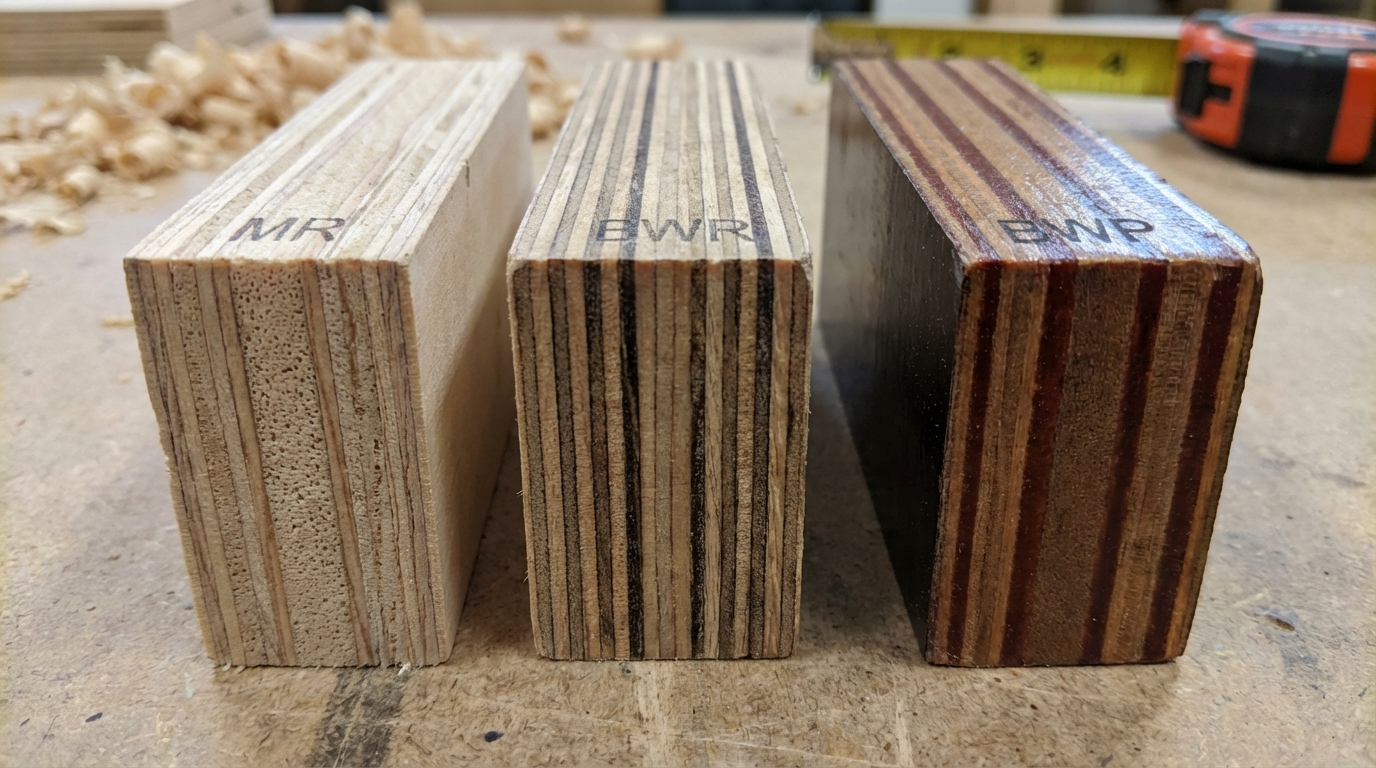
Use MR plywood for dry bedrooms, BWR for kitchens and BWP for bathrooms and other wet areas. The difference is the glue: MR uses urea-formaldehyde, BWR uses phenolic resin that survives 4-8 hours of boiling, and BWP uses extended-cure phenolic glue for constant moisture.
Last updated: . Grades and standards checked against current BIS standards.
What MR, BWR, and BWP Grades Actually Mean in Plywood
In India's diverse climate, where monsoon humidity swings from 90% in coastal Kerala to arid 20% in Rajasthan interiors, plywood grading hinges on glue performance under moisture stress. These grades—MR, BWR, and BWP—stem from Indian Standards Institute (ISI) boiling water tests, dictating how long the board's glue lines hold before delamination.
MR stands for Moisture Resistant, using urea-formaldehyde (UF) resins suited for low-humidity zones. BWR means Boiling Water Resistant, relying on phenolic-formaldehyde (PF) glues that withstand three cycles of 8-hour boiling and 16-hour drying without core separation. BWP, or Boiling Water Proof, employs extended-cure PF glues, passing a 72-hour boil test per IS:303 standards. This progression reflects glue chemistry: UF's cost-effective but hydrolyzes quickly; PF's thermoset bonds resist hydrolysis longer.
Glue Chemistry Breakdown
From first principles, plywood strength derives from glue-veneer adhesion. UF glues in MR plywood cross-link under heat but revert in water, causing layer swelling. PF glues in BWR/BWP form irreversible networks, with BWP's higher molecular weight delaying breakdown. Indian manufacturers tweak face veneers (hardwood like poplar or eucalyptus) and core density (typically 500-650 kg/m³) to meet grade specs, but glue remains the differentiator.
Side-by-Side Comparison: MR vs BWR vs BWP
| Parameter | MR Grade | BWR Grade | BWP Grade |
|---|---|---|---|
| Glue Type | Urea-Formaldehyde (UF) | Phenolic-Formaldehyde (PF) | Premium Phenolic-Formaldehyde (PF) |
| Boiling Water Test (IS:303) | 3-hour soak at 60°C, three cycles | 8-hour boil, three cycles | 72-hour boil |
| Moisture Content Tolerance | 8-12% (dry interiors) | 12-18% (moderate humidity) | 18-25% (high humidity/wet areas) |
| Screw Holding Strength (Dry) | Good (150-200 N) | Very Good (200-250 N) | Excellent (250+ N) |
| Screw Holding After Wetting | Poor (loses 50%+) | Fair (loses 20-30%) | Strong (loses <10%) |
| Typical Thickness Range | 3-25 mm | 6-25 mm | 12-25 mm |
| Face Finish | Basic (may need extra polishing) | Smooth, paint-ready | Superior, veneer-compatible |
| Best Use Cases | Furniture in AC rooms | Kitchens, wardrobes in humid areas | Bathrooms, exteriors |
This table distills lab-tested metrics from ISI protocols. Note: Real-world performance varies with manufacturing quality—check for BIS certification (IS:1659 for softwood, IS:303 for hardwood) to avoid subpar boards masquerading as premium grades.
Performance Under Indian Conditions
India's construction reality amplifies grade differences. In Delhi's dry winters, MR suffices for bedroom cabinets, but Mumbai's 80%+ monsoon RH triggers MR delamination within months. BWR handles intermittent spills in Pune kitchens; BWP endures constant dampness in Kolkata bathrooms.
Durability Metrics Explained
- Tensile Strength: BWP leads at 40-50 MPa dry, retaining 80% post-wet cycles vs MR's 50% drop.
- Bending Strength: All grades hit 40-50 MPa, but BWP's glue preserves it after 24-hour soaks.
- Swelling Ratio: MR swells 10-15% in water; BWR 5-8%; BWP under 3%.
Contractors in Tier-2 cities like Jaipur report BWR's edge in cost-sensitive wardrobes, while architects in Bangalore specify BWP for modular kitchens exposed to steam.
Choosing Plywood for Bedrooms: Why MR Often Wins
Bedrooms prioritize stability over moisture resistance, as controlled environments (fans/AC) keep RH below 60%. Homeowners fitting outsource to local carpenters who favor MR for its workability—easier sawing, nailing without glue-line tears.
Decision Logic: If your bedroom is inland (e.g., Lucknow, low humidity), MR at 18x4 ft sheets supports beds, lofts. Pair with laminate tops for aesthetics. Avoid if windows face monsoon splash—upgrade to BWR.
Pros of MR here: Lighter weight eases installation; sufficient for 10-15 year spans. Cons: Not for slatted designs prone to sweat-induced warping.
Typical buyer: Middle-class family renovating post-Diwali, balancing budget with ISI-marked boards from dealer yards.
Kitchens: BWR as the Balanced Choice
Kitchens face oil splatters, steam, and 70%+ RH during cooking. BWR's PF glue resists these without BWP's premium cost, ideal for modular setups in urban apartments.
What to Check Before Using BWR in a Kitchen
Steam from pressure cookers penetrates edges; BWR's boil-tested glue (three 8-hour boil cycles) prevents bubbling. In hot-humid Gujarat summers, it outperforms MR by 2-3x in lifecycle. Architects recommend edge-sealing with putty for longevity.
Vs Alternatives: MR fails under sink cabinets; BWP overkill unless commercial. Contractors in Chennai stock BWR 18mm for cabinets, citing 20% better screw grip post-wetting.
Buyer scenario: Working couple in Hyderabad kitchenette—BWR ensures no sagging shelves from dal spills.
Bathrooms and Wet Areas: BWP is Non-Negotiable
Direct water exposure (showers, leaks) demands BWP's 72-hour boil proofing. In coastal Goa homes or high-rise Mumbai bathrooms, inferior grades lead to fungal cores and insurance claims.
Practical Insights: Use 12-18mm BWP for vanities, walls. Combine with marine-grade sealants. Homeowners regret skimping—MR delaminates in 6 months; BWR in 2 years under constant dampness.
Interior designers in Tier-1 cities pair BWP with vitrified tiles for steam rooms, noting its minimal warping (under 1mm/m). Dealer tip: Inspect core layers for voids, common in unbranded BWP.
Pricing Dynamics: What Drives Cost Differences
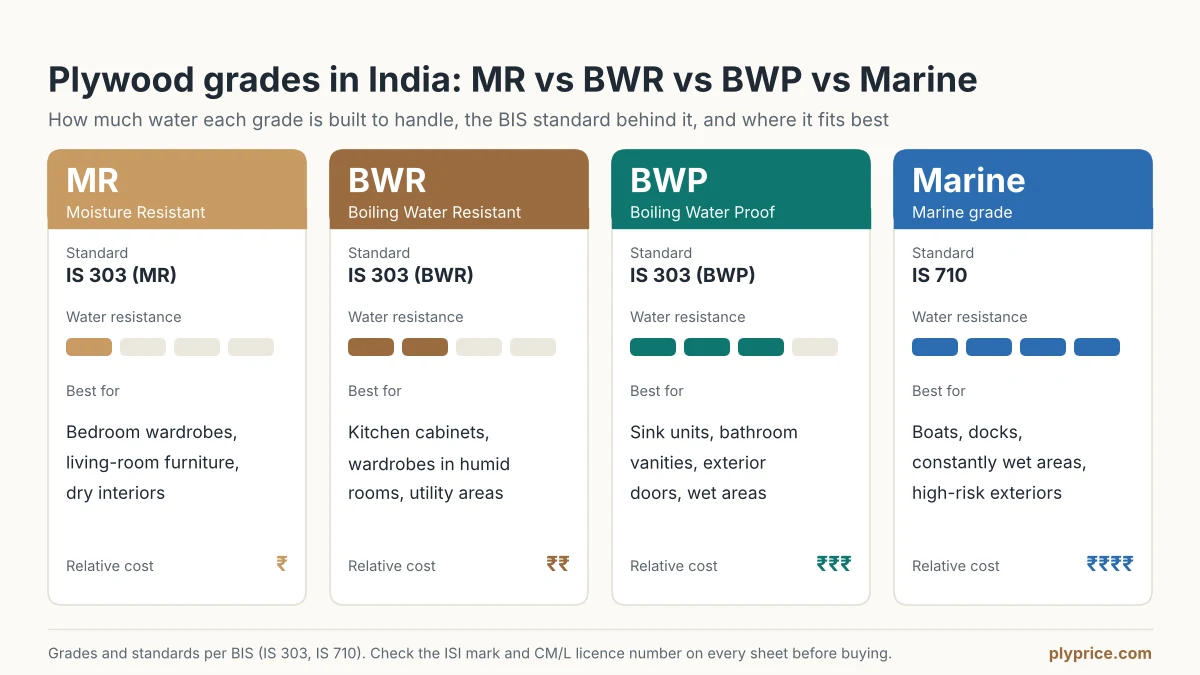
MR starts lowest due to cheaper UF glue and simpler pressing—expect 20-30% less than BWR per sheet. BWR adds PF resin costs (10-15% markup), while BWP's extended curing and denser veneers push it 30-50% above MR.
Regional Variations:
- North India (Delhi-NCR): Lower due to poplar proximity; MR competitive.
- South (Chennai): Humidity premiums inflate BWR/BWP by 15%.
- Dealer vs Retail:
- Dealers offer 10-20% bulk discounts for contractors.
- Retail (home centers): 20-30% higher, bundled with polishing.
Cost drivers: Thickness (18mm pricier than 12mm), veneer quality (teak-face BWP spikes 50%), and certification (BIS adds 5-10%). Quote multiple dealers; negotiate on volume.
Factors Beyond Grade: What Buyers Overlook
Thickness and Density Interplay
Grade alone misleads—18mm BWR outperforms 12mm BWP in load-bearing. Aim for 600+ kg/m³ density; tap-test sheets for solidity.
Environmental and Termite Resistance
All grades need preservatives (IS:12076). Coastal buyers add anti-fungal treatments; inland focus termiticides.
Installation Nuances
Contractors: Pre-drill for screws in BWP to avoid splits. Homeowners: Acclimate sheets 48 hours pre-install.
Testing Grades Yourself: Dealer Yard Realities
Myth: Nail test proves grade. Reality: All hold dry; wet after 24 hours reveals truth. Better: Drop-test edges or check BIS hologram. Avoid "lab-tested" claims sans reports—Indian mills vary wildly.
Pro Tip: For hybrids (BWR frame, MR face), ensure glue compatibility to prevent shear failures.
Long-Term Ownership: Lifecycle Costs
MR: 8-12 years in dry use; replace sooner in humid. BWR: 15-20 years versatile. BWP: 25+ years wet-proof. Factor repairs—delaminated MR costs 2x in callbacks for carpenters.
Architects advise: Match grade to room RH profile. Homeowners: Budget 20% extra for BWR/BWP upfront saves 50% long-term.
MR, BWR or BWP: Which Plywood Grade Should You Buy?
| Room/Use | Recommended Grade | Why? (India Context) | Alternatives if Budget Tight |
|---|---|---|---|
| Bedroom Furniture | MR | Controlled RH, cost-effective | BWR for wardrobes |
| Kitchen Cabinets | BWR | Steam/spill resistance | BWP under sinks |
| Bathroom Vanities | BWP | Constant moisture | Waterproof laminates over BWR |
| Balconies/Exteriors | BWP | Rain exposure | MR + heavy sealing (risky) |
This framework aligns with contractor workflows and homeowner budgets. Consult local dealers for stock; verify grades via edge stamps.
Related guides on PlyPrice
Want Plywood Suggestions?
Share a few details and a PlyPrice specialist will suggest suitable brands and connect you to responsive dealers.