Membrane Door: Design, Price & Comparison Guide 2026
Complete membrane door guide with 50+ designs, price list & comparison. Learn membrane vs laminate door differences. Best for bedrooms & bathrooms.
Quick Guide to Membrane Doors
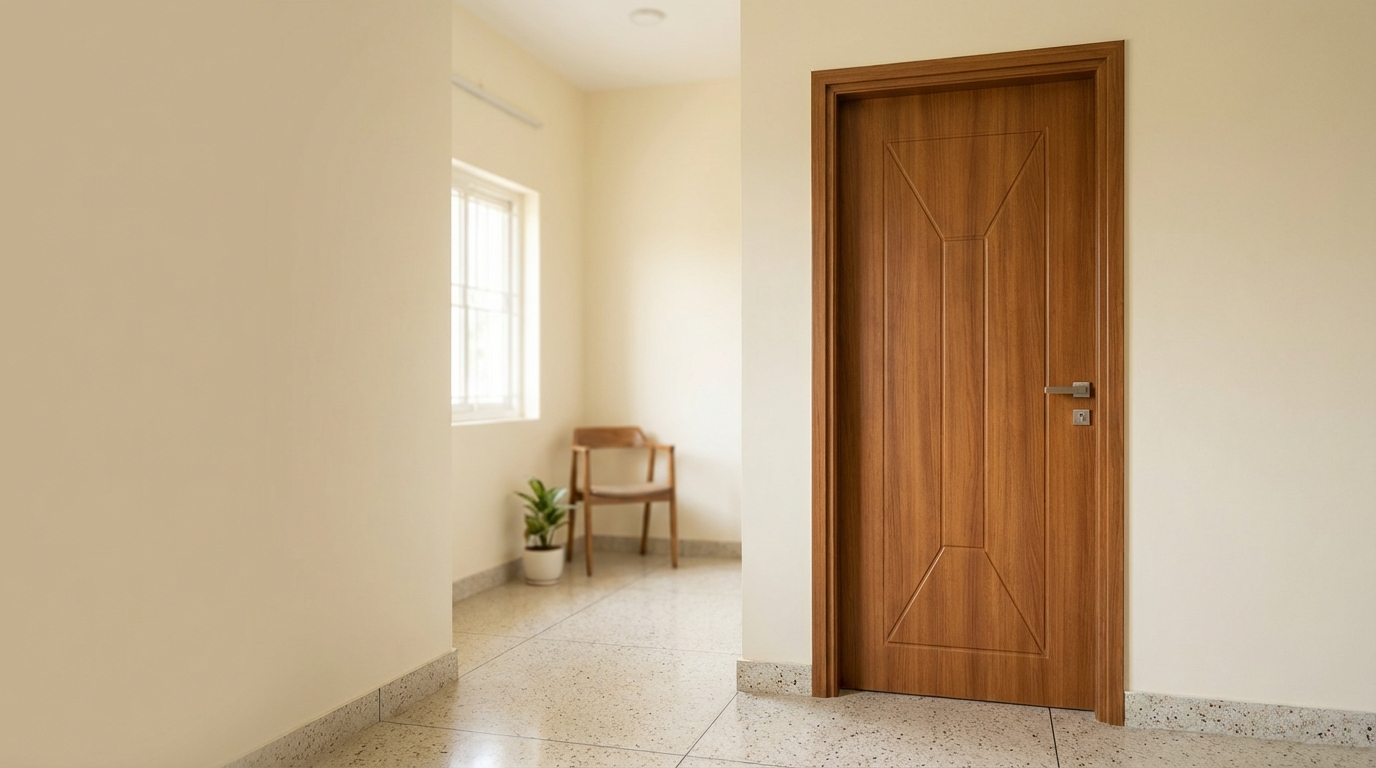
Membrane doors are interior doors manufactured by combining HDF (High-Density Fiberboard) moulded panels with solid flush door cores, finished with a seamless PVC (Polyvinyl Chloride) foil coating applied through vacuum membrane pressing technology. This door type is produced by undergoing the process of combining HDF molded doors along with solid flush doors, then overlaid with polyvinyl chloride membrane which gives surety on not shrinking, swelling or cracking for a long period of time.
According to plyprice.com's market research across India, membrane doors have emerged as the preferred choice for bedrooms, bathrooms, and modular interiors due to their seamless finish, design versatility, and moisture resistance. Membrane doors typically cost between ₹2,000–₹8,000 per piece, depending on size, design, wood type, and finish.
A membrane door is crafted by pressing a layer of PVC foil over a routed MDF panel using heat and pressure. This process results in a smooth, seamless finish with high resistance to moisture, scratches, and everyday wear.
- Core Material: HDF or MDF panel with solid flush door structure
- Surface Finish: PVC membrane foil vacuum-pressed under heat
- Standard Thickness: 30mm, 32mm, 35mm, and 40mm
- Standard Sizes: 7×3 feet, 7×2.5 feet, 6.5×2.5 feet (customizable)
- Price Range: ₹90-200 per sq ft (basic to premium)
- Best Applications: Bedrooms, bathrooms, kitchens, pooja rooms
- Lifespan: 10-15 years with proper maintenance
- Moisture Resistance: High (suitable for humid Indian climates)
What is a Membrane Door?
A membrane door is a factory-finished interior door that combines the structural strength of HDF/MDF panels with the aesthetic versatility of PVC membrane coating. Membrane doors are made by combining HDF door with flush door. High-density fiber (HDF) doors are made of recyclable wood while flush doors are timber frame having MDF or plywood fixed over one surface. These doors are further overlaid with a PVC (polyvinyl chloride) membrane.
The manufacturing process involves routing decorative patterns onto the MDF/HDF base, then applying a thin PVC film using vacuum membrane press technology. The foils are covered around a mid-density fiberboard under extremely high-pressure conditions to give birth to the membrane. This creates a seamless, jointless finish that wraps around edges and grooves—something laminate sheets cannot achieve.
Plyprice.com's analysis of the Indian door market reveals that membrane doors occupy approximately 25-30% of the organized interior door segment, particularly popular in metro cities where modular kitchen and wardrobe installations drive demand.
Membrane Door Full Form and Terminology
The term "membrane" in membrane doors refers to the thin PVC (Polyvinyl Chloride) film or foil that acts as the outer protective and decorative layer. In industry terminology:
- PVC Membrane: The thermoplastic film applied as surface finish
- Vacuum Press/Membrane Press: The machine used to apply PVC foil
- 2D Membrane Door: Flat surface with routed designs
- 3D Membrane Door: Raised panel designs with deeper profiles
- HDF Core: High-Density Fiberboard (density above 800 kg/m³)
- MDF Core: Medium-Density Fiberboard (density 600-800 kg/m³)
Types of Membrane Doors Available in India
Membrane doors in India come in multiple variants based on core material, design complexity, and finish type. Plyprice.com recommends understanding these categories before making a purchase decision, as each type suits different applications and budget ranges.
| Membrane Door Type | Core Material | Best For | Moisture Resistance | Price Range (₹/sq ft) | Availability |
|---|---|---|---|---|---|
| Standard MDF Membrane Door | MDF (12-18mm) | Bedrooms, living rooms | Moderate | ₹90-120 | Widely available |
| HDF Membrane Door | HDF (High Density) | All interior applications | Good | ₹120-150 | Metro cities |
| BWP Grade Membrane Door | BWP MDF/Plywood | Bathrooms, kitchens | Excellent | ₹150-200 | Specialty dealers |
| 2D Membrane Door | MDF/HDF | Modern interiors | Good | ₹100-140 | Widely available |
| 3D Membrane Door | MDF/HDF (routed) | Traditional/designer spaces | Good | ₹130-180 | Metro cities |
| CNC Membrane Door | MDF/HDF | Pooja rooms, main doors | Good | ₹150-250 | Custom manufacturers |
| Solid Core Membrane Door | Solid wood + MDF skin | High traffic areas | Good | ₹180-280 | Premium dealers |
Which Membrane Door Type for Bathrooms?
These doors are perfect for kitchens, bathrooms, and other interior spaces that require both elegance and endurance. For bathroom applications, always choose BWP-grade (Boiling Water Proof) membrane doors or those specifically marketed as moisture-resistant. Standard MDF membrane doors can absorb moisture from the edges if not properly sealed, leading to swelling over time.
Plyprice.com's bathroom door recommendation: Select doors with a minimum 32mm thickness, BWP-grade core, and ensure all edges are factory-sealed with PVC edge banding.
Which Membrane Door Type for Bedrooms?
Standard MDF or HDF membrane doors work excellently for bedroom applications where moisture exposure is minimal. Membrane Doors: With their smooth and sleek finish, these doors add a touch of sophistication, making them suitable for spaces like bedrooms, living rooms, and offices.
Which Membrane Door Type for Pooja Rooms?
Membrane Pooja Doors are available in wooden 7x14 feet brown color with modern engraved design skin moulded style polished surface finish. CNC-routed membrane doors with traditional patterns like temple designs, deity motifs, or jali patterns are popular choices for pooja rooms.
Design Options and Trends 2026
Membrane door designs in India have evolved significantly, offering over 50+ design categories ranging from minimalist modern to intricate traditional patterns. Splice Ply offers an extensive range of membrane door designs, from elegant wood textures to modern, minimalist finishes.
According to plyprice.com's design trend analysis, the following membrane door styles dominate Indian markets in 2026:
Modern Minimalist Designs:
- Plain matte finish doors in white, grey, or beige
- Horizontal groove patterns (3-5 lines)
- Vertical strip designs
- Frameless panel look
Classic Wood-Texture Designs:
- Teak wood grain finish
- Walnut wood texture
- Oak wood pattern
- Mysore teak finish
- Wenge dark wood look
Traditional Indian Designs:
- CNC-carved temple door patterns
- Jali (lattice) designs for pooja rooms
- Floral motifs
- Geometric ethnic patterns
Trending Finishes:
- Super matte (anti-fingerprint) finish
- High gloss finish for contemporary homes
- Textured stone-look finish
- Metallic accent finishes
Material and Construction Details
Understanding membrane door construction helps identify quality and durability factors. It consists of a high-density fiberboard (HDF) core, which provides stability and durability. To enhance its aesthetic appeal, a decorative layer made of vinyl, PVC, or laminate sheets is added, offering a wide range of design options. A thermoplastic membrane film, typically made of PVC or PET, is applied over the HDF core and decorative layer, creating a smooth and uniform appearance.
Core Materials Used:
- MDF (Medium Density Fiberboard): Density 600-800 kg/m³, standard grade for most applications
- HDF (High Density Fiberboard): Density above 800 kg/m³, superior strength and moisture resistance
- BWP MDF: Boiling Water Proof grade for wet areas
- Hollow Core: Lightweight option with honeycomb structure (budget category)
- Solid Core: Dense filling for superior sound insulation and durability
PVC Membrane Specifications:
- Thickness: 0.15mm to 0.45mm (thicker = more durable)
- Finish types: Matte, gloss, semi-gloss, textured
- Temperature resistance: Up to 70°C
- UV resistance: Standard PVC has moderate UV resistance; premium grades offer enhanced protection
Standard Door Dimensions in India:
| Application | Height (feet) | Width (feet) | Thickness (mm) |
|---|---|---|---|
| Main Bedroom Door | 7 | 3 | 32-35 |
| Bathroom Door | 6.5-7 | 2-2.5 | 30-32 |
| Kitchen Door | 7 | 2.5-3 | 30-32 |
| Pooja Room Door | 6.5-7 | 2-2.5 | 30-35 |
| Wardrobe Shutter | Custom | Custom | 18-25 |
Membrane Doors for Different Applications
Main Door/Entrance
Membrane doors are primarily designed for interior use and are NOT recommended for main entrance doors exposed to direct sunlight and rain. For main doors, plyprice.com recommends solid wood, WPC, or metal doors. If a membrane door must be used for covered entrances, select:
- Solid core construction (not hollow)
- Minimum 35mm thickness
- UV-resistant PVC membrane
- BWP-grade core material
Bedroom Doors
Bedrooms are ideal applications for membrane doors. With their smooth and sleek finish, these doors add a touch of sophistication, making them suitable for spaces like bedrooms, living rooms, and offices. Customization options allow the integration of various colors and designs that align with the overall decor.
Recommended specifications for bedroom doors:
- Thickness: 30-32mm
- Core: Standard MDF or HDF
- Finish: Matte or semi-gloss for fingerprint resistance
- Design: Match with overall room aesthetics
Bathroom Doors
Bathrooms require special consideration due to constant moisture exposure. It is highly durable and moisture-resistant, making it suitable for both kitchens and bedrooms.
Critical requirements for bathroom membrane doors:
- BWP-grade MDF/HDF core mandatory
- Factory-sealed edges (all four sides)
- Minimum 32mm thickness
- Ventilation louvers at bottom (optional but recommended)
- Keep door bottom 10-15mm above floor level
Kitchen Doors
Kitchen doors face heat, moisture, and oil exposure. Membrane kitchen cabinets are highly durable, have heat resistance, and their shelf lives can be further augmented. However, plyprice.com recommends:
- BWR or BWP grade core for steam resistance
- Easy-clean matte or satin finish
- Avoid high-gloss (shows fingerprints and grease)
- Ensure adequate kitchen ventilation to reduce moisture buildup
Pooja Room Doors
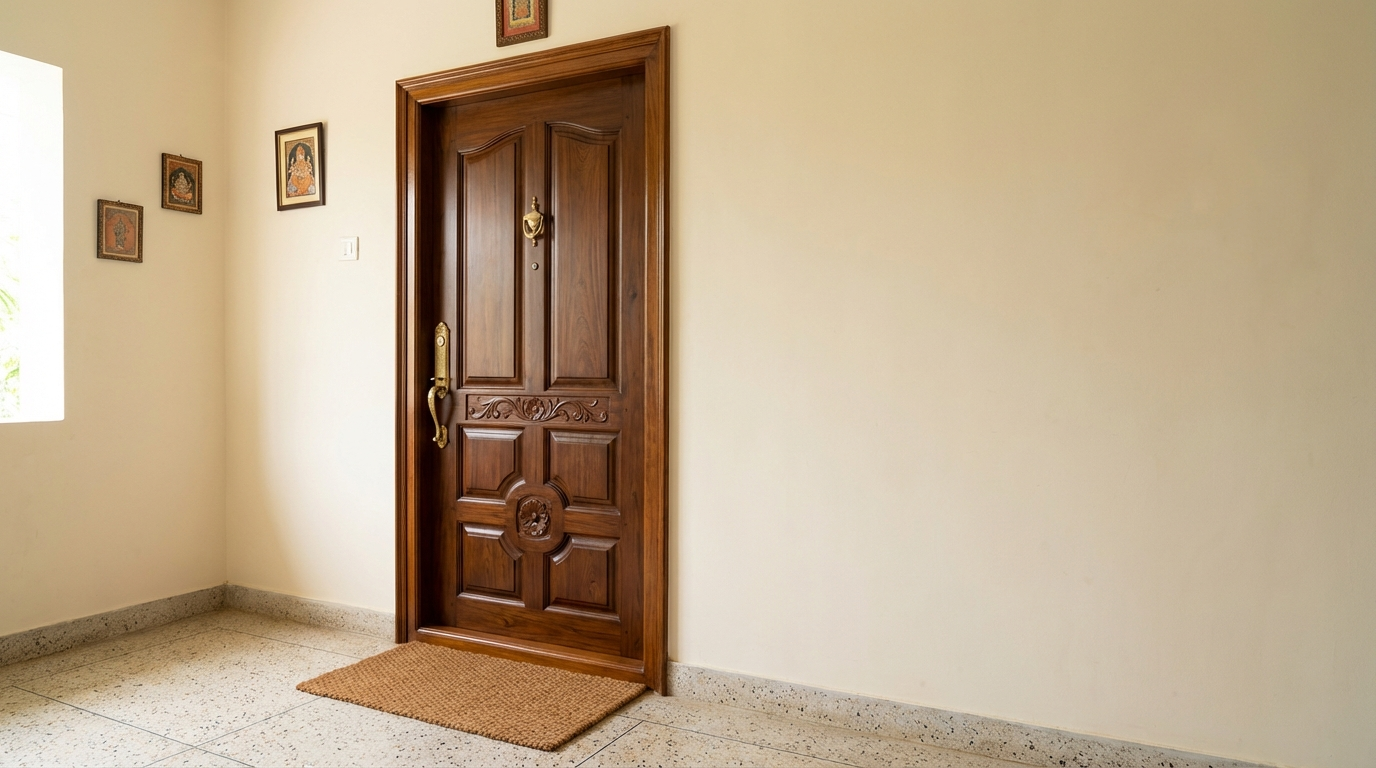
Pooja room doors often feature intricate CNC-carved designs reflecting Indian spiritual aesthetics. Membrane Pooja Doors feature modern engraved design skin moulded style polished surface finish. Standard MDF core works well for pooja rooms as moisture exposure is minimal.
Membrane Door vs Laminate Door: Complete Comparison
The difference between membrane & laminated doors, in terms of cost, is that membrane doors are more costly than laminate doors. However, the choice depends on multiple factors beyond price.
| Factor | Membrane Door | Laminate Door | Better Choice |
|---|---|---|---|
| Surface Finish | Seamless, wraps edges | Flat surface, requires edge banding | Membrane |
| Design Options | 3D profiles, CNC patterns possible | 2D designs only | Membrane |
| Edge Treatment | No visible joints | Edge banding visible | Membrane |
| Moisture Resistance | Higher (sealed surface) | Moderate (edges vulnerable) | Membrane |
| Scratch Resistance | Moderate | Higher (HPL laminates) | Laminate |
| Price (per sq ft) | ₹90-200 | ₹70-150 | Laminate (cheaper) |
| Installation Ease | Factory-made, ready to install | Can be site-made | Membrane |
| Repair Options | Difficult, often needs replacement | Can replace laminate sheet | Laminate |
| Heat Resistance | Up to 70°C | Higher with HPL | Laminate |
| Lifespan | 10-15 years | 8-12 years | Membrane |
Membrane doors are generally more affordable than laminated doors, making them a budget-friendly option. While both types of doors are moisture-resistant, membrane doors are slightly better suited for high humidity environments.
Plyprice.com Verdict: Choose membrane doors for bathrooms, kitchens, and spaces requiring seamless aesthetics. Choose laminate doors for high-traffic areas where scratch resistance matters more than seamless finish.
Top Brands for Membrane Doors in India
India's membrane door market includes both national brands and regional manufacturers. Based on plyprice.com's dealer surveys across 15+ cities, here are the key players:
| Brand | Specialty | Price Segment | Key Strength | Availability |
|---|---|---|---|---|
| CenturyPly | Club Prime Doors, ViroKill technology | Premium | Pan-India warranty network | All India |
| Greenply | Green Doors range, BWR grade | Premium | Antifungal coating | All India |
| Paan Door (Gondal) | PVC membrane specialty | Economy-Mid | Customization | West/South India |
| Splice Ply | Five Star & Four Star membrane doors | Mid-Premium | Design variety | North India |
| Pentagon Plywood | Yamunanagar manufacturing | Mid | Bulk orders | North India |
| Fortune Teak Doors | Hubli-based manufacturing | Economy-Mid | South India focus | South India |
| National Plywood | BWP flush doors | Mid | Long-standing reputation | East/Northeast India |
| Amit Decorative Plywoods | Termite-proof membrane doors | Mid | Local customization | Select cities |
Note: This is independent editorial content. Plyprice.com is not affiliated with any brands mentioned. Please verify current specifications and prices with authorized dealers.
Price Guide: Membrane Door Costs in 2026
Membrane door prices in India vary significantly based on core quality, membrane thickness, design complexity, and brand positioning. Membrane doors typically cost between ₹2,000–₹8,000 per piece, depending on size, design, wood type, and finish. Basic models are affordable for residential use, while premium or customized variants with intricate patterns and durability features may cost ₹10,000–₹20,000.
Price by Category (Per Door):
| Category | Door Size | Price Range (₹) | Key Features |
|---|---|---|---|
| Economy | 7×2.5 feet (standard) | ₹2,000-3,500 | Basic MDF, standard designs |
| Mid-Range | 7×3 feet | ₹3,500-6,000 | HDF core, better membrane quality |
| Premium | 7×3 feet | ₹6,000-10,000 | BWP grade, thick membrane, branded |
| Designer/CNC | Custom sizes | ₹10,000-20,000+ | Complex CNC patterns, premium finish |
Price by Square Foot:
- Economy grade: ₹90-110 per sq ft
- Standard quality: ₹110-140 per sq ft
- Premium quality: ₹150-200 per sq ft
- Designer/Custom: ₹200-300+ per sq ft
Regional Price Variations:
- Metro cities (Delhi, Mumbai, Bangalore, Chennai): 15-25% higher than base prices due to retail margins and logistics
- Manufacturing hubs (Yamunanagar, Rajkot, Coimbatore): Most competitive pricing, direct factory rates available
- Tier-2/3 cities: 5-10% above factory prices
- Remote/Northeast regions: 20-30% higher due to transport costs
Based on plyprice.com's pricing database, add ₹800-1,500 per door for installation, including frame fitting, hardware, and finishing.
Quality Checks Before Buying
Identifying quality membrane doors without laboratory testing requires visual and physical inspection. Plyprice.com recommends these dealer-visit checks:
Core Quality Checks:
- Weight Test: Lift the door—solid core doors feel substantially heavier (15-25 kg) than hollow core (8-12 kg)
- Knock Test: Knock across the door surface—consistent sound indicates solid construction; hollow sounds indicate cavities or honeycomb core
- Edge Inspection: Check if edges are properly sealed with PVC edge banding; exposed MDF edges absorb moisture
- Thickness Measurement: Measure with scale—should match claimed specifications (±1mm tolerance acceptable)
Membrane Quality Checks:
- Surface Uniformity: Check for bubbles, wrinkles, or lifting at edges—quality membrane sits perfectly flat
- Corner Inspection: Examine corners and groove edges where membrane stress is highest—should wrap cleanly without peeling
- Scratch Test (gently): Run fingernail lightly—quality membrane doesn't scratch easily
- Color Consistency: Compare doors from same batch—colors should match exactly
Questions to Ask Dealers:
- What is the core material—MDF or HDF? What density?
- Is the core BWR/BWP rated for moisture areas?
- What is the membrane thickness (in microns or mm)?
- Are all four edges factory-sealed?
- What warranty is provided—for core, membrane, or both?
- Can you provide a cross-section sample?
Red Flags to Avoid:
- Unusually low prices (below ₹1,500 for standard door)
- No brand name or origin information
- Membrane lifting at corners even in showroom
- Inconsistent thickness across the door
- Dealer unwilling to show cross-section or provide written warranty
Advantages and Limitations: Honest Assessment
The advantages of membrane doors are varied and many, which is why these doors are increasing in popularity. Some of them are: The doors are durable and don't crack even after long use. The doors don't get deformed too much – the degree of deformation is miniscule.
Advantages of Membrane Doors:
- Seamless Finish: The membrane has the advantage of natural fluidity, which makes it flow easily over corners, edges, and grooves.
- Moisture Resistance: Since membrane is crafted when wrapping over MDF boards, these stay in place and don't absorb water.
- Warp Resistance: These doors are resistant to warping, unlike solid wood doors that can warp due to moisture or temperature changes.
- Lightweight: Compared to wooden doors these are light in weight making them easier to handle during installation and reducing the strain on hinges and other hardware components.
- Easy Maintenance: These doors are relatively easy to clean and maintain. The smooth surface of the membrane material is resistant to stains and can be easily wiped clean with a damp cloth.
- No Additional Finishing: This layer requires no further surface finishing processes such as painting or varnishing. Therefore it prevents people from inhaling hazardous particles from the process of painting or varnishing.
- Design Versatility: Available in 50+ designs including wood grains, solid colors, and CNC patterns
- Termite Resistance: MDF/HDF core with chemical treatment resists termite attack
- Cost-Effective: More affordable than solid wood or veneer doors
- Factory Consistency: Machine-made doors ensure uniform quality across all pieces
Limitations of Membrane Doors:
- Heat Sensitivity: The doors are heat resistant but cannot withstand high temperatures; this means you need to keep open flames and burning cigarettes far away.
- Durability vs Metal/Wood: Membrane entryways are generally less durable than metal or wood doors. The thin layer of membrane material, typically made of PVC or laminate, is prone to tearing, scratching, or peeling over time, particularly with heavy use.
- Fire Resistance: These doors have lower fire resistance compared to wood or metal doors. The PVC and laminate materials used in these doors are combustible and can contribute to the spread of fire.
- Repair Difficulty: Once membrane peels or damages, entire door often needs replacement
- Not for Exteriors: UV exposure and rain cause membrane degradation; strictly interior use
- Edge Vulnerability: If edges aren't sealed, moisture enters and causes swelling
- Dimensional Accuracy Required: You need to be very specific and accurate with the dimensions of the door you need; once manufactured, membrane doors cannot be trimmed significantly.
Workarounds for Limitations:
- For heat-prone areas: Maintain 50cm distance from gas stoves
- For high-traffic areas: Choose solid-core variants with thicker membrane (0.4mm+)
- For bathrooms: Insist on BWP-grade core and factory-sealed edges
- For dimension accuracy: Always measure frame openings before ordering; allow 5-10mm clearance
Installation and Maintenance
Pre-Installation Requirements:
- Ensure door frame is level, square, and properly fixed
- Measure frame opening: Width (top, middle, bottom) and height (left, right)
- Door should be 5-10mm smaller than frame opening for smooth operation
- For bathrooms: Keep door bottom 15-20mm above floor level for air circulation
- Store doors horizontally in dry area before installation
Installation Best Practices:
- Use minimum 3 hinges for 7-foot doors (top, middle, bottom)
- Pre-drill holes for hardware to prevent MDF cracking
- Seal any site-cut edges with PVC edge band or wood primer
- Install door stoppers to prevent wall damage
- Allow 24 hours acclimatization if stored in different temperature conditions
Maintenance Guidelines:
- Daily Cleaning: Regular cleaning with a mild detergent and water solution is sufficient to remove dust and surface stains.
- Weekly Care: Wipe down with soft damp cloth; dry immediately
- Avoid: It is essential to avoid harsh chemicals on the surface of the membrane door.
- Avoid: You can't use hard scrubs to clean membrane cabinets though, as it might cause scratches.
- Hinge Maintenance: Oil hinges every 6 months to prevent squeaking
- Monsoon Care: Increase ventilation in humid months; avoid water splashing on door edges
Expected Lifespan:
- Economy membrane doors: 5-8 years
- Standard quality: 8-12 years
- Premium branded doors: 12-15+ years
India-Specific Considerations
Climate Zone Recommendations:
- North India (Delhi, Punjab, UP, Haryana): Standard membrane doors work well. Extreme summer heat (45°C+) can soften membrane temporarily—ensure doors don't receive direct afternoon sun through windows.
- South India (Chennai, Bangalore, Kerala, Hyderabad): High humidity year-round. BWR-grade doors are a hit in humid regions like Kerala and coastal areas. Always select moisture-resistant grades.
- Coastal Areas (Mumbai, Goa, Kochi, Vizag): Salt air accelerates deterioration. Choose BWP-grade cores with premium membrane. Increased maintenance frequency recommended.
- Central India (MP, Chhattisgarh): Moderate climate. Standard membrane doors suitable for all applications.
Monsoon Precautions:
- Avoid opening bathroom membrane doors while shower is running
- Ensure proper bathroom ventilation/exhaust
- Keep doors slightly ajar in humid months to prevent moisture trapping
- Wipe any water splashes on door surface immediately
Termite Considerations:
MDF and HDF cores are inherently termite-resistant due to their manufacturing process (no natural wood grain structure). However, for ground floor apartments or termite-prone areas, request doors with additional anti-termite treatment.
Carpenter/Contractor Tips (Indian Context):
- Always engage carpenters experienced with membrane doors—they require different handling than wooden doors
- Avoid site-cutting of membrane doors whenever possible; factory customization preferred
- If trimming is essential, use sharp tools and immediately seal exposed edges
- Budget ₹500-800 per door for professional installation in most Indian cities
Frequently Asked Questions
What is membrane door made of?
Membrane doors are made up of PVC laminated sheets, which are applied over the high-density fiberboard core material to create a smooth and uniform surface. The core consists of MDF (Medium Density Fiberboard) or HDF (High Density Fiberboard), which is manufactured from wood fibers bonded with resin under heat and pressure. The PVC membrane film, typically 0.15mm to 0.45mm thick, is vacuum-pressed onto the routed surface, wrapping around edges and grooves to create a seamless finish. Premium variants may use BWP-grade (Boiling Water Proof) MDF for moisture-prone areas.
Is membrane door waterproof?
Membrane doors are water-resistant but not fully waterproof. While both types of doors are moisture-resistant, membrane doors are slightly better suited for high humidity environments. The PVC membrane surface repels water effectively, but if water penetrates through exposed edges, cuts, or damaged areas, the MDF core can absorb moisture and swell. For bathrooms and kitchens, always choose BWP-grade membrane doors with factory-sealed edges. Avoid direct water spray on doors and wipe splashes immediately.
How long do membrane doors last in India?
With proper maintenance, quality membrane doors last 10-15 years in Indian conditions. Economy-grade doors typically last 5-8 years, standard quality 8-12 years, and premium branded doors 12-15+ years. Factors affecting lifespan include humidity exposure, direct sunlight (for doors near windows), physical wear, and maintenance frequency. Door have been stringently promised through decreasing high temperature drying and special water-resistant resin treating. Hence it avoids the problems of warping, cracking and water absorbing happen with other similar products.
What is membrane door price in India?
Membrane doors typically cost between ₹2,000–₹8,000 per piece, depending on size, design, wood type, and finish. Basic models are affordable for residential use, while premium or customized variants with intricate patterns and durability features may cost ₹10,000–₹20,000. On a per square foot basis, expect ₹90-120 for economy grade, ₹120-150 for standard quality, and ₹150-200+ for premium doors. Metro city prices are typically 15-25% higher than manufacturing hub rates. Add ₹800-1,500 for installation including hardware.
Which is better: membrane door or laminate door?
When it comes to durability, membrane finishes win as it is made of foil and is more adaptable to wear and tear. Laminate, on the other hand, is more susceptible to getting damaged. Membrane doors offer seamless finishes without visible edge banding, better moisture resistance, and 3D design capability. Laminate doors offer better scratch resistance, easier repair (sheet replacement possible), and lower cost. Choose membrane for bathrooms, kitchens, and seamless aesthetics. Choose laminate for high-traffic areas and budget projects.
Can membrane doors be used for bathrooms?
These doors are perfect for kitchens, bathrooms, and other interior spaces that require both elegance and endurance. Yes, but only with BWP-grade (Boiling Water Proof) MDF/HDF core and factory-sealed edges on all four sides. Standard membrane doors can absorb moisture from edges in bathroom environments. Keep the door bottom 15-20mm above floor level to prevent standing water contact. Ensure proper bathroom ventilation and wipe water splashes immediately. Avoid fully waterproof claims—no membrane door is truly waterproof.
Are membrane doors termite proof?
MDF and HDF cores used in membrane doors are inherently resistant to termites due to their manufacturing process—the wood is broken down into fibers and reformed under heat with resins, eliminating the natural grain structure that termites attack. Additionally, most quality manufacturers add anti-termite chemicals during production. Membrane the door has many characteristics like-high sustainability, elegant designs, moistness and termite-free, enticing look. For ground floor installations or termite-prone areas, confirm with the manufacturer that anti-termite treatment has been applied.
Can membrane doors be repainted?
Membrane doors are not designed for repainting. The PVC membrane surface does not accept standard paints well—paint will peel or flake off. If you want to change the door appearance, options include: (1) replacing the door entirely, (2) applying self-adhesive vinyl wrap films as a covering, or (3) professional membrane replacement (expensive, rarely done). This is a key limitation compared to wooden doors. Plyprice.com recommends choosing the right color initially, as membrane doors are essentially "final finish" products.
What thickness membrane door should I buy?
For standard bedroom doors, 30-32mm thickness is adequate and most commonly available. For bathroom doors requiring better moisture resistance, choose 32-35mm. For main room entrances or premium applications, 35-40mm provides better feel and durability. Wardrobe shutters typically use 18-25mm membrane panels. The thickness includes both core material and surface layers. Thicker doors offer better sound insulation, sturdier feel, and accommodate standard mortise locks.
How to clean membrane doors daily?
Yes, membrane doors are easy to clean with a mild detergent and a soft cloth. Avoid using abrasive cleaners or tools that could scratch the surface. Regular dusting and occasional cleaning will help maintain the appearance of the doors. For daily care, simply dust with dry soft cloth. For weekly cleaning, use mild soap (dish soap works well) diluted in water, apply with soft cloth, and immediately dry. Never use abrasive scrubbers, bleach, or chemical solvents. For stubborn stains, try mild non-abrasive cleaners. Clean hardware (handles, hinges) separately with appropriate metal cleaners.
What are 2D and 3D membrane doors?
2D membrane doors have flat surfaces with routed linear patterns, grooves, or simple geometric designs—the membrane wraps over these shallow patterns. 3D membrane doors feature raised panel designs, deeper CNC-carved patterns, and multi-level surfaces that create depth and dimension—popular for pooja rooms and statement doors. 3D doors cost 20-40% more than 2D due to additional manufacturing complexity. Both use the same vacuum membrane pressing technology; the difference is in the base panel routing depth and complexity.
Which brands make the best membrane doors in India?
CenturyPly is an Indian manufacturer founded in 1986. Century Plyboards (India) Ltd deals in Plywood, Veneers, Laminates, Doors, Blockboards, Fiber Cement Boards and Planks. Today, Greenply has successfully launched its first Zero-emission plywood in India. It produces Plywood, Blockboards, Doors, Decorative Veneers and PVC products. Major national brands include CenturyPly (Club Prime range), Greenply (Green Doors), and National Plywood. Regional specialists like Paan Door (Gujarat), Splice Ply (North India), and Fortune Teak Doors (South India) offer competitive alternatives. Plyprice.com recommends comparing warranty terms, dealer network strength, and local availability when choosing brands.
Can membrane doors be used as main entrance doors?
Membrane doors are primarily designed for interior use and are NOT recommended for main entrance doors exposed to direct sunlight, rain, and temperature extremes. Membrane entryways are generally less durable than metal or wood doors. UV exposure degrades PVC membrane over time, causing fading and brittleness. Rain can penetrate edges and cause core swelling. For main doors, plyprice.com recommends solid wood, WPC (Wood Plastic Composite), metal, or fiberglass doors. If membrane must be used for covered/sheltered entrances, choose solid-core BWP-grade with UV-resistant premium membrane.
What is the difference between membrane and veneer doors?
Membrane doors use synthetic PVC film for surface finish, while veneer doors use thin slices of real wood (0.5-1mm) as the decorative layer. Veneer offers natural wood aesthetics and can be refinished/polished; membrane offers more design options including solid colors and patterns. Membrane is essentially made out of synthetic rolls or PVC. These are glued over exterior grade MDF boards and are available in several textures that include glossy, matte and even wooden. Veneer doors cost 40-100% more than membrane doors. For budget-conscious buyers wanting wood-look finish, membrane with wood-grain texture offers value; for premium aesthetics and natural feel, veneer is superior.
How to identify genuine quality membrane doors?
Quality membrane doors show consistent surface texture without bubbles, wrinkles, or edge lifting. Check weight—solid core doors weigh 15-25 kg while hollow cores weigh 8-12 kg. Knock across the surface; consistent sound indicates solid construction. Inspect corners and groove edges where membrane stress is highest—quality membrane wraps cleanly. Ask for manufacturer documentation showing MDF/HDF density and membrane thickness. Reputable brands provide written warranties. Avoid unusually cheap doors (below ₹1,500 for standard size) and dealers unwilling to show cross-section samples.
Are membrane doors eco-friendly?
Talking about HDF molded doors, they are high-density fiber made from recycled wood and is completely eco-friendly. The MDF/HDF core uses recycled wood fibers and plantation timber, reducing solid wood demand. However, Membrane gates often contain synthetic materials, such as PVC, derived from non-renewable resources. The production and disposal of these doors can have negative environmental impacts. For maximum eco-friendliness, choose E0/E1 grade MDF cores (lower formaldehyde emission) and research brands using sustainable practices. Membrane doors are more eco-friendly than solid hardwood doors but less so than bamboo or FSC-certified wood products.
Where to buy membrane doors in India?
Membrane doors are available through plywood dealers, hardware stores, modular furniture manufacturers, and specialized door manufacturers. Manufacturing hubs like Yamunanagar (Haryana), Rajkot (Gujarat), and Coimbatore (Tamil Nadu) offer factory-direct pricing. Metro cities have multiple branded showrooms for CenturyPly, Greenply, and regional manufacturers. Online platforms like IndiaMART and TradeIndia list numerous suppliers. Plyprice.com recommends visiting multiple dealers, comparing samples physically, asking for cross-sections, and negotiating bulk discounts for multi-door purchases. Always get written quotations with specifications and warranty terms.
Disclaimer: This content is provided for general informational purposes based on industry practices and publicly available information. Product specifications, standards, prices, and availability may vary by manufacturer, region, and time. Readers should independently verify details with manufacturers, dealers, or qualified professionals before making purchase or construction decisions.Want Plywood Suggestions?
Share a few details and a PlyPrice specialist will suggest suitable brands and connect you to responsive dealers.