What Is Plywood Made Of? The Manufacturing Process Step by Step
Plywood is made of thin wood veneers peeled from logs, dried, coated with glue, laid up in cross-grained layers and hot-pressed into a sheet, then trimmed and checked. The glue and the process decide the grade that BIS tests under IS 303 (MR, BWR and BWP) and IS 710 (marine).
Last updated: . Grades and standards checked against current BIS standards.
How Is Plywood Made, and Why Should Buyers Care?
In India's diverse construction landscape, where humid monsoons and varying regional climates challenge building materials, grasping the plywood manufacturing process equips buyers—homeowners renovating kitchens, contractors bidding on projects, or architects specifying interiors—with the insight to select durable sheets. Unlike superficial overviews, this guide breaks down each stage from raw logs to finished panels, highlighting decision points that influence strength, moisture resistance, and value. Indian standards like IS 303 for MR, BWR and BWP grades, or IS 710 for marine plywood, emphasize these steps, as deviations often lead to warping or delamination in real-world use.

Step 1: Sourcing and Preparing Logs—The Foundation of Strength
Every plywood sheet begins with timber selection, a critical yet often overlooked phase. In India, mills typically source fast-growing species like eucalyptus, poplar, or acacia for cost efficiency, supplemented by hardwoods like gurjan for face veneers in premium grades. Logs must be straight, free from defects like knots or cracks, as these propagate weaknesses through the final product.
Preparation starts with debarking, where rotary lathes or steam chambers remove bark to prevent contaminants. Conditioning follows: logs soak in hot water (around 70-80°C) for 4-8 hours to soften fibers, reducing breakage during peeling. This step is vital in India's tropical climate, where improper conditioning leads to veneers prone to splitting under monsoon humidity.
- Buyer insight: Ask suppliers for log origin certificates; imported hardwood faces signal better surface quality but higher costs.
- Quality check: Uniform log diameter (over 30 cm ideal) ensures consistent veneer thickness, key for load-bearing applications like flooring.
Step 2: Veneer Peeling—Creating Thin Layers with Precision
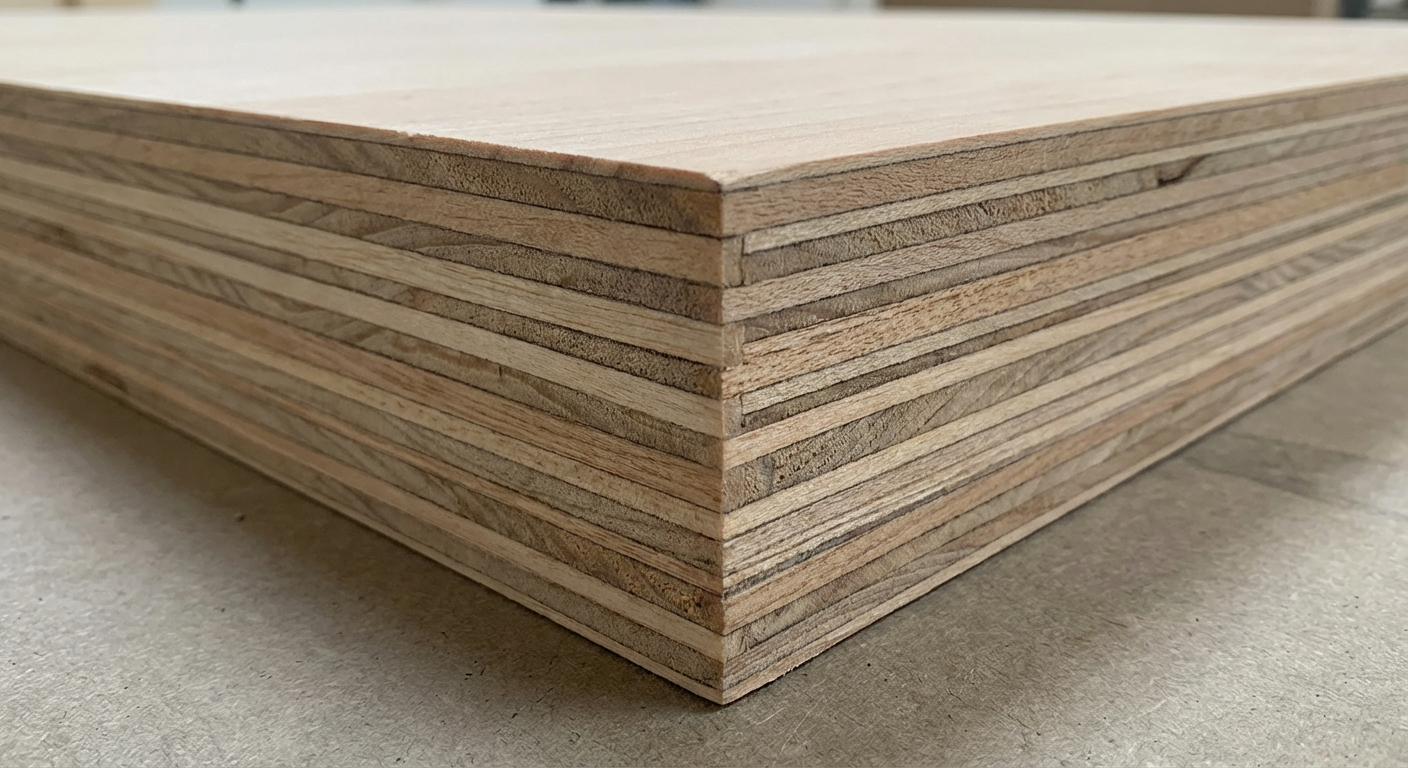
Peeling transforms conditioned logs into thin veneers (0.5-3 mm thick) using a rotary lathe, where the log spins against a fixed knife, unrolling like a continuous sheet. This cross-grain peeling is fundamental: plywood's signature strength arises from stacking veneers with grains at 90° angles, countering wood's natural expansion/contraction.
In Indian mills, peelers operate at speeds up to 100 meters per minute, producing 'green' veneers with 40-60% moisture. Core veneers are thicker (2-3 mm) for stability, while face veneers are finer for aesthetics. Defects like lathe checks (micro-cracks) occur if knife sharpness falters, compromising glue bonds later.
Regional nuance: Northern mills using poplar excel in smooth peeling due to softer wood, while southern teak-hardwood setups yield denser but pricier veneers suited for coastal humidity.
| Veneer Position | Typical Thickness (mm) | Role in Strength | India-Specific Consideration |
|---|---|---|---|
| Face/Back | 0.5-1.2 | Surface finish, aesthetics | Smooth for painting; defects show in humid areas |
| Core/Crossbands | 1.5-3.0 | Structural rigidity | Thicker cores resist sagging in furniture |
Step 3: Veneer Drying—Removing Moisture to Prevent Failures
Freshly peeled veneers hold excess moisture, risking mold, warping, or weak bonds if not dried. Jet dryers or roller dryers blast hot air (120-180°C) through veneers on perforated belts, reducing moisture to 8-12%—a precise target per ISI norms for boil-water resistance.
Drying duration varies: thin faces take 2-5 minutes, cores longer. Over-drying causes brittleness; under-drying leads to steam pockets during pressing, forming voids. In India, where ambient humidity spikes to 90% in monsoons, this step differentiates MR (moisture-resistant) from BWR (boiling-water-resistant) plywood.
- Process variations: Festoon dryers hang veneers for natural convection, common in smaller mills for uniform drying without scorching.
- Buyer red flag: Veneers with color inconsistencies (dark streaks) indicate uneven drying, prone to bubbling in kitchen cabinets.
Post-drying, veneers undergo sorting and clipping: machines trim edges and repair minor defects with tape or putty, ensuring flatness for layup.
Step 4: Gluing and Layup—Bonding Layers for Composite Power
Gluing is plywood's 'secret sauce,' where adhesives penetrate veneers to create a monolithic panel. Assemblies involve spreading glue via roller coaters (20-40 g/m² spread), then stacking 3-13 veneers in cross-grain orientation: face grain parallel to panel length, cores perpendicular.
India's adhesive choices reflect grade needs:
| Grade | Adhesive Type | Key Properties | Cost Driver |
|---|---|---|---|
| MR (Moisture Resistant) | Urea-Formaldehyde (UF) | Indoor use; economical | Lowest; 20-30% of sheet cost |
| BWR (Boiling Water Resistant) | Phenol-Formaldehyde (PF) modified | 3-hour boil test pass | Mid-range; better for bathrooms |
| BWP (Boiling Water Proof) | Pure PF or MF | 72-hour boil; marine-grade | Highest; ideal for exteriors |
Glue mix includes extenders (wheat flour) for gap-filling and hardeners for cure speed. Uneven spread causes 'telegraphing' (glue lines visible post-sanding). In humid Indian warehouses, improper pH control leads to slow curing, explaining why dealer-stocked MR plywood sometimes delaminates prematurely.
Step 5: Hot Pressing—Fusing Under Heat and Pressure
Laid-up assemblies enter multi-daylight hydraulic presses (10-40 openings), subjected to 1-1.5 MPa pressure and 120-150°C for 20-60 seconds per mm thickness. This thermoplastic phase melts glue, driving water out as steam while forming covalent bonds.
Cycles repeat for uniform heat transfer; short cycles risk under-cure, long ones cause scorching. Press platens must be chrome-plated for release. In India, high-volume mills use automated presses for consistency, while artisanal ones rely on manual timing—explaining price variations between branded and local sheets.
Strength secret: Proper pressing eliminates voids (visible as dark spots in edge cross-sections), enabling plywood to outperform solid wood in shear strength by 5-10 times due to balanced anisotropy.
Step 6: Post-Pressing: Cooling, Trimming, and Quality Control
Hot panels transfer to cooling presses (maintained at 1 MPa, 20-30°C) for 30-60 minutes, preventing warp from uneven contraction. Trimmers cut to size (e.g., 8x4 ft standard in India), followed by sanding (150-220 grit) for smoothness.
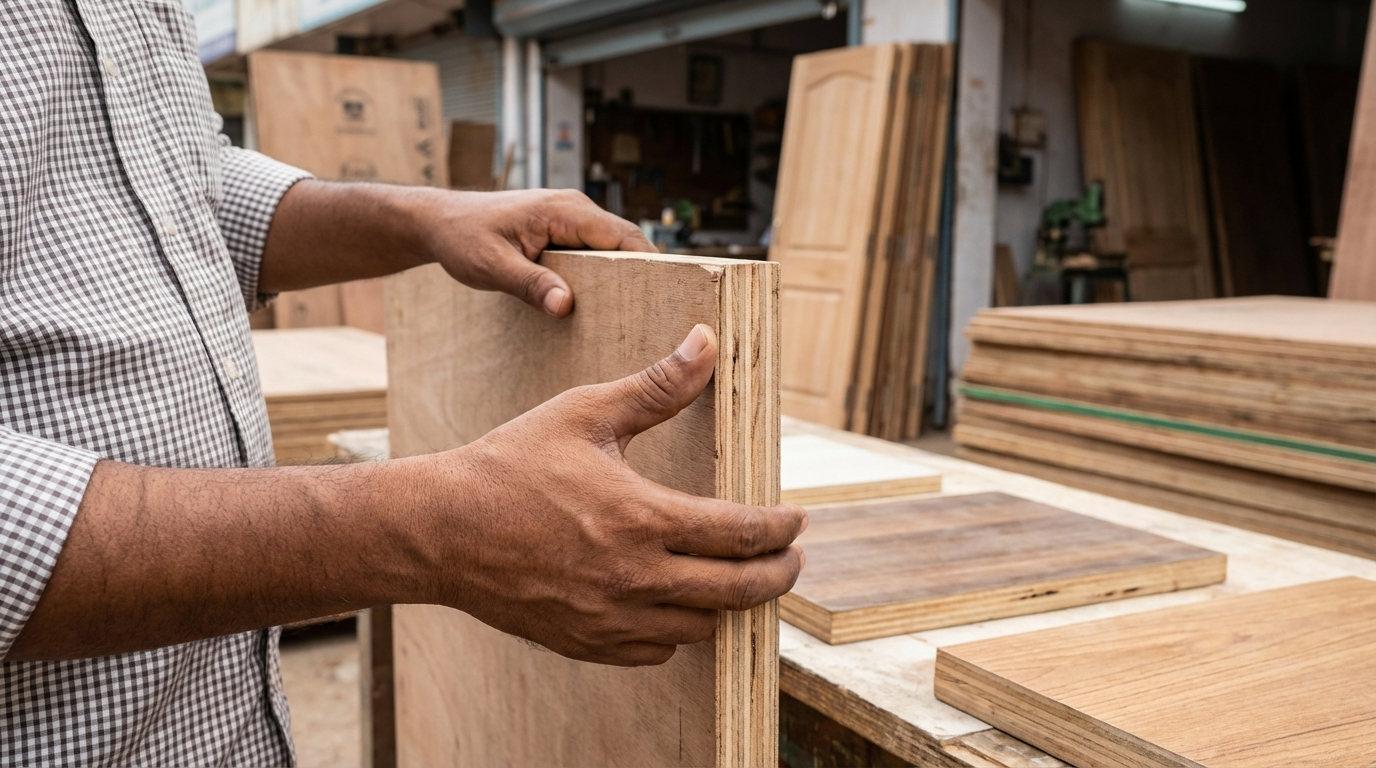
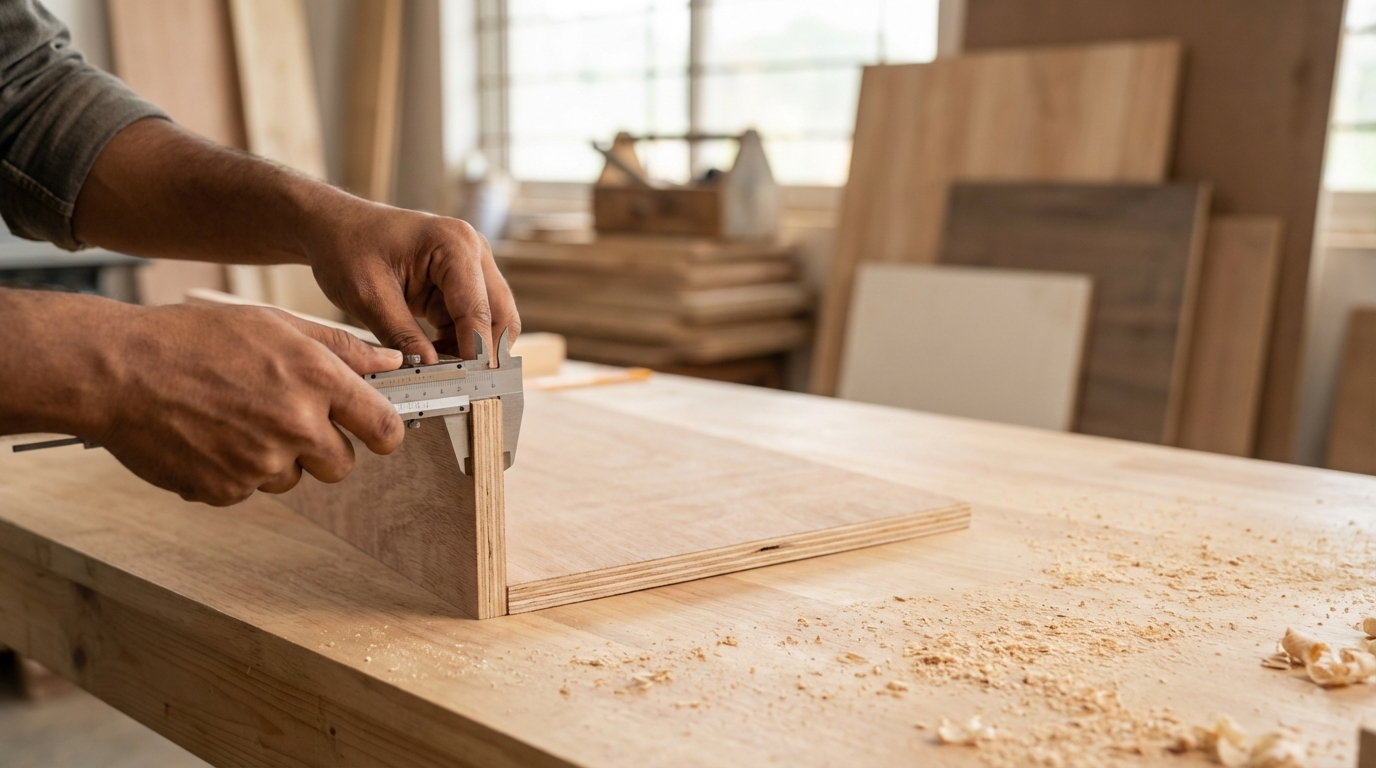
Final grading per BIS standards checks for delamination, twist (<2 mm), and glue shear strength. Markings like ISI stamps confirm compliance, though buyers should verify via hammer-tap tests for hollow sounds indicating voids.
Key Factors That Make a Plywood Sheet Strong and Reliable
Beyond steps, quality hinges on integration: veneer uniformity provides isotropy; optimal glue lines (invisible post-sand) ensure bond integrity; pressing density (0.6-0.75 g/cm³) governs screw-holding power.
In Indian contexts:
- Climate adaptation: BWP's PF glue resists 95% humidity; MR suits dry interiors but fails in godowns.
- Load scenarios: 12 mm for partitions (low shear); 18 mm for shelves (high compression).
- Defect avoidance: Avoid 'dead wood' cores that compress under weight.
| Strength Metric | Influenced By | Buyer Test |
|---|---|---|
| Bending Strength | Veneer quality, grain alignment | Flex panel ends; no crack |
| Shear Strength | Glue penetration, pressing | Edge screw pullout >100 kg |
| Moisture Durability | Drying precision, adhesive type | 72-hr boil for BWP |
Navigating Indian Market Realities: From Mill to Your Site
Dealer markups (20-40%) reflect transport from mills in Punjab or Kerala. Contractors prioritize volume discounts on MR; homeowners opt for branded BWR to avoid callbacks. Always inspect edges for glue squeeze-out—a sign of robust pressing.
Decision logic: For monsoon-prone Mumbai, BWP justifies premium; Delhi's dry heat suits MR with edge-sealed paints.
Common Myths and Practical Buying Checks
Myth: Thicker always stronger—false; poor core voids negate it. Check: Weigh sheets (heavier often denser). Myth: All ISI-marked equal—false; verify grade-specific tests.
- Tap test: Uniform thud = solid.
- Knot count: <5 per sq ft for faces.
- Moisture meter: 10-12% ideal.
Future Trends Shaping Plywood Production in India
Sustainable sourcing (FSC-certified poplar) and bio-resins reduce formaldehyde emissions, aligning with green building norms. Automated peeling and RF curing cut defects by 15-20%, stabilizing supply chains amid wood shortages.
This process demystifies why not all plywood performs equally—empowering informed choices for enduring structures.
Related guides on PlyPrice
Want Plywood Suggestions?
Share a few details and a PlyPrice specialist will suggest suitable brands and connect you to responsive dealers.