What Is MR Plywood? Moisture Resistant Grade, Uses and Limits
MR plywood is moisture resistant, entry-level commercial plywood bonded with urea formaldehyde (UF) resin under IS 303, built for humidity swings in dry interiors but not direct water. Compare it with BWR and BWP, see ideal uses, monsoon and termite limits and buying checks.
Last updated: . Grades and standards checked against current BIS standards.
What Does MR Mean in Plywood?
MR plywood, shorthand for Moisture Resistant plywood, represents the entry-level engineered wood panel commonly used in India's residential and light commercial interiors. Unlike waterproof variants, MR plywood relies on urea formaldehyde (UF) resin as its primary bonding agent, which provides basic protection against humidity fluctuations typical in non-exposed areas. This classification stems from Indian Standards Institution (ISI) norms under IS 303, positioning it as a commercial-grade product suited for environments where direct water contact is absent.
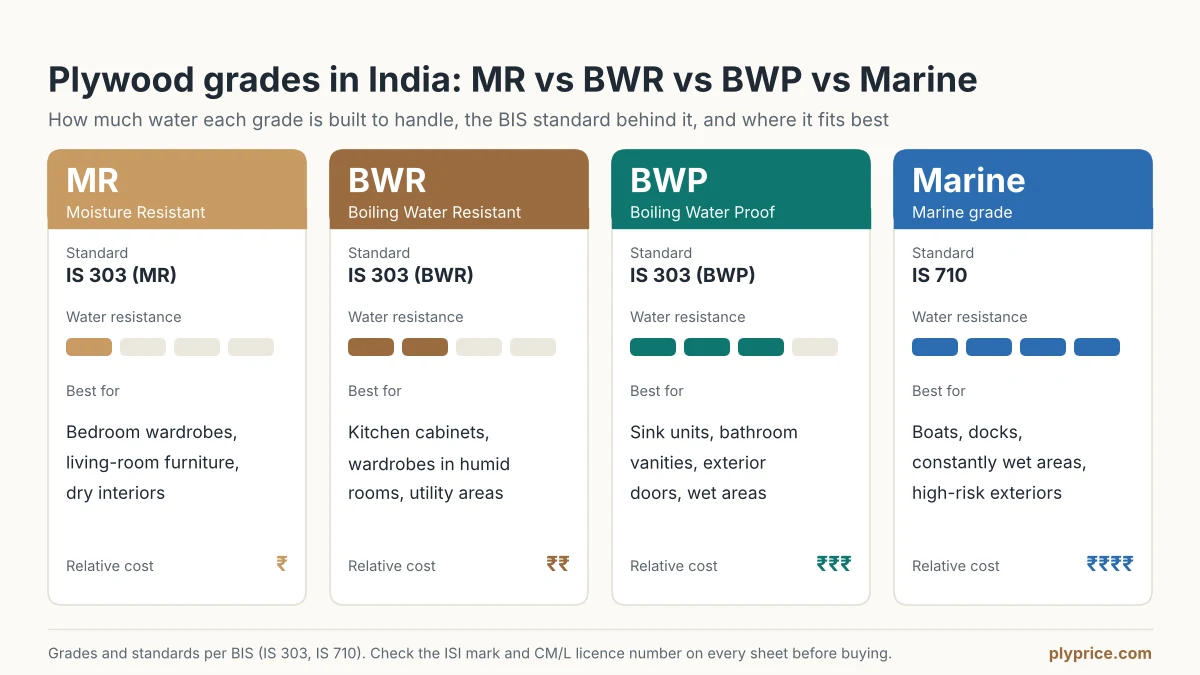
From a first-principles perspective, plywood's resistance derives from the glue line's behavior under stress. UF resin cures into a brittle bond that holds veneers together under normal indoor conditions but degrades when exposed to prolonged moisture, explaining its "resistant" rather than "proof" designation. Indian buyers, from homeowners renovating apartments in Mumbai's humid suburbs to contractors fitting out budget office partitions, gravitate toward MR for its balance of affordability and functionality in dry zones.
Core Composition: Role of Urea Formaldehyde Resin
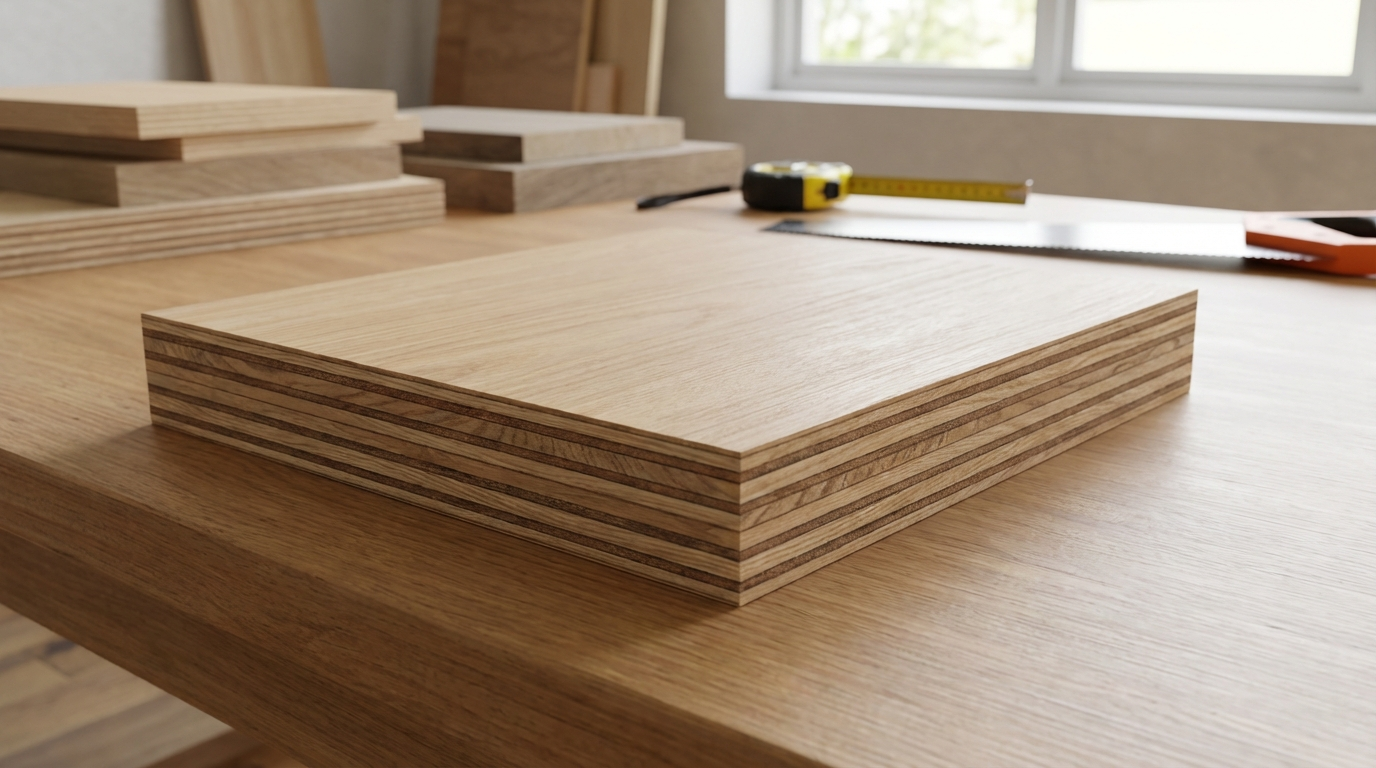
At its heart, MR plywood consists of multiple thin layers of wood veneers—typically from species like poplar, eucalyptus, or tropical hardwoods—glued cross-grain for stability. The distinguishing feature is the UF resin, a synthetic adhesive mixed with hardeners and fillers during production.
- Veneer quality: Core veneers are often from fast-growing plantation woods, with face veneers graded BWR-equivalent or better for surface finish.
- Resin properties: UF offers strong initial adhesion but limited hydrolysis resistance, meaning it withstands occasional dampness (e.g., post-monsoon humidity) without delaminating immediately.
- Density range: Typically 500-650 kg/m³, influencing screw-holding capacity for furniture assembly.
In India's decentralized manufacturing landscape, mills in Uttar Pradesh or Kerala source veneers locally, affecting consistency. Buyers should note that resin content (around 120-150g/m² per glue line) directly impacts durability, with higher grades using extended boiling tests for validation.
Manufacturing Process Breakdown
MR plywood production follows a hot-pressing cycle tailored to UF's curing needs, differing from phenolic resins in higher grades:
- Veneer preparation: Logs are peeled into 1.0-3.0mm thick sheets, dried to 8-12% moisture content to match Indian ambient humidity (40-70% RH).
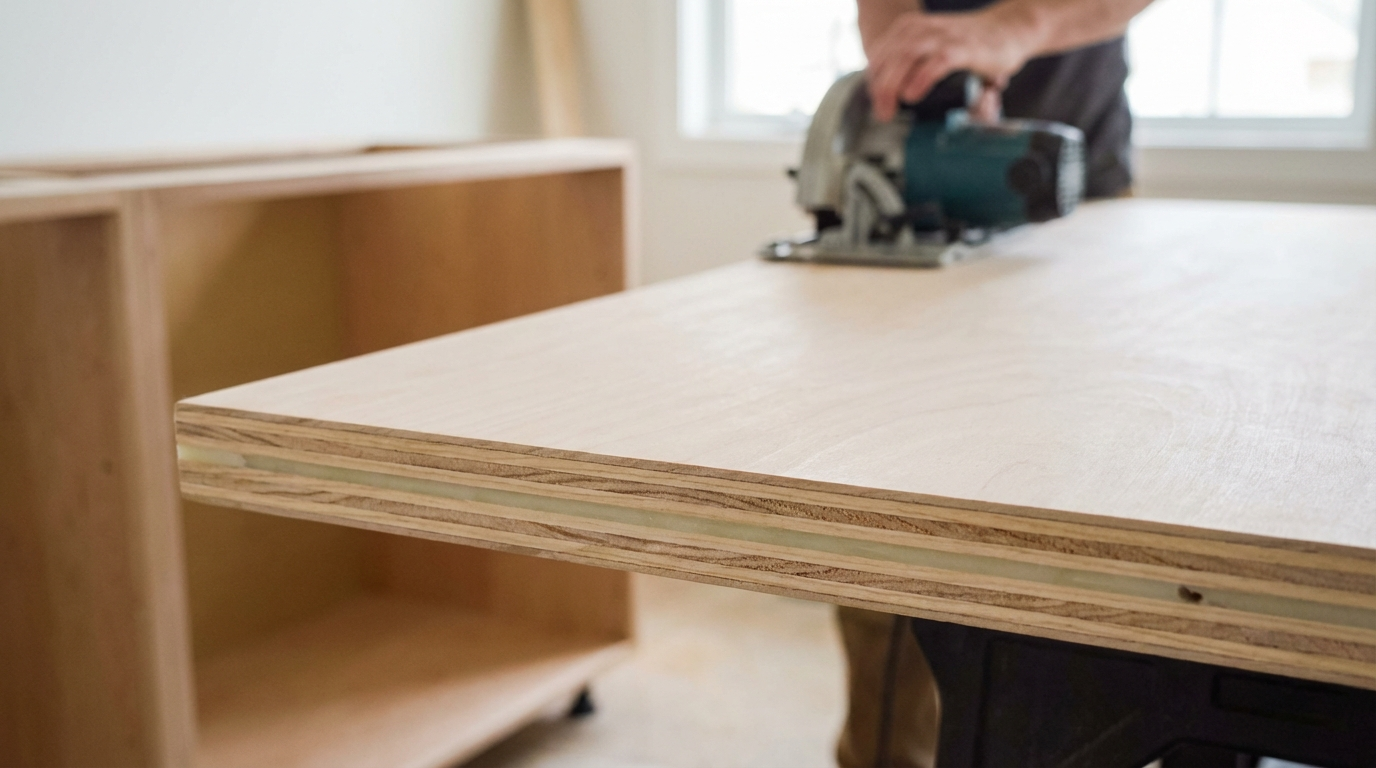
- Glue spreading: UF resin applied via roller or curtain coater, with assembly into a book of 3-21 plies depending on thickness (3-25mm).
- Hot pressing: 120-140°C at 1.2-1.5 N/mm² pressure for 5-15 minutes per mm of thickness, forming the glue line.
- Trimming and grading: Sanding to uniform thickness, visual checks for defects like knots or patches.
This process prioritizes volume output for competitive pricing, making MR plywood a staple in India's unorganized dealer networks from Delhi's Bhagirath Palace to Chennai's plywood hubs.
ISI Standards and Quality Grading for MR Plywood
Under IS 303:2024, MR plywood must pass three cycles of 3-hour soaking in 60°C water and 8-hour drying at 65°C, then a ply-adhesion test, distinguishing it from untreated commercial ply. Grades are denoted by face veneer quality:
| Grade | Face Veneer Defects Allowed | Typical Use Case | Strength Retention After Test |
|---|---|---|---|
| MR Grade 1 | Minimal knots, no patches | Exposed furniture surfaces | 85-90% |
| MR Grade 2 | Small knots, limited fills | Partitions, concealed framing | 80-85% |
| MR Commercial | Patches allowed, sound knots | Substrate under laminates | 75-80% |
Certifications like ISI mark indicate compliance, though field enforcement varies regionally. Architects specify MR for non-structural elements, verifying via glue line strength (min 1.0 N/mm² parallel to grain).
Ideal Applications in Dry Indian Interiors
MR plywood excels where ambient moisture stays below 70% RH, aligning with India's urban dry interiors:
- Bedrooms and living rooms: Wardrobes, bed frames, paneling—handles AC-induced dryness well.
- Kitchens (dry zones): Cabinets away from sinks, avoiding steam exposure.
- Office fitouts: False ceilings, partitions in air-conditioned spaces.
- Furniture manufacturing: Carcasses under veneer or laminate, common in modular setups by brands like Godrej Interio alternatives.
Homeowners in Pune or Bangalore apartments favor 18mm MR for cost-effective stability during seasonal shifts, while contractors use 12mm for lightweight partitioning.
Key Limitations: Why MR Isn't for Wet Areas
UF resin's water solubility limits MR plywood to non-wet zones. Exposure to spills, leaks, or monsoons triggers swelling (upto 15% thickness increase) and bond failure within hours. Avoid in:
- Bathrooms, laundry areas.
- Exterior cladding or verandas.
- High-humidity coastal regions without sealing.
Contractors report delamination in 6-12 months under poor ventilation, underscoring the need for BWR/BWP upgrades in marginal cases.
Comparing MR with BWR and BWP Grades
Understanding trade-offs aids buyer decisions in India's tiered pricing ecosystem:
| Attribute | MR (UF Resin) | BWR (PF Modified) | BWP (Pure PF) |
|---|---|---|---|
| Boil Test | 3-hour soak at 60°C, three cycles | 8-hour boil, three cycles | 72-hour boil |
| Moisture Limit | Dry interiors (<20% MC) | Semi-wet (kitchens) | Wet/exterior |
| Cost Relative to MR | Baseline | 20-40% higher | 40-70% higher |
| Screw Hold | Good in dry | Better retention | Superior |
| ISI Standard | IS 303 | IS 710 | IS 710 |
MR suits 70% of interior jobs by volume, per industry estimates, but BWR steps up for longevity where budgets allow.
Practical Buying Considerations for MR Plywood
Dealers in India's markets (e.g., Hyderabad's Tadbund) quote based on thickness, size (8x4 ft standard), and origin—northern mills cheaper than southern. Cost drivers:
- Thickness: 6mm economical for shelves; 18-19mm for structural loads.
- Quality checks: Tap test for voids, knife test for glue pull-out, weigh for density.
- Regional variation: 10-25% premium in metros vs. wholesale yards.
- Storage advice: Elevate stacks, cover to prevent site moisture.
Architects recommend pairing with PU sealers for edge protection, extending usability in variable climates.
Addressing Common Buyer Queries on MR Plywood
Can MR Plywood Handle Indian Monsoon Humidity?
Short-term yes, if sealed and ventilated; long-term no, without upgrades.
Is MR Plywood Termite Resistant?
Not inherently—opt for treated variants with preservatives like copper chrome boron.
How to Differentiate Genuine MR from Substandard?
ISI mark, lab test reports, avoid overly cheap imports lacking boil certification.
Thickness Recommendations for Home Use?
12mm for doors/panels; 18mm for heavy cabinets.
MR plywood's role as a reliable dry-area workhorse persists in India's evolving construction scene, rewarding informed selection over assumptions.
Related guides on PlyPrice
Want Plywood Suggestions?
Share a few details and a PlyPrice specialist will suggest suitable brands and connect you to responsive dealers.