Plywood Material: Composition, Grades & Quality Factors
What is plywood made of? Complete guide to plywood materials - wood species, adhesives, face veneers & quality factors. Understand what makes good ply.
Quick Answer: Plywood Composition in 30 Seconds
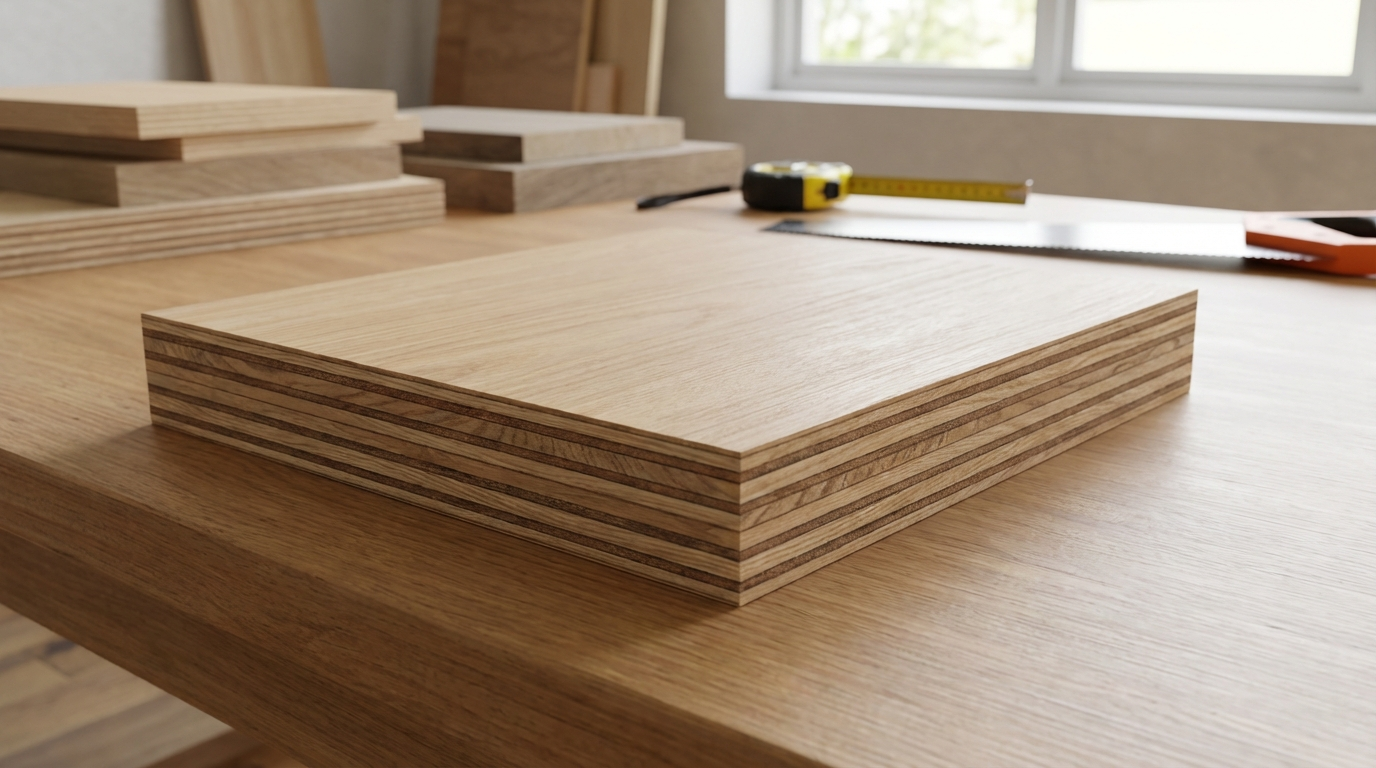
Plywood is an engineered wood product manufactured from thin layers of wood veneer (called plies) that are glued together with adjacent layers having their grain rotated at 90 degrees to each other. This cross-graining technique reduces the tendency of wood to split when nailed at the edges, reduces thickness swelling and shrinkage, provides improved dimensional stability, and makes the strength of the panel consistent across all directions.
In simple terms, plywood is like a sandwich of thin wood sheets stacked and bonded under high pressure and heat. The quality depends on three critical factors: the wood species used for core and face veneers, the type of adhesive binding the layers, and the manufacturing process. According to plyprice.com's analysis of 100+ brands in India, understanding these composition elements helps you choose between ₹35-200 per sq ft plywood options with confidence.
- Plywood sheets are made by gluing several veneer sheets together, with a minimum of 3 veneers (3-ply-plywood), and plywood is always made up of an odd number of veneers.
- Plywood is made of cross-bonded core veneers and panel veneers, glued together under high heat and pressure, with the choice of raw materials such as the source of wood and adhesive used defining the fineness of plywood.
- Standard sizes in India: 8x4 feet (2440x1220mm), 7x4 feet, 6x4 feet, 6x3 feet
- Thickness range: 4mm to 25mm for most furniture applications
- ISI standards: IS:303 (MR/BWR grades), IS:710 (Marine/BWP grade)
- Three main adhesive types determine water resistance levels
- Core woods: Poplar, Eucalyptus, Gurjan/Hardwood
- Face veneers: Gurjan, Okoume, Keruing, Birch, Teak
What Exactly is Plywood Made Of?
Plywood is a composite material manufactured from thin layers, or "plies", of wood veneer that have been stacked and glued together, making it an engineered wood from the family of manufactured boards. Every plywood sheet consists of three essential components that determine its quality, durability, and price.
The manufacturing process begins with rotary cutting of wood logs to obtain thin veneer sheets. These veneers are thin sheets of wood obtained by rotary cutting of logs, and plywood is made up of these veneer sheets. The veneers are then dried, treated, coated with adhesive, and pressed together under controlled heat and pressure.
Why does plywood composition matter for Indian homes? India's diverse climate zones—from the humid coastal areas of Kerala and Mumbai to the extreme temperature variations of Delhi and Punjab—demand specific material qualities. Plyprice.com recommends understanding composition thoroughly because the same 18mm plywood sheet can range from ₹35 to ₹150 per sq ft depending on the materials used.
Each layer, or ply, is glued together, with the grains of adjoining layers placed at right angles, and this cross-graining enhances the plywood's strength and minimizes the chances of splitting when nailed at the edges. This fundamental construction principle makes plywood superior to solid wood for furniture applications where dimensional stability matters.
The Three Pillars of Plywood Composition
Every plywood sheet's performance depends on these three elements working together:
- Core Veneers: The inner layers that provide structural strength
- Face/Back Veneers: The outer layers that determine appearance and surface quality
- Adhesive/Glue: The binding agent that determines moisture resistance and bonding strength
Wood Species Used in Plywood Manufacturing
Plywood is made from different species of wood and therefore comes in different qualities, and plywood of the same species and number of ply can differ from manufacturer to manufacturer because of changes in method of manufacturing.
| Wood Type | Origin | Density | Best For | Price Impact |
|---|---|---|---|---|
| Gurjan (Dipterocarpus) | Southeast Asia (Myanmar, Indonesia) | High (700-850 kg/m³) | Premium furniture, marine applications | Highest (+40-60%) |
| Eucalyptus | Africa, India, Australia | Medium-High (580-650 kg/m³) | Quality furniture, structural applications | High (+20-30%) |
| Poplar | North India (Haryana, UP, Punjab) | Low-Medium (400-500 kg/m³) | Commercial furniture, interior use | Base price |
| Hardwood Mix | Various tropical regions | Variable (550-750 kg/m³) | General purpose, mid-range furniture | Medium (+15-25%) |
| Softwood (Pine/Fir) | Imported, some domestic | Low (350-450 kg/m³) | Packaging, temporary structures | Lowest (-10-20%) |
Hardwood vs Softwood Plywood
Hardwood plywood is made out of wood from dicot trees like oak, beech and mahogany and is used for demanding end uses, characterized by its excellent strength, stiffness, durability and resistance to creep.
Hardwood plywood is made from veneers or wood obtained from species like Teakwood, Gurjan or Birchwood, and plywood made from veneers obtained from these trees is also termed as 100% hardwood plywood, making it an expensive product.
Softwood plywood is made from veneers or wood obtained from species like Spruce-Pine-Fur (SPF) or mango wood, and softwood ply is not as strong as hardwood ply and therefore comes at a cheaper rate.
Core Wood Species in Indian Plywood
The plywood core is considered the most important part of the plywood, and together with glue, plywood core determines the strength and durability of the plywood, meaning any good ply should have a decent core.
Poplar Core: Poplar wood is cheaper compared to other wood and is available abundantly in the northern part of India, with most Indian manufacturers located in Yamunanagar, Haryana, so prices of plywood manufactured from this wood core are very cheap.
Eucalyptus Core: Eucalyptus is a tropical hardwood material, and almost all eucalyptus veneer core plywood are processed under two times hot press, with a good two times hot press eucalyptus core with WBP glue sold as marine grade.
Combination (Combi) Core: COMBI is short for combination, and COMBI core is usually a mixture of poplar veneer and eucalyptus veneer, offering a balance between poplar plywood and eucalyptus plywood.
Face Veneer Types and Quality Grades
The face of plywood is taken from high quality wood, and in India most face veneer for plywood is imported from foreign countries, with popular types including Gurjan face veneer, Okoume face veneer, and Keruing face veneer, available in grades like AA, A, B, C, D and E.
| Face Veneer | Source | Thickness | Characteristics | Best Application |
|---|---|---|---|---|
| Gurjan | Myanmar, Thailand, Indonesia | 0.28-0.60mm | Strong grain, high durability, premium look | Premium furniture, marine plywood |
| Keruing | Indonesia, Malaysia | 0.30-0.32mm | Durable, low maintenance, construction-grade | Structural plywood, quality furniture |
| Okoume | Gabon, Africa | 0.3-0.6mm | Lightweight, uniform grain, pinkish-brown | Commercial furniture, decorative panels |
| Birch | Russia, Europe | 0.5-1.5mm | Very smooth, excellent finish, pale color | High-end furniture, cabinetry |
| Recon Veneer | China (poplar-based engineered) | 0.26-1.0mm | Uniform appearance, cost-effective | Budget furniture, mass production |
Better grade face veneer is thicker and more expensive than inferior grade, and plywood made with better grade face veneer looks like wood veneer, is stronger and costlier.
Adhesive Types and Their Impact on Plywood Grades
Glue is an essential part of plywood manufacturing—you can say it is the most important element of plywood—and together with the veneer material, glue determines the strength, quality, and durability of the plywood panels.
The adhesive used in plywood manufacturing is the single most important factor determining its water resistance grade. According to plyprice.com's research, understanding adhesive types helps you match plywood to specific applications.
| Adhesive Type | Full Form | Water Resistance | Plywood Grade | Cost | Best For |
|---|---|---|---|---|---|
| UF (Urea Formaldehyde) | Urea Formaldehyde Resin | Moisture Resistant only | MR Grade (IS:303) | Lowest | Dry interior areas |
| MUF (Melamine Urea Formaldehyde) | Melamine-Modified UF | Better moisture resistance | MR+ / BWR Grade | Medium | Semi-humid areas |
| PF (Phenol Formaldehyde) | Phenol Formaldehyde Resin | Boiling water resistant/proof | BWR/BWP (IS:710) | Highest | Kitchens, bathrooms, marine |
Urea Formaldehyde (UF) Adhesive
Urea-Formaldehyde (UF) is the type of formaldehyde that off-gasses at higher levels and for longer—when you think of furniture that is off-gassing for many years it was likely made with urea-formaldehyde.
The UF resin adhesive is a cheap and colorless adhesive that is typically used in interior applications. This is the standard adhesive for MR grade plywood, suitable only for dry indoor environments.
Phenol Formaldehyde (PF) Adhesive
Phenol formaldehyde glue is completely waterproof and is widely used in plywood for boatbuilding, being BS 1088, BS 6566 and AS/NZS 2272 compliant.
Phenol formaldehyde resin is used for bonding the plies of veneer in marine plywood. Phenolic resins exhibit stronger bonding compared to urea-based resins, so they are used in the manufacture of exterior grade plywood (BWR-boiling water-resistant) and marine-grade plywood.
Phenol Formaldehyde is darkly coloured and can be seen in the seam of marine and exterior plywood, needs good contact and pressure to make a solid bond, and is more expensive than Urea Formaldehyde glue which explains why it is not used for all plywood.
Melamine-Urea Formaldehyde (MUF) Adhesive
Melamine-urea formaldehyde (MUF) adhesives combine properties from urea and melamine polymers to ensure optimal and cost-efficient performance, being a condensation product of melamine, urea and formaldehyde.
Plywood Grades: IS:303 vs IS:710 Standards Explained
As per Indian standards, IS 303 plywood specification stands for Moisture resistant and Boiling Water Resistant grades of plywood, while IS 710 specification stands for marine-grade plywood.
| Parameter | IS:303 MR Grade | IS:303 BWR Grade | IS:710 BWP/Marine Grade |
|---|---|---|---|
| Full Form | Moisture Resistant | Boiling Water Resistant | Boiling Water Proof (Marine) |
| Adhesive Used | Urea Formaldehyde (diluted) | Phenol Formaldehyde | Undiluted Phenol Formaldehyde |
| Water Resistance | Humidity/dampness only | Resistant to boiling water | Completely waterproof |
| Boiling Water Test | Cannot survive | Survives limited exposure | Survives 72+ hours immersion |
| Best Applications | Living room, bedroom furniture | Kitchen cabinets, bathrooms | Marine, outdoor, wet areas |
| Price Range (18mm) | ₹40-90 per sq ft | ₹60-150 per sq ft | ₹100-200 per sq ft |
MR Grade Plywood (Commercial Plywood)
MR grade plywood is also known as moisture resistant grade plywood, showing good resistance against moisture and humidity as it is treated with resins such as formaldehyde, but should be avoided in areas with prolonged moisture exposure like kitchens or bathrooms. Reputed manufacturers offer borer and termite proof MR grade plywood due to preservative treatment, making it ideal for interiors like furniture, cabinets, and shelves, which is why it is commonly called commercial plywood.
BWR Grade Plywood
BWR plywood is known for its superior resistance to moisture and boiling water, manufactured using phenolic resin which enhances its water-resistant properties, and is commonly used in areas where high levels of humidity and water exposure are expected.
BWP/Marine Grade Plywood (IS:710)
IS:710 Plywood is BWP or Boiling Waterproof grade plywood, also known as Marine-grade plywood, which is much stronger than MR or BWR grade plywoods with excellent waterproof quality. It is used for making ships and boats and won't get damaged even if kept submerged in water for long, making BWP grade highly recommended for washrooms, kitchens and all water-prone areas.
Marine plywood can be submerged in water for 72 hours without any kind of damage, uses phenol formaldehyde resin for bonding, is used for making ships and boats, and is exterior-grade plywood designed to withstand extreme weather conditions.
Quality Factors That Determine Plywood Performance
Plyprice.com's extensive research across Indian plywood markets identifies these critical quality factors that separate premium plywood from substandard products:
1. Number of Plies and Thickness Ratio
The ply count directly impacts strength. For 18mm plywood:
- 7-ply: Budget option, acceptable for light-duty applications
- 9-ply: Standard quality for most furniture
- 11-ply: Premium quality, better screw holding
- 13-ply: Highest grade, maximum strength and stability
2. Core Gap and Void Content
Each wood veneer in quality marine plywood will be from tropical hardwoods and have negligible core gap, limiting the chance of trapping water in the plywood and providing a solid and stable glue bond.
3. Veneer Thickness Consistency
Calibrated plywood offers consistent thickness throughout the sheet, while non-calibrated plywood may have variations of 1-2mm across the surface, affecting furniture fitting and finishing.
4. Glue Line Quality
The bond between veneer layers should be uniform without gaps, bubbles, or weak spots. Premium manufacturers use AEGL (Alternate Extra Glue Line) technology for enhanced bonding.
5. Wood Treatment
Quality plywood undergoes treatment for:
- Termite and borer resistance
- Fungal protection
- Fire retardancy (for specialized grades)
| Quality Parameter | Economy Grade | Standard Grade | Premium Grade |
|---|---|---|---|
| Core Wood | Poplar only | Poplar/Combi | Eucalyptus/Gurjan |
| Face Veneer | C/D grade Okoume | B grade Gurjan/Keruing | AA grade Gurjan |
| Ply Count (18mm) | 7-ply | 9-ply | 11-13 ply |
| Calibration | Non-calibrated | Semi-calibrated | Fully calibrated |
| ISI Certification | Often absent | IS:303 marked | IS:303/710 marked |
| Termite Treatment | Basic/None | Standard treatment | Premium treatment with warranty |
| Price Range (18mm MR) | ₹35-50/sq ft | ₹50-75/sq ft | ₹75-120/sq ft |
How to Verify Plywood Quality Without Lab Tests
As recommended by plyprice.com experts, these practical checks help identify good quality plywood at the dealer level:
Visual Inspection Checks
- Surface Smoothness: Run your palm across the face—premium plywood feels uniformly smooth without rough patches
- Edge Examination: Look at the cross-section for uniform veneer thickness, minimal gaps, and consistent glue lines
- Face Veneer Grain: Natural, consistent grain pattern indicates quality face veneer; artificial uniformity suggests recon veneer
- Color Consistency: Even color across the sheet indicates proper processing
Physical Tests at Dealer
- Weight Test: Heavier plywood (for same thickness) generally indicates denser core wood
- Flex Test: Gently flex the sheet—premium plywood shows controlled flex without cracking sounds
- Tap Test: Tap the surface—solid, consistent sound indicates good internal bonding; hollow sounds suggest voids
- Scratch Test: Lightly scratch the surface with fingernail—quality face veneer resists superficial scratching
ISI Mark Verification
To identify genuine ISI-approved plywood, check for the correct ISI Logo visible and printed on the sheet, the IS Code (e.g., IS:303 or IS:710) corresponding to the type of plywood, and the CM/L Number which is a 7-8 digit license number that BIS provides to the manufacturer.
India-Specific Considerations for Plywood Selection
Plyprice.com's region-wise analysis reveals these crucial factors for Indian buyers:
Monsoon and Humidity Impact
India receives 3-4 months of heavy monsoon in most regions. For furniture exposed to high humidity:
- Coastal areas (Mumbai, Chennai, Kolkata, Kochi): Minimum BWR grade mandatory
- High rainfall zones (Kerala, Northeast, Konkan): BWP grade preferred
- Semi-arid zones (Rajasthan, Gujarat interior): MR grade acceptable for most applications
Regional Price Variations
| Region | Price Factor | Reason |
|---|---|---|
| Yamunanagar Hub (Haryana) | Base price | Manufacturing center, lowest transport cost |
| North India (Delhi NCR, Punjab, UP) | +5-10% | Close to manufacturing hub |
| West India (Mumbai, Gujarat) | +10-15% | Transport costs, higher demand |
| South India (Chennai, Bangalore, Hyderabad) | +12-18% | Higher transport, import costs |
| East India (Kolkata, Odisha) | +8-12% | Transport and logistics |
| Kerala and Northeast | +15-25% | Remote location, high moisture requirements |
Termite Considerations
Termite prevalence varies significantly across India:
- High Risk: Coastal areas, South India, Eastern states—always choose treated plywood
- Medium Risk: Central India, parts of North India—treated plywood recommended
- Lower Risk: Dry zones like Rajasthan, Ladakh—standard treatment acceptable
Common Misconceptions About Plywood Materials
Myth 1: "Waterproof plywood can be used outdoors indefinitely"
Reality: Even BWP grade plywood needs proper finishing and protection for outdoor use. The glue is waterproof, but the wood itself can degrade with prolonged sun and rain exposure.
Myth 2: "Higher price always means better quality"
Reality: Brand premium, dealer margins, and location factors affect price. An ISI-marked local brand may offer better value than an overpriced branded product.
Myth 3: "Marine plywood is only for boats"
Reality: For home interiors too, marine ply is used in wet areas like kitchens and bathrooms where commercial ply would get damaged and develop odor.
Myth 4: "All ISI-marked plywood is genuine"
Reality: Some companies misuse the ISI mark illegally without adhering to any BIS standards, so identifying real ISI-approved plywood matters.
Myth 5: "Thicker plywood is always stronger"
Reality: A 15mm plywood with 9-ply Gurjan core can be stronger than 19mm plywood with 7-ply poplar core. Ply count and wood quality matter more than raw thickness.
Myth 6: "MR grade is sufficient for kitchen cabinets"
Reality: Indian kitchens experience significant moisture from cooking steam and cleaning. BWR grade minimum is recommended for kitchen carcasses.
Advantages and Limitations: Honest Assessment
Advantages of Plywood
- Plywood is more durable than standard wood, as well as cheaper, more flexible, and less prone to swelling and shrinking.
- Cross-grain stability: Resists warping better than solid wood
- Consistent quality: Engineered product with predictable properties
- Size availability: Large sheets reduce joinery requirements
- Screw holding: Multiple layers provide good fastener grip
- Cost efficiency: Better utilization of timber resources
- Variety: Available in grades matching every application and budget
- Finishing options: Takes laminate, veneer, paint, and polish well
Limitations and Workarounds
- Edge exposure: Raw edges absorb moisture; use edge banding or lipping
- Formaldehyde emission: Choose E0/E1 grade for bedrooms; allow new furniture to off-gas
- Weight: Heavier than MDF/particle board; consider for wall-mounted units
- Surface texture: Grain shows through paint; use primer or laminate for smooth finish
- Edge screwing: Can split at edges; pre-drill holes and use proper hardware
- Price variation: Quality varies significantly; buy from trusted sources
Best Applications for Different Plywood Compositions
| Application | Recommended Composition | Minimum Grade | Thickness | Why This Choice |
|---|---|---|---|---|
| Modular Kitchen Carcass | Eucalyptus core, Gurjan face | BWR/BWP | 18-19mm | Moisture exposure, heavy loads |
| Kitchen Shutters | Hardwood core, quality face | BWR minimum | 12mm | Steam and moisture exposure |
| Wardrobe Carcass | Poplar/Combi core, good face | MR grade | 18mm | Dry location, load bearing |
| Wardrobe Shutters | Poplar core, decent face | MR grade | 12mm | Lighter weight for hinges |
| Bathroom Vanity | Eucalyptus/Gurjan core | BWP (IS:710) | 18-19mm | Constant moisture, water splashes |
| TV Unit | Poplar/Combi core | MR grade | 18mm | Equipment weight, dry location |
| Study Table | Poplar/Combi core | MR grade | 18mm | Moderate load, indoor use |
| Bed Frame | Hardwood core | MR+ grade | 18-19mm | Heavy load bearing required |
| False Ceiling | Poplar core, basic face | MR grade | 6-9mm | Lightweight, no load |
| Wall Paneling | Depends on location | MR/BWR | 4-6mm | Decorative, minimal stress |
Price Guide: What to Expect in 2025
Based on plyprice.com's pricing database across 50+ Indian cities, here are current price ranges:
| Plywood Type | Thickness | Economy Range | Standard Range | Premium Range |
|---|---|---|---|---|
| MR Grade Commercial | 18mm | ₹35-50/sq ft | ₹50-75/sq ft | ₹75-100/sq ft |
| MR Grade Commercial | 12mm | ₹28-40/sq ft | ₹40-55/sq ft | ₹55-75/sq ft |
| BWR Grade | 18mm | ₹55-75/sq ft | ₹75-100/sq ft | ₹100-150/sq ft |
| BWP/Marine Grade | 19mm | ₹85-110/sq ft | ₹110-150/sq ft | ₹150-200/sq ft |
| Calibrated Plywood | 18mm | ₹65-85/sq ft | ₹85-120/sq ft | ₹120-160/sq ft |
Note: Prices are indicative as of January 2025 and vary by location. Metro cities typically have 10-15% higher prices than tier-2 towns. Always get multiple quotes and verify specifications.
Frequently Asked Questions
What is the difference between MR and BWR plywood?
MR (moisture-resistant) plywood offers basic resistance to moisture and is suitable for indoor applications, while BWR (Boiling Water Resistant) plywood is highly resistant to boiling water and extreme weather conditions, making it ideal for areas with high moisture exposure. The fundamental difference lies in the adhesive used—MR uses urea formaldehyde while BWR uses phenol formaldehyde resin. For Indian homes, MR grade works for living rooms and bedrooms, while BWR is essential for kitchens and near bathrooms. MR grade plywood typically costs ₹40-90 per sq ft for 18mm, while BWR ranges from ₹60-150 per sq ft.
Is marine plywood the same as waterproof plywood?
Marine plywood (IS:710 grade) is the highest form of waterproof plywood, capable of surviving submersion in water for over 72 hours. Marine plywood is manufactured from durable face and core veneers with few defects so it performs longer in both humid and wet conditions and resists delaminating and fungal attack, constructed to be used in environments where it is exposed to moisture for long periods. However, "waterproof" is a marketing term that can apply to various grades. Always check for IS:710 certification for true marine-grade performance.
What is the best wood species for plywood core?
Eucalyptus core plywood uses denser hardwood veneers throughout the core, and eucalyptus provides higher density and strength compared to poplar. For premium applications requiring maximum strength and moisture resistance, Gurjan core is ideal. For cost-effective quality furniture, eucalyptus or hardwood mix cores offer excellent value. Poplar core is budget-friendly and sufficient for basic interior furniture in dry areas. The "best" choice depends on your application, budget, and location.
How can I identify good quality plywood at a shop?
Look for these indicators: uniform thickness across the sheet, consistent veneer layers when viewing the edge, absence of voids or gaps between layers, smooth face without patches or repairs, and proper ISI marking with CM/L number. A good quality plywood board will usually be termite-resistant and have an ISI stamp on it. Weight is another indicator—for the same thickness, heavier plywood typically has denser, better quality core wood. Ask the dealer for the brand's test certificate and warranty documentation.
What thickness of plywood should I use for wardrobes?
For wardrobe carcass (the main structure), use 18mm plywood with at least MR grade. For shelves expected to bear heavy loads, consider 18mm or step down to 12mm for lighter items. Wardrobe shutters work well with 12mm plywood as it reduces weight on hinges. Back panels can use 6mm plywood. In humid climates or near bathrooms, upgrade to BWR grade. Premium brands offer calibrated 18mm plywood specifically for modular furniture that ensures consistent fitting.
Is calibrated plywood worth the extra cost?
Calibrated plywood offers consistent thickness throughout the sheet (tolerance within ±0.2mm), unlike regular plywood that may vary by 1-2mm across the surface. For modular kitchen installations and precision furniture where tight fits matter, calibrated plywood is worth the 15-25% premium. It also accepts laminate and veneer application better with fewer air bubbles. For basic furniture where slight variations are acceptable, standard plywood works fine.
What causes plywood to warp and how to prevent it?
Warping occurs due to uneven moisture absorption, improper storage, or poor quality manufacturing with inconsistent veneer tension. Prevention includes: choosing appropriate grade for the environment (BWR for humid areas), proper acclimatization before use (store flat for 2-3 days at installation site), applying finish to all surfaces including edges, and buying from reputable manufacturers with proper core treatment. Calibrated plywood with higher ply count resists warping better.
How do I verify if ISI marking on plywood is genuine?
Before buying plywood for large projects, always purchase from reputed dealers or authorized showrooms, request the BIS test certificate or laboratory reports from the brand, search for printed branding along the side of the plywood sheet, and if uncertain, check the CM/L number online. The ISI mark should include the specific IS number (303 or 710), license number, and be printed (not stuck as a label). Suspicious markings warrant verification through BIS portal.
What is the lifespan of plywood furniture?
Properly made furniture with quality plywood can last 15-25 years or more. Factors affecting lifespan include: grade selection appropriate for the location, quality of construction and hardware, proper finishing to seal surfaces, regular maintenance, and climate conditions. Kitchen furniture with BWR grade typically lasts 12-15 years; bedroom furniture with MR grade can exceed 20 years. Cheap plywood furniture in humid environments may deteriorate within 5-7 years.
Can plywood be used for bathroom cabinets?
Yes, but only with BWP/Marine grade (IS:710) plywood. IS:710 is waterproof plywood used in kitchens, lavatories, and even boat construction, capable of handling significant water and moisture exposure. The cabinet should also have waterproof laminate or acrylic finish, sealed edges, and proper ventilation. Even with BWP grade, avoid direct contact with standing water. For vanity units and wash basin cabinets, consider HDHMR or marine ply with PU finish for maximum durability.
What is the difference between 3-ply, 7-ply, and 13-ply plywood?
The number indicates how many veneer layers are bonded together. For the same total thickness: 3-ply has thicker individual veneers with less cross-grain strength; 7-ply offers moderate strength suitable for general furniture; 13-ply has thinner individual layers with maximum dimensional stability and strength. Higher ply count provides better screw holding, less warping tendency, and superior overall performance. Premium brands offer 11-13 ply for 18mm plywood, while budget options may have only 7 plies.
Is plywood better than MDF for furniture?
They serve different purposes. Plywood excels in: moisture resistance (especially BWR/BWP grades), screw holding at edges, structural strength, and longevity. MDF is better for: perfectly smooth surfaces, intricate CNC work, painted finishes, and uniform density. For kitchen and bathroom furniture, plywood is superior due to moisture resistance. For wardrobes in dry areas with laminate finish, both work well. MDF is typically 20-30% cheaper but cannot match plywood's strength and water resistance.
What is the safest plywood for children's furniture and bedrooms?
Look for E0 or E1 grade plywood with low formaldehyde emission. Zero Emission plywood is an engineered plywood with wood particles and fibres combined with a low-formaldehyde adhesive, meaning it doesn't create toxic emissions unlike other types of plywood, and comes with E-0 emission certification. Reputed brands now offer CARB P2 certified plywood suitable for indoor use. Allow new furniture to off-gas for 2-3 weeks before use. Use water-based paints and finishes for additional safety.
Why is Gurjan plywood more expensive than poplar plywood?
The main reason that decides prices is the type of wood core used, with popular wood species including Poplar, Eucalyptus and Gurjan—the better the quality of wood used, the better the plywood quality and prices. Gurjan (Dipterocarpus) is a premium hardwood from Southeast Asian tropical forests with higher density, superior strength, and natural moisture resistance. Poplar is abundantly available in North India, making it economical. Gurjan plywood typically costs 40-60% more but offers significantly better durability and performance.
How should I store plywood before furniture installation?
Store plywood flat on a level surface with support at regular intervals to prevent sagging. Keep away from direct sunlight and moisture. Stack with stickers (thin wooden strips) between sheets for air circulation. Maintain at least 6 inches gap from floor and walls. Allow 2-3 days acclimatization at the installation site before cutting. Cover with plastic sheet if storing outdoors temporarily. Never store plywood vertically for extended periods as it can warp.
What questions should I ask my plywood dealer?
Essential questions include: What is the core wood species? What grade of face veneer (AA, A, B, C)? What adhesive type (UF, MUF, PF)? Is it ISI marked and which standard (IS:303 or IS:710)? What is the ply count for this thickness? Is it calibrated? What termite/borer treatment is applied? What warranty is offered? Can you provide manufacturer's test certificate? What is the density/weight per sheet? These questions help verify claims and compare products objectively.
Note: This is independent editorial content. Plyprice.com is not affiliated with any plywood manufacturer or brand mentioned. Please verify current specifications, certifications, and prices with authorized dealers before making purchase decisions. Prices and specifications may have changed since publication.
Disclaimer: This content is provided for general informational purposes based on industry practices and publicly available information. Product specifications, standards, prices, and availability may vary by manufacturer, region, and time. Readers should independently verify details with manufacturers, dealers, or qualified professionals before making purchase or construction decisions.Want Plywood Suggestions?
Share a few details and a PlyPrice specialist will suggest suitable brands and connect you to responsive dealers.