How to Read Plywood Labels: CML Number, ISI Mark, Grade and Thickness
A plywood label shows the grade (MR, BWR or BWP), thickness in millimetres, batch number and date code, and the BIS ISI mark with its CML licence number, which you can verify to confirm the manufacturer. Missing or blurred details are a red flag.
Last updated: . Grades and standards checked against current BIS standards.
Why Plywood Labels Matter for Indian Buyers
In India's diverse climates—from coastal humidity to inland monsoons—plywood selection hinges on label details. Homeowners fitting kitchens, contractors building formwork, and designers specifying wardrobes rely on these markings to match material performance against real-world demands like steam exposure or termite risks. Misreading a label can lead to warping in humid Bangalore homes or delamination on Mumbai sites, inflating rework costs. This guide breaks down labels using everyday buyer logic, focusing on grades, thickness, batch details, and certification numbers.
Core Components of Indian Plywood Labels
Standard plywood sheets carry printed or stamped info per BIS norms (Bureau of Indian Standards). Labels appear on edges or faces, often in small fonts. Key elements signal compliance, durability, and traceability.
Grade Markings: MR, BWR, and BWP Explained
Grades indicate glue-line resistance to moisture and boiling water, critical for India's wet conditions. Derived from adhesive type and core construction:
- MR (Moisture Resistant): Urea-formaldehyde glue suits dry interiors like bedrooms. Fails under prolonged dampness—avoid for kitchens or bathrooms.
- BWR (Boiling Water Resistant): Phenol-formaldehyde glue withstands short boils (8 hours). Ideal for humid zones or semi-exposed furniture.
- BWP (Boiling Water Proof): Highest phenol-formaldehyde grade, passing a 72-hour boil test. Essential for marine edges, boiling-hot curry counters, or shuttering in Kerala rains.
Logic for buyers: Contractors prioritize BWP for reusable shuttering to cut long-term costs; homeowners opt for MR to balance budget in low-moisture Delhi flats.
| Grade | Glue Type | Best For | India Scenario | Relative Cost Driver |
|---|---|---|---|---|
| MR | Urea-Formaldehyde | Interiors | Partition walls in AC homes | Lowest |
| BWR | Phenol-Formaldehyde | Semi-exterior | Kitchen cabinets in humid areas | Medium |
| BWP | Advanced Phenol-Formaldehyde | High-exposure | Shuttering plywood in monsoons | Highest |
Thickness Specifications in Millimeters
Listed as 3mm, 6mm, 12mm, 18mm, or 25mm. Measures total sheet caliper post-pressing. Indian standards allow ±10% tolerance for commercial grades.
Buyer reasoning: Thicker (18-25mm) for structural flooring or heavy furniture resists sagging under load; thinner (4-6mm) for paneling saves weight and nails. Check against project span—e.g., 12mm spans 24-30 inches unsupported in wardrobes. Variations arise from core voids; always measure multiple spots on-site.
Batch Number and Date Codes
A alphanumeric code like "BATCH A123/25-10" traces production lot. First part is batch ID, followed by manufacturing month-year (e.g., 25-10 for Oct 2025).
Why it counts: Ensures freshness—plywood over 6-12 months old risks glue degradation in storage. Dealers rotate stock poorly; reject batches older than 3 months for moisture-sensitive jobs. Contractors log batches for warranty claims on site failures.
BIS ISI Mark and CML License Number
The ISI mark (with "IS 303" for MR, BWR and BWP, or "IS 710" for marine) confirms third-party testing. Paired with CML (Central Marked License) number, e.g., "CML No. 12345," it's the manufacturer's BIS approval ID.
Practical check: Scan QR if present for BIS portal verification. Absence flags non-compliant stock flooding markets like local haats. Genuine CML ties to audited mills, reducing fakes mimicking brands.
Step-by-Step Guide to Reading a Plywood Label
- Locate the label: Check all four edges; face stamps fade.
- Verify BIS ISI + Grade: IS 303/MR? Skip for wet areas.
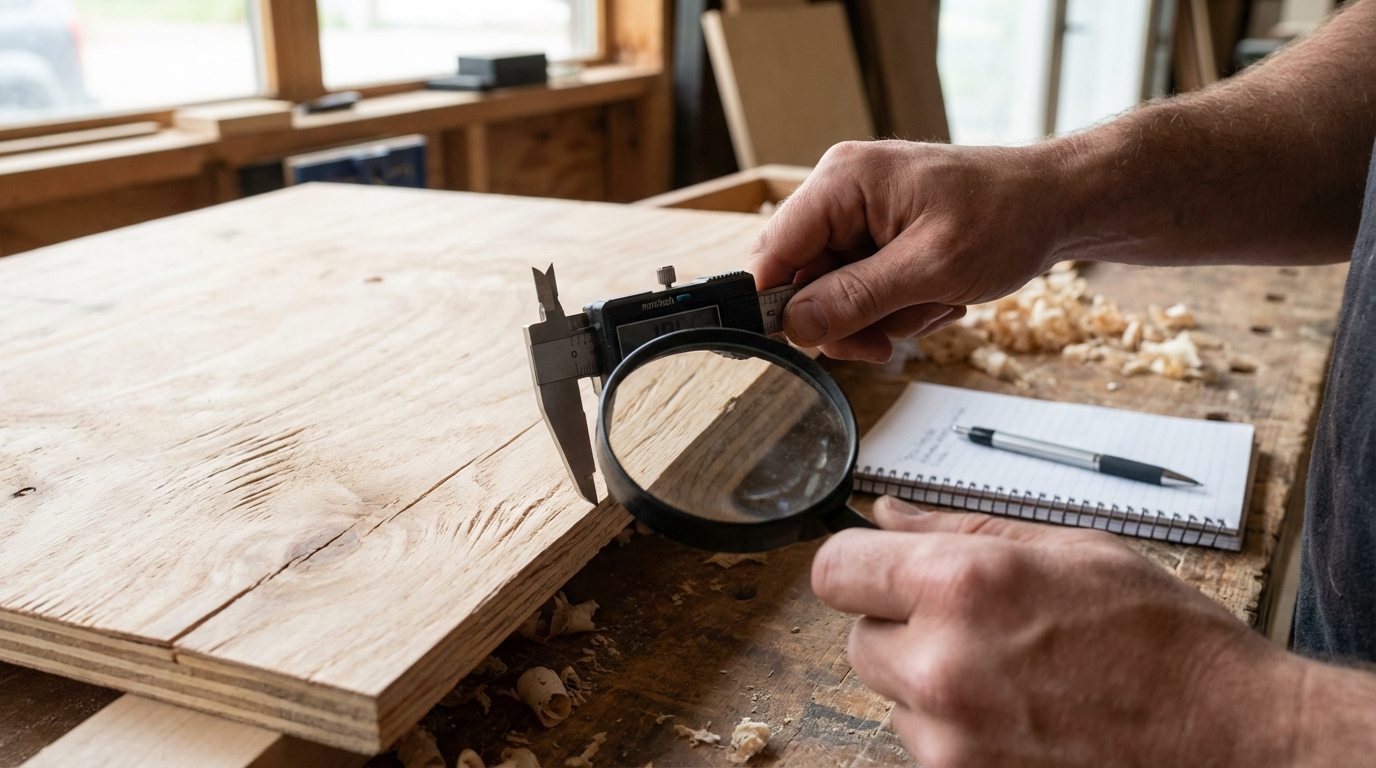
- Confirm Thickness: Cross-measure with caliper; note tolerance.
- Decode Batch/Date: Fresh? Under 6 months preferred.
- Validate CML: Google "BIS CML [number]" or app-check.
- Inspect extras: Veneer grade (e.g., B/BB), core material (poplar/hardwood).
For architects: Photograph labels pre-purchase; share with clients for spec matching.
Additional Markings and What They Reveal
- Face/Back Veneer Grades: BWR-BB means uniform face, minor defects on back. Impacts finish costs—contractors plane B/BB for painting.
- Core Type: Hardwood core stronger but pricier than softwood.
- Termite Treatment: "IS 12076" treatment code for pest resistance in termite-prone Rajasthan.
- Manufacturer Details: Factory address aids local sourcing, reducing transport premiums.
Common Label Red Flags in Indian Markets
Dealers tamper stickers; watch for:
- Faded or peeled labels—hides age.
- Mismatched grade/thickness—e.g., labeled 18mm but measures 16mm.
- Missing CML—90% fakes lack it.
- Non-standard codes—true BWP won't say "waterproof" vaguely.
Scenario: Mumbai contractor rejects MR-labeled sheets for formwork after boil-test fail, saving site delays.
How Labels Guide Cost-Effective Choices
Labels drive value: BWP 18mm costs more upfront but lasts 50+ shuttering pours vs. MR's 10. Homeowners weigh thickness vs. span—over-spec 25mm wastes budget. Regional logic: Coastal buyers demand BWP/CML-verified; dry interiors suffice MR. Always negotiate based on label specs—stronger grades justify premiums from ethical dealers.
| Buyer Type | Label Priority | Decision Logic |
|---|---|---|
| Homeowner | Grade + Thickness | Match room humidity + load |
| Contractor | BIS CML + Batch | Traceability for bulk claims |
| Designer | Veneer + Core | Aesthetic + structural fit |
Quick Verification Tools for Buyers
Use BIS website (bis.gov.in) for CML lookup or apps like "Plywood Checker." On-site: Boil scrap in water—genuine BWP holds layers. Consult local testing labs for high-stakes projects.
Related guides on PlyPrice
Want Plywood Suggestions?
Share a few details and a PlyPrice specialist will suggest suitable brands and connect you to responsive dealers.