Wood Sheet Types: Plywood, MDF, HDF & Particle Board Compared
Compare all wood sheet types - plywood, MDF, HDF, particle board & OSB. Strength, cost & application differences explained. Choose the right board.
Quick Answer: Wood Sheet Types in 30 Seconds
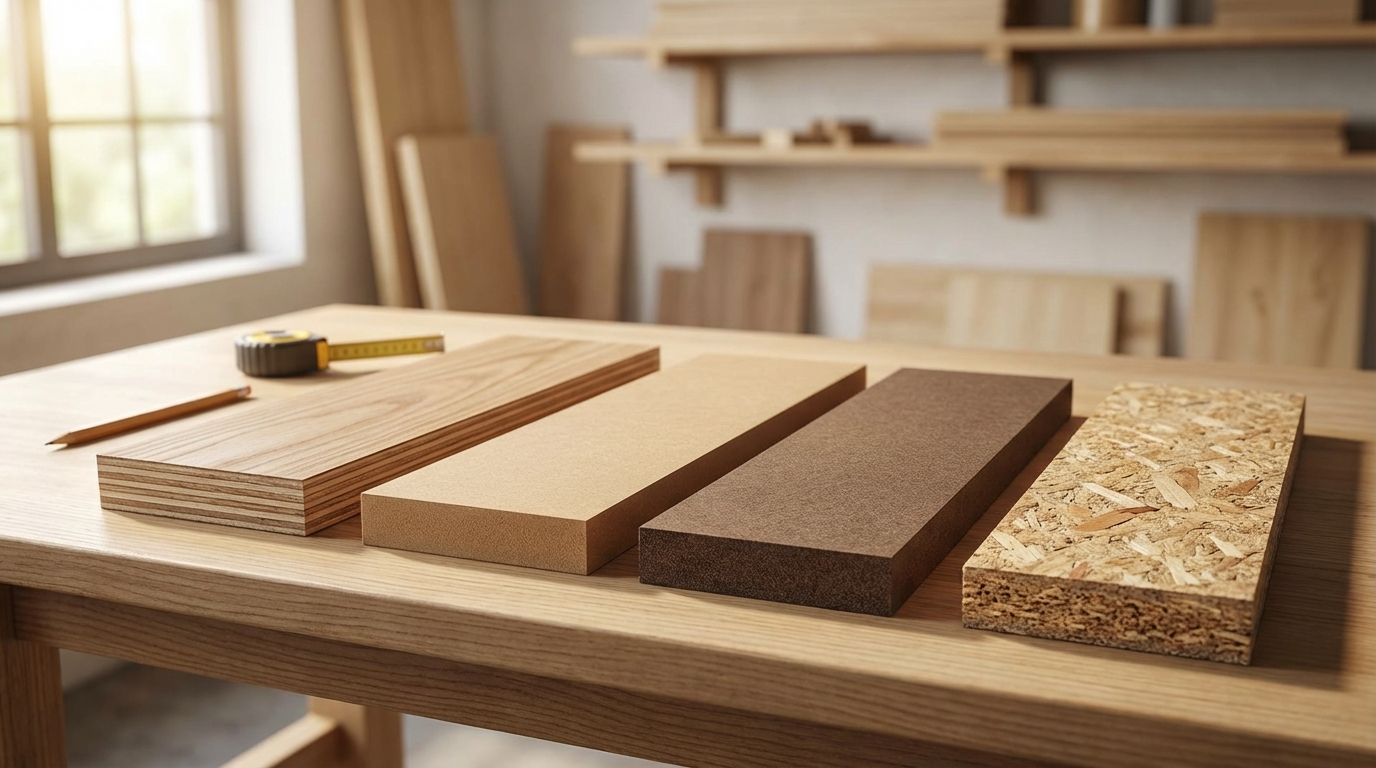
Wood sheets in India fall into five main categories: Plywood (layered veneers bonded together), MDF (medium-density fiberboard from compressed wood fibers), HDF (high-density fiberboard for heavy-duty use), Particle Board (compressed wood chips with resin), and OSB (oriented strand board with cross-layered wood flakes). Plywood is the strongest and most durable among the three main options.
In simple terms: Each wood sheet type offers distinct advantages for Indian homes and budgets. The majority of India has a tropical climate; therefore, the surface has to withstand water, moisture, and heat at some point. According to plyprice.com's research, plywood remains the preferred choice for moisture-prone areas like kitchens (₹45-180 per sq ft), while MDF (₹20-50 per sq ft) excels in decorative applications, and particle board (₹17-40 per sq ft) serves budget-conscious projects effectively.
- Plywood: Cross-laminated wood veneers, strongest screw-holding, best moisture resistance
- MDF: Smooth fiberboard surface, ideal for painting and routing, susceptible to water
- HDF: Denser than MDF, used for flooring and door skins
- Particle Board: Most affordable option, lightweight, limited moisture tolerance
- HDHMR: High moisture-resistant engineered board, kitchen-ready alternative
- OSB: Cross-oriented wood strands, structural applications, limited availability in India
What Exactly Are Wood Sheet Types?
Wood sheets, also called engineered wood panels, are manufactured products created by binding wood fibers, particles, veneers, or strands with adhesives under heat and pressure. Engineered wood products consist of wood materials and adhesives formed with pressure and heat to create alternatives to solid wood. These products often use wood waste from lumber mills, turning these remnants into useful building supplies.
Unlike solid timber, engineered wood sheets offer consistent dimensions, predictable performance, and cost efficiency. In India, these products form the backbone of modular kitchens, wardrobes, TV units, study tables, office furniture, and interior woodwork across residential and commercial spaces.
Plyprice.com's analysis of 100+ brands shows that understanding the manufacturing process helps buyers make informed decisions. The key differentiator between wood sheet types lies in three factors: raw material composition (veneers, fibers, or particles), bonding agent used (phenol formaldehyde, urea formaldehyde, or melamine resin), and the pressing process (temperature, pressure, and duration).
Why Wood Sheet Selection Matters for Indian Homes
The climate of India is such that structures will come into contact with moisture sooner or later. This makes material selection critical. Choosing the wrong board type for kitchens results in swelling, delamination, and premature furniture failure—a costly mistake that plyprice.com helps buyers avoid through comprehensive guidance.
Types of Wood Sheets Available in India
The Indian market offers six primary wood sheet categories, each manufactured differently and suited for specific applications. Plywood gives a solid foundation to a project, but there are other wood boards that get the job done too. Apart from plywood, MDF and particleboard are the most common ones.
| Wood Sheet Type | Full Form | Composition | Price Range (₹/sq ft) | Best Application | Moisture Resistance |
|---|---|---|---|---|---|
| Plywood | N/A (Named for "plies") | Cross-laminated wood veneers | ₹45-180 | Kitchens, Structural Furniture | Good to Excellent (grade-dependent) |
| MDF | Medium Density Fiberboard | Compressed wood fibers + resin | ₹20-50 | Decorative panels, Routing work | Poor (standard) to Moderate (MR grade) |
| HDF | High Density Fiberboard | Highly compressed wood fibers | ₹40-80 | Flooring, Door skins | Moderate |
| HDHMR | High Density High Moisture Resistant | Dense fibers + moisture-resistant additives | ₹60-120 | Kitchen shutters, Bathroom vanities | Good |
| Particle Board | N/A | Wood chips + sawdust + resin | ₹17-40 | Budget furniture, False ceiling | Poor |
| OSB | Oriented Strand Board | Cross-oriented wood strands | ₹25-60 | Sheathing, Packaging, Flooring base | Moderate to Good |
Which Type for Kitchens and Bathrooms?
For kitchens or bathrooms in India, go with MR or waterproof plywood. Standard MDF and particle board fail in high-moisture environments. Go for something that can handle all the kitchen chaos: water, steam, and heat. Waterproof plywood (like BWP) works best here. It'll keep your cabinets from swelling or falling apart over time.
HDHMR boards are widely used for kitchen cabinets, bathroom vanities, and other interior applications where moisture resistance is essential. This makes HDHMR a viable plywood alternative for modular kitchens in humid regions like Kerala, coastal Maharashtra, and Bengal.
Which Type for Wardrobes and Bedrooms?
For wardrobes we recommend MR plywood. However, if you are looking for a budget friendly option, you can opt for MDF or Particleboard too. Since wardrobes face minimal water exposure, moisture-resistant grades work adequately. Pre-laminated particle board (PLPB) offers an economical solution for wardrobe carcasses in dry regions.
Which Type for Commercial and Office Use?
Particle Board is extensively used in commercial and retail furniture due to its affordability. Pre-laminated MDF finds wide application in office partitions, reception counters, and modular workstations where aesthetics matter more than heavy-duty performance. Commercial plywood suits office furniture requiring durability and screw-holding strength for hardware fittings.
Technical Specifications Explained
Understanding technical specifications helps buyers verify quality and select appropriate materials. Plyprice.com recommends checking these parameters before purchase:
| Specification | Plywood | MDF | HDF | HDHMR | Particle Board |
|---|---|---|---|---|---|
| Density (kg/m³) | 500-700 | 600-800 | 800-1000 | 850-950 | 500-750 |
| Standard Sizes (feet) | 8×4, 7×4, 6×4, 6×3 | 8×4, 8×6, 7×4 | 8×4, 7×4 | 8×4 | 8×4, 8×6, 9×6 |
| Common Thickness (mm) | 6, 8, 12, 16, 18, 19, 25 | 2.5, 3, 6, 8, 12, 18, 25 | 2.5, 3, 6, 8 | 8, 12, 16, 18, 25 | 8, 11, 17, 25 |
| Screw Holding | Excellent | Good | Good | Very Good | Poor to Moderate |
| Surface Smoothness | Moderate (veneer texture) | Excellent | Excellent | Very Good | Good (pre-laminated) |
| Relevant ISI Standard | IS:303, IS:710, IS:5509 | IS:12406 | IS:12406 | - | IS:3087 |
As per the latest BIS Standard IS 12406:2021 (Grade 1), MDF is classified as Moisture Resistant (MR) and is ideal for varied Indian climatic conditions. Understanding these standards helps buyers verify genuine products versus counterfeit materials commonly found in unorganized markets.
Top Brands Manufacturing Wood Sheets in India
The Indian wood panel industry features established national brands alongside regional manufacturers. Plyprice.com's pricing database covers 100+ brands across all categories to help buyers compare options effectively.
| Brand | Products Offered | Price Segment | Key Strength | Pan-India Availability |
|---|---|---|---|---|
| CenturyPly | Plywood, MDF, Particle Board, Laminates | Mid to Premium | Wide dealer network, Brand recognition | Yes |
| Greenply/Greenpanel | Plywood, MDF, Pre-laminated boards | Mid to Premium | Strong MDF range, European technology | Yes |
| Action TESA | Particle Board, MDF, HDHMR, HDF Flooring | Budget to Mid | India's largest particle board capacity | Yes |
| VIR (Rushil Decor) | MDF, Pre-laminated MDF, HDHMR, Laminates | Mid | MDF expertise, Wide color options | Yes |
| Merino | Laminates, Compacts, Pre-laminated boards | Mid to Premium | Premium laminate finishes | Yes |
| Kitply | Plywood, Blockboard | Mid to Premium | Assam-based, Hardwood expertise | North/East India focus |
| Austin Plywood | Plywood (BWP, BWR) | Mid to Premium | South India presence, Marine ply focus | South India |
Note: This is independent editorial content. Plyprice.com is not affiliated with any brand mentioned above. Please verify current specifications and prices with authorized dealers.
Common Misconceptions Cleared
The Indian market is rife with confusion about wood sheet terminology and capabilities. Here are the facts that plyprice.com experts clarify most frequently:
Misconception 1: "Waterproof plywood" means completely water-immune.
HDHMR is high moisture resistant, not truly waterproof by default. It performs well in humid interiors and occasional splashes when edges are sealed, but continuous water exposure requires more specialized solutions. Even BWP grade plywood requires proper edge sealing for long-term performance.
Misconception 2: MDF is just cheap plywood.
MDF offers a smooth finish and is easy to work with, but it's heavier and can swell when exposed to water. MDF serves different purposes than plywood—it excels in CNC routing, decorative applications, and painted finishes where its smooth, grain-free surface provides superior results.
Misconception 3: Higher density always means better quality.
Density affects workability and application suitability. High-density boards like HDF suit flooring but become impractical for large furniture due to excessive weight. Selection should match application requirements, not chase highest specifications.
Misconception 4: Particle board always fails quickly.
As a material, its durability may not surpass more than 10 years. Nonetheless, it finds frequent use in ready-made furniture, kitchen wall units, false ceilings, panelling, wall partitions, and the carcases of modular furniture. When kept dry and used within load limits, pre-laminated particle board serves adequately for many years.
Misconception 5: All branded plywood carries ISI certification.
Ensure the ISI number is printed on each sheet, not just mentioned on the invoice. Fake plywood often lacks genuine ISI stamping or displays a wrong code.
Misconception 6: OSB can directly replace plywood in India.
While OSB is widely used in construction for sheathing, subflooring, and roofing and is a cost-effective alternative to plywood with good structural stability, its availability in India remains limited compared to Western markets. Most OSB in India is imported, affecting pricing and consistent supply.
Advantages and Limitations: Honest Assessment
Every wood sheet type has genuine strengths and real weaknesses. As detailed in plyprice.com's materials guide, understanding both helps make practical decisions:
Plywood
Advantages:
- Plywood is made by gluing together thin layers of wood veneer, with the grain of each layer running perpendicular to the one before it. This cross-grain construction gives plywood its strength.
- Superior screw-holding capacity for hardware-intensive furniture
- Available in multiple moisture-resistance grades (MR, BWR, BWP)
- Resists cracking and splitting better than solid wood
- Termite-treated options available for pest-prone areas
- Flexible variants available for curved furniture designs
Limitations:
- Higher cost compared to engineered alternatives (₹45-180/sq ft vs ₹17-50/sq ft)
- Visible edge layers require edge banding or lipping
- Quality varies significantly between organized and unorganized sector products
- Surface may require additional finishing for smooth painted results
MDF
Advantages:
- MDF boards are smooth, easy to paint, and generally used in interior projects.
- No visible grain allows consistent painted finishes
- Excellent for CNC routing and decorative moulding profiles
- Pre-laminated options reduce finishing costs
- Lower environmental impact using recycled wood fibers
Limitations:
- MDF is super smooth and dense, but it doesn't like moisture. Use it only where things are going to stay dry.
- Heavier than equivalent plywood thickness
- Edges absorb moisture rapidly if unsealed
- Limited structural load-bearing capability
- Fine dust during cutting requires proper ventilation
Particle Board
Advantages:
- The price of a Particle Board ranges between ₹17 and ₹40 per sq. ft. – and that makes it perhaps one of the most cost-effective options compared to other materials!
- Due to its low density, Particle Board is comparatively lighter than other core construction materials. It is one of the most inexpensive materials to use for all your home interiors. Made from recycled timber, Particle Board is an environmentally-conscious material.
- Pre-laminated surfaces eliminate separate lamination cost
Limitations:
- It's affordable but less durable and moisture-resistant compared to plywood or MDF.
- Poor screw-holding—repeated screw insertion weakens board structure
- Cannot be used in load-bearing applications
- Swells irreversibly when wet
Best Applications in Indian Homes
Application-wise material selection ensures optimal performance and value. Plyprice.com recommends this room-by-room approach:
| Application Area | Recommended Material | Alternative | Why This Choice | Thickness Guide |
|---|---|---|---|---|
| Kitchen Cabinets (Carcass) | BWR/BWP Plywood | HDHMR | Steam, water exposure daily | 18-19mm |
| Kitchen Shutters | HDHMR or BWR Plywood | Pre-laminated MDF (MR grade) | Moisture + finish quality needed | 18mm |
| Wardrobe Carcass | MR Grade Plywood | PLPB or MDF | Moderate moisture, structural loads | 18-19mm |
| Wardrobe Shutters | Pre-laminated MDF | Plywood with laminate | Smooth finish, design flexibility | 18mm |
| TV Unit | MDF or Plywood | PLPB | Moderate load, aesthetic focus | 18mm (shelves), 12mm (back panel) |
| Study Table | MR Plywood | MDF | Screw holding for hardware | 18-25mm (top) |
| Bed Frame | BWR Plywood | Commercial Plywood | Load-bearing, occasional humidity | 18-19mm |
| False Ceiling | MDF | Particle Board | Lightweight, no moisture contact | 8-12mm |
| Wall Paneling | MDF | Pre-laminated Particle Board | Smooth routing, decorative potential | 8-18mm |
| Bathroom Vanity | BWP Plywood (Marine Grade) | HDHMR (with waterproof laminate) | Direct water splash exposure | 18-19mm |
Regional Climate Considerations
North India (Delhi NCR, Punjab, Haryana, UP): Extreme temperature variations between summers (45°C+) and winters demand dimensionally stable materials. Standard MDF works well. Yamunanagar's proximity makes plywood economically viable.
South India (Chennai, Bangalore, Kerala, Hyderabad): Year-round humidity requires upgraded moisture protection. Even wardrobe carcasses benefit from BWR grade. MR MDF performs better than standard MDF.
Coastal Areas (Mumbai, Kochi, Goa, Vizag): Salt air accelerates moisture damage. BWP plywood or HDHMR with proper edge sealing becomes essential. Avoid standard particle board in coastal homes.
East India (Kolkata, Odisha, Northeast): High humidity during monsoons combined with heavy rainfall makes moisture-resistant grades necessary even for bedroom furniture.
Quality Verification Without Lab Tests
Plyprice.com recommends these practical checks that any buyer can perform without specialized equipment:
For Plywood:
- BWR plywood is manufactured using phenol-formaldehyde resin, giving it the ability to resist boiling water for up to 8 hours. It's ideal for kitchens, semi-wet areas, and moderate exterior use. Check for dark-colored glue lines at edges indicating PF resin.
- Authentic phenol-formaldehyde bonded plywood gives off a strong chemical smell. Fake plywood uses urea-formaldehyde and lacks this distinct odor.
- Examine core layers for gaps, voids, or uneven veneer thickness
- Check ISI marking printed on sheet surface, not just on packaging
- Bend test: Quality plywood shows controlled flex, not cracking sounds
For MDF/HDF/HDHMR:
- Edge inspection: Uniform density without visible layers or gaps
- Weight check: Genuine HDHMR feels noticeably heavier than standard MDF
- Surface test: No visible pits, bumps, or inconsistencies
- Confirm the board category: HDHMR vs MR MDF vs HDF as labeling confusion is common
For Particle Board:
- Pre-laminated surface should resist light scratching
- Edge particle distribution should be uniform
- No unusual chemical odors indicating low-grade resins
Questions to Ask Your Dealer
- Is this ISI certified? Which standard—IS:303, IS:710, or IS:12406?
- What is the core material—Gurjan, Eucalyptus, Poplar, or mixed?
- What adhesive was used—Phenol Formaldehyde (PF) or Urea Formaldehyde (UF)?
- Is this from organized or unorganized sector manufacturing?
- What is the warranty period and claim process?
- Do you have the brand authorization certificate?
- What is the exact thickness after calibration (stated 18mm might be 17.5mm)?
Care, Maintenance, and Longevity
Proper maintenance extends wood sheet lifespan significantly. Based on plyprice.com's material analysis, expected lifespans vary considerably:
Expected Lifespan by Material:
- BWP/Marine Plywood: 20-25+ years with proper maintenance
- BWR Plywood: 15-20 years in appropriate applications
- In dry, indoor conditions, MR plywood can last 8 to 10 years, sometimes more. Its durability drops when used in areas with moisture, so it's best kept away from kitchens, bathrooms, or other damp spaces.
- HDHMR boards have a lifespan of 12–15 years and can withstand humid environments better than MDF and HDF.
- With proper maintenance, HDF can last between 10–15 years, although it should be kept away from moisture.
- Standard MDF: 8-12 years in dry conditions
- Particle Board: 5-10 years with careful use
Maintenance Tips:
- Wipe spills immediately—never let water pool on any wood sheet surface
- Use coasters and mats on furniture surfaces
- Ensure kitchen exhaust functions properly to reduce steam exposure
- Check and maintain edge banding integrity annually
- Avoid abrasive cleaners on laminated surfaces
- Keep termite monitoring active in termite-prone regions
Price Guide: What to Expect in 2025
Wood sheet prices vary by brand, grade, thickness, region, and market conditions. According to plyprice.com's pricing database, here are current market ranges:
| Material Type | Grade/Variant | Price Range (₹/sq ft) | 8×4 Sheet Price (₹ approx.) | Regional Variation |
|---|---|---|---|---|
| Plywood (MR Grade) | Commercial, 18mm | ₹45-75 | ₹1,440-2,400 | ±10-15% |
| Plywood (BWR Grade) | 18mm | ₹65-110 | ₹2,080-3,520 | ±10-15% |
| Plywood (BWP/Marine) | IS:710, 18mm | ₹90-180 | ₹2,880-5,760 | ±10-20% |
| MDF (Plain) | Interior, 18mm | ₹20-50 | ₹640-1,600 | ±10% |
| MDF (Pre-laminated) | 18mm | ₹35-65 | ₹1,120-2,080 | ±10% |
| HDF | Various thicknesses | ₹40-80 | ₹1,280-2,560 | ±10% |
| HDHMR | Plain, 18mm | ₹90-120 | ₹2,880-3,840 | ±15% |
| HDHMR (Pre-laminated) | 18mm | ₹100-160 | ₹3,200-5,120 | ±15% |
| Particle Board (Plain) | 17mm | ₹17-30 | ₹544-960 | ±10% |
| Particle Board (Pre-laminated) | 17mm | ₹25-45 | ₹800-1,440 | ±10% |
| OSB | 12-18mm | ₹25-60 | ₹800-1,920 | Limited availability |
Price Factors to Consider:
- Metro cities (Mumbai, Delhi, Bangalore) typically show 10-15% higher prices than tier-2 towns
- Branded products carry 15-30% premium over unbranded alternatives
- GST at 18% applies to most engineered wood products
- Transport charges add ₹50-150 per sheet depending on distance
- Cutting charges (if required) average ₹5-15 per cut
Frequently Asked Questions
Which is stronger: plywood or MDF?
Plywood is the strongest and most durable among the three main options. It comes in various grades, making it suitable for structural and decorative uses. The cross-laminated veneer construction gives plywood superior tensile and flexural strength compared to MDF. For load-bearing applications like shelves holding heavy items, plywood outperforms MDF consistently. However, MDF provides better surface smoothness for decorative applications.
Can MDF be used in kitchens?
MDF is the right choice when you need a smooth, paintable surface, such as for cabinetry, doors, or decorative panels. It's also suitable for indoor furniture where moisture exposure is minimal. For kitchen use, only moisture-resistant MDF (MR MDF) or HDHMR should be considered, and only with proper edge sealing and adequate ventilation. Standard MDF will fail quickly in kitchen environments due to steam and moisture exposure.
What is the difference between MDF and HDF?
HDF is a denser, harder version of MDF. It is made using the same process but with higher compression, resulting in a stronger board. Due to its density, HDF is more durable and can withstand more wear and tear than MDF. HDF typically has density above 800 kg/m³ compared to MDF's 600-800 kg/m³. HDF suits flooring, door skins, and high-wear applications, while MDF works better for furniture and decorative panels.
Is HDHMR waterproof?
HDHMR boards are an upgraded version of HDF with enhanced moisture resistance, making them suitable for areas prone to humidity. They are produced by using hardwood fibers with added adhesives, which are processed under high pressure to increase durability and moisture resistance. However, HDHMR is moisture-resistant, not waterproof. It handles humidity and occasional splashes well but should not be submerged or constantly exposed to water. Edge sealing remains important.
What is the price difference between plywood and particle board?
Based on plyprice.com's pricing database, 18mm commercial MR plywood costs ₹45-75 per sq ft, while the price of a Particle Board ranges between ₹17 and ₹40 per sq. ft. This makes particle board approximately 40-60% cheaper than equivalent plywood. However, the application should justify this cost saving, as particle board cannot match plywood's strength, moisture resistance, or longevity.
Which brands manufacture HDHMR in India?
Popular brands for HDHMR include Action Tesa, CenturyPly, and Rushil Décor. Other notable manufacturers include Greenpanel and various regional brands. When buying HDHMR, verify the actual board category, as confusion between HDHMR, MR MDF, and HDF is common in the market.
What is BWR and BWP plywood?
BWR denotes boiling water resistant grade plywood, while BWP stands for boiling water proof grade plywood. BWR plywood can handle moisture like steam or occasional spills. BWP plywood, on the other hand, is fully waterproof. It's made for areas that see a lot of water over time, such as bathrooms or outdoor spaces.
What ISI standard applies to marine plywood?
ISI:710 is the Indian Standards Institute certification specifically for BWP-grade plywood. It's the gold standard for waterproof plywood in India. Under Indian Standards, BWP plywood is classified as IS 710. In other words, the plywood is capable of withstanding 72 hours of boiling water.
Is OSB available in India?
OSB (Oriented Strand Board) is a type of engineered wood product commonly used in construction and furniture making. It is made by compressing and bonding together layers of wood strands, using adhesives and resins, in a specific orientation. This construction technique gives OSB board its characteristic strength and stiffness. OSB availability in India remains limited compared to plywood and MDF. Most OSB is imported, making it less economical for typical furniture applications. It finds use primarily in packaging, temporary construction, and niche applications.
How do I identify fake BWP plywood?
The market today is flooded with plywood options labeled as "waterproof", "BWR", or "BWP" — but not all of them are genuine. Many sellers falsely brand commercial-grade or MR plywood as BWR or BWP to command higher prices. As a buyer, it's essential to know how to spot authentic waterproof plywood and avoid fake or substandard sheets. Check for ISI:710 marking on each sheet, dark-colored phenolic glue lines at edges, and request warranty documentation from authorized dealers only.
Which is better for wardrobes: plywood or MDF?
For wardrobe carcasses (structural framework), plywood provides superior screw-holding for hinges and handles. For wardrobes we recommend MR plywood. For wardrobe shutters, pre-laminated MDF offers smoother finish and better routing options for decorative designs. A practical combination uses MR plywood for carcass and MDF or HDHMR for shutters.
What thickness should I use for kitchen cabinets?
Plyprice.com recommends 18-19mm thickness for kitchen cabinet carcasses and shutters. Thinner boards (12mm) suit internal partitions and back panels. Using 12mm for carcasses compromises structural integrity and hardware holding capacity. Premium kitchens may use 25mm for countertop base frames requiring additional support.
Does termite treatment work on MDF?
Greenpanel Exterior Grade MDF offers resistance to termites, borers, and fungus. Many MDF manufacturers now offer termite-resistant variants with chemical treatments. However, plywood's veneer structure accepts termite treatment more effectively than MDF's fiber composition. For termite-prone areas in South and East India, treated plywood remains the safer choice.
What is pre-laminated particle board (PLPB)?
Laminated Particle Board is a pre-laminated particle board created by attaching a thin laminate sheet to the surface of a plain particle board. PLPB eliminates separate lamination costs and labor, making it economical for budget furniture. The laminate layer provides better moisture resistance than plain particle board, though it remains unsuitable for wet areas.
How much do cutting charges add to wood sheet costs?
Cutting charges typically range from ₹5-15 per cut at timber markets and dealer shops. For a standard wardrobe requiring 15-20 cuts, this adds ₹75-300 to material costs. Some dealers include basic cutting in sheet price. CNC cutting for precision work costs ₹15-30 per running foot.
Can particle board be painted?
Its smooth surface accepts paint well, allowing for a wide range of finishes that can easily match any decor style. However, particle board requires proper primer application, and exposed edges must be sealed before painting. Pre-laminated particle board cannot be painted directly—the laminate surface must be removed or appropriately prepared.
Disclaimer: This content is provided for general informational purposes based on industry practices and publicly available information. Product specifications, standards, prices, and availability may vary by manufacturer, region, and time. Readers should independently verify details with manufacturers, dealers, or qualified professionals before making purchase or construction decisions.Want Plywood Suggestions?
Share a few details and a PlyPrice specialist will suggest suitable brands and connect you to responsive dealers.