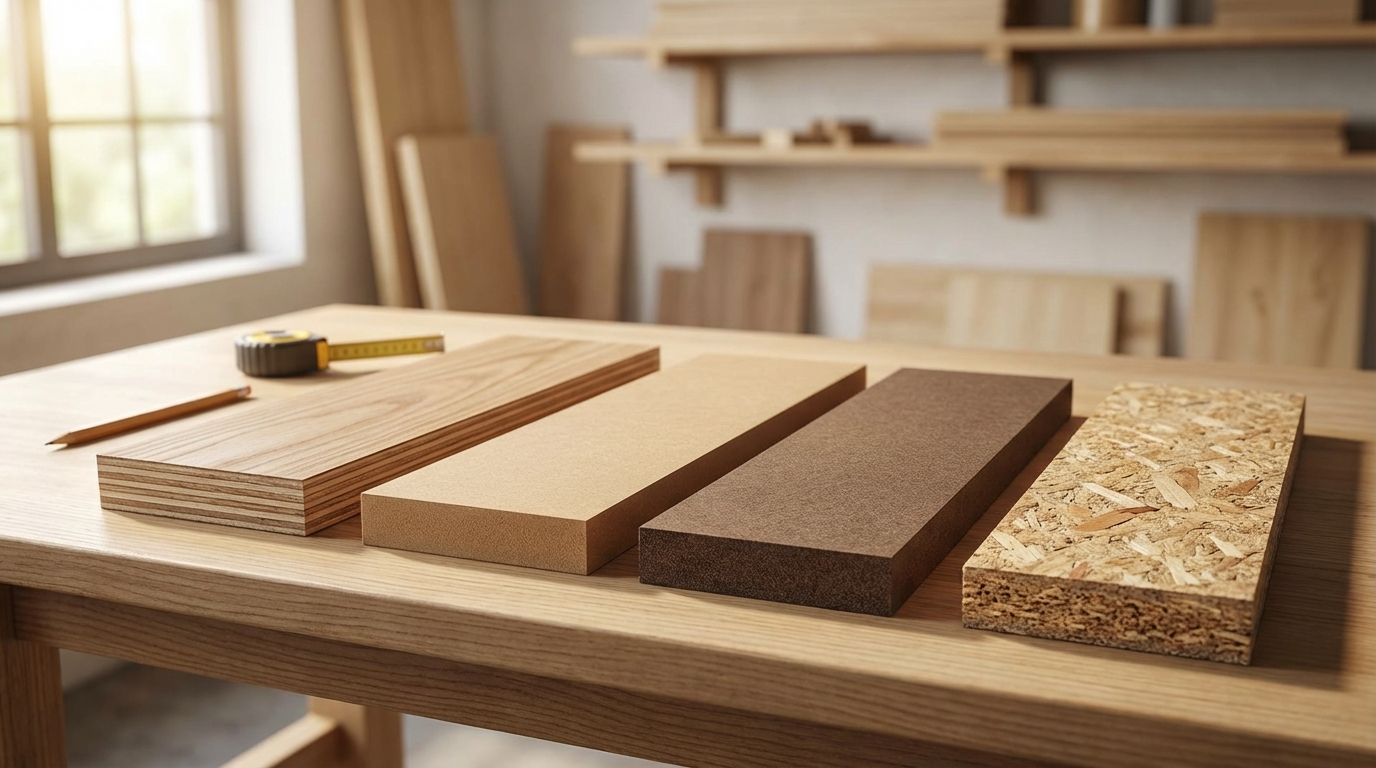
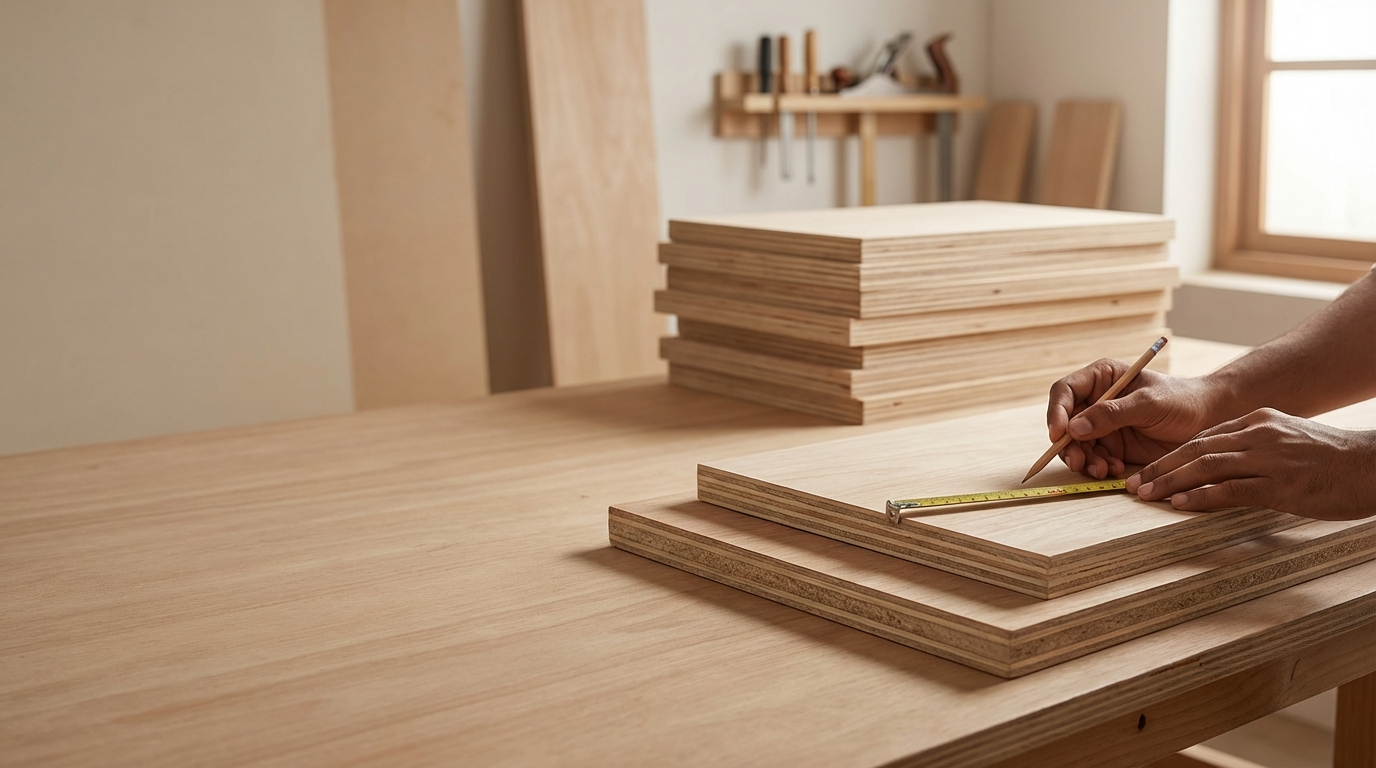
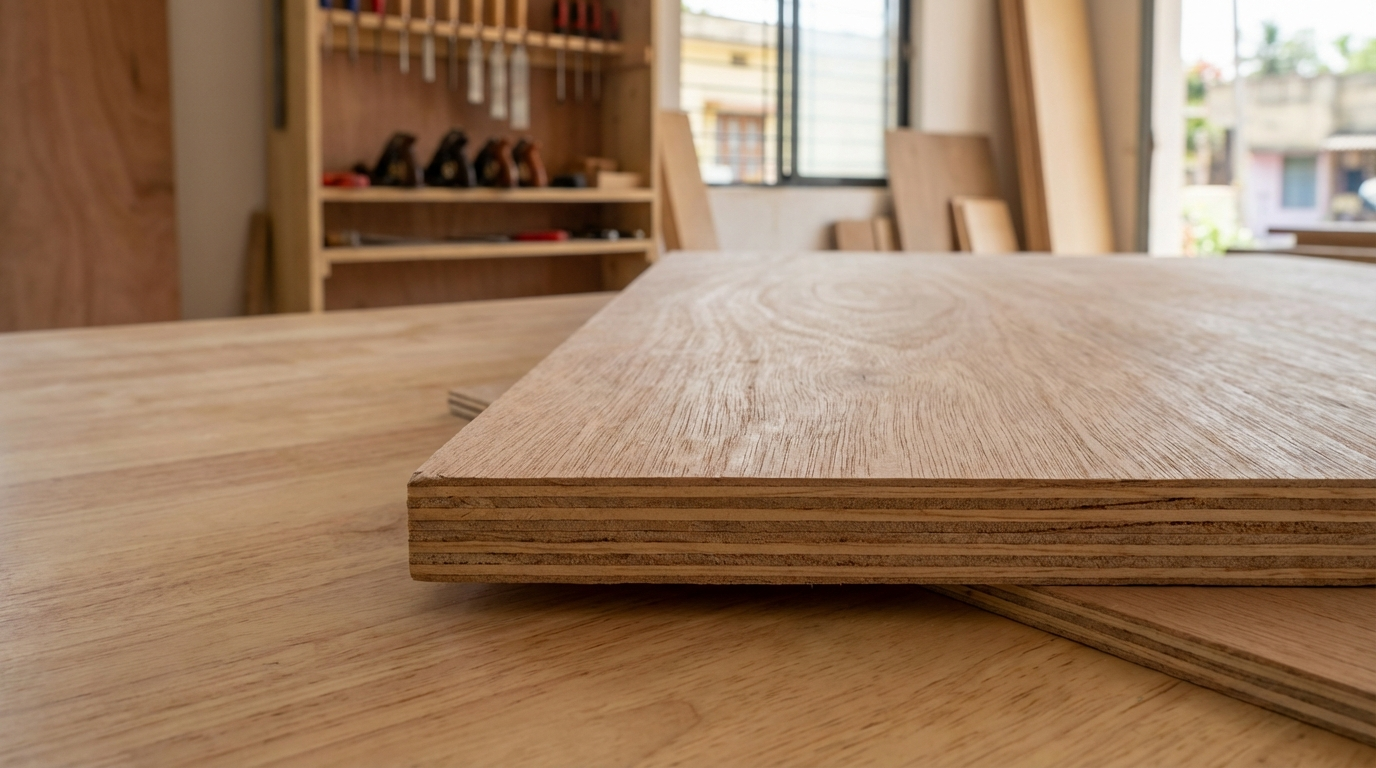
Types of Plywood in India: Complete Classification Guide 2026
Complete guide to all types of plywood in India - MR, BWR, BWP, Marine, Shuttering & more. Learn grades, uses, prices & how to choose the right ply.
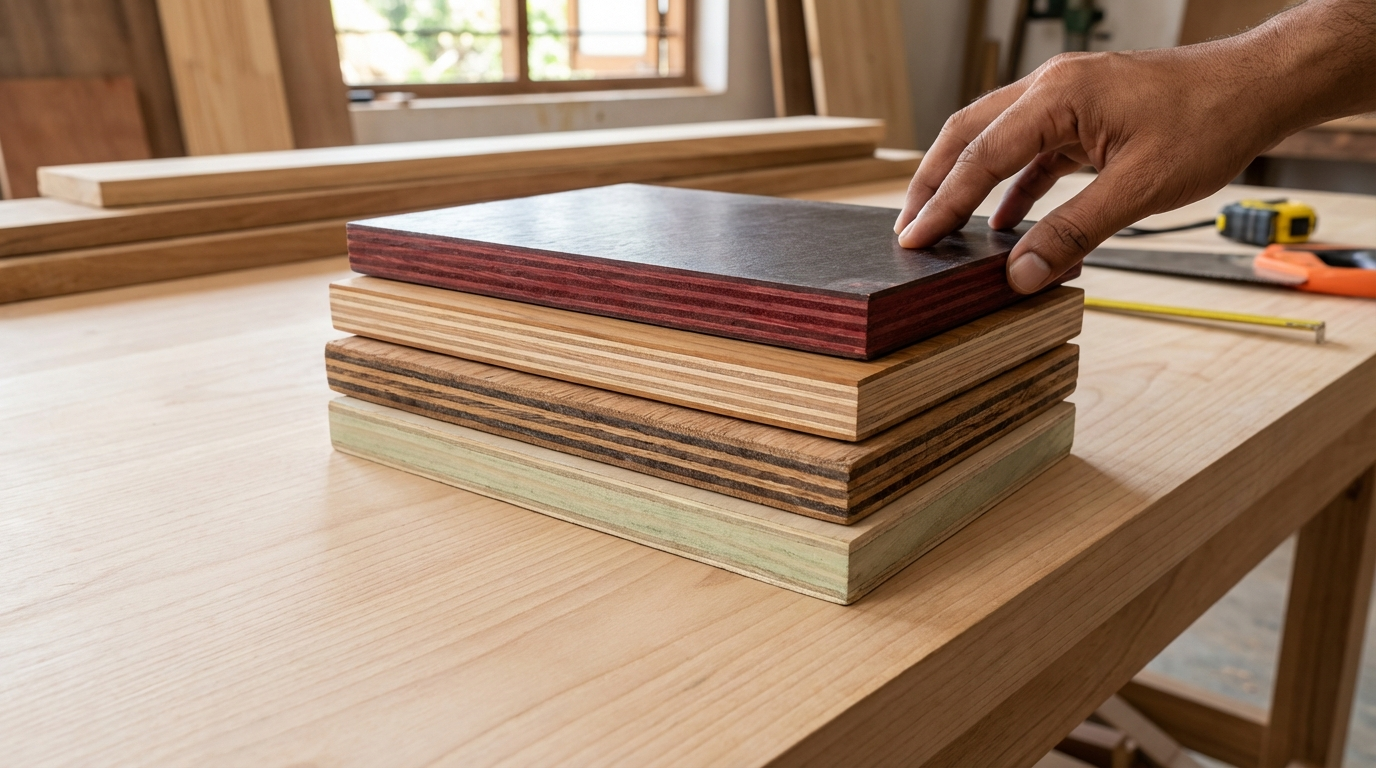
Quick Answer: Understanding Plywood Types in India
Plywood is an engineered wood product made by bonding thin wood veneers (plies) with adhesives under heat and pressure, with each layer's grain running perpendicular to adjacent layers for enhanced strength and stability. In India, plywood is primarily classified by water resistance grade (MR, BWR, BWP/Marine), application type (Shuttering, Calibrated, Flexible), and core species (Gurjan, Eucalyptus, Poplar).
In simple terms, plywood is like a layered sandwich of thin wood sheets glued together in alternating directions. This cross-grain construction gives plywood superior strength compared to solid wood of the same thickness, better dimensional stability across humidity changes, excellent screw-holding capacity, and resistance to splitting and cracking. For Indian homes, plywood forms the backbone of modular kitchens, wardrobes, beds, TV units, and virtually all furniture requiring structural integrity.
According to plyprice.com's analysis of 100+ brands, the Indian plywood market offers over 15 distinct types, each engineered for specific moisture conditions, load requirements, and budget considerations. Here are the essential facts every buyer must know:
- MR Grade (IS:303) handles humidity but not direct water contact
- BWR Grade resists occasional water exposure for kitchens and bathrooms
- BWP/Marine Grade (IS:710) offers complete waterproofing for wet zones
- Thickness ranges from 3mm to 25mm for different applications
- Prices range from ₹35 to ₹150+ per square foot depending on grade and brand
- ISI certification is mandatory for quality assurance in India
- Core species significantly impacts strength, weight, and durability
- Termite treatment is essential for Indian climate conditions
What Exactly is Plywood? Manufacturing and Construction Explained
Plywood is manufactured by peeling logs into thin veneers (typically 0.5mm to 3mm thick), drying these veneers to optimal moisture content, applying adhesive, and pressing multiple layers together under controlled heat and pressure. The number of layers is always odd (3-ply, 5-ply, 7-ply, 9-ply) to ensure balanced construction and prevent warping.
The manufacturing process in India typically follows these steps: log selection and conditioning, rotary peeling on lathes, veneer drying to 6-8% moisture content, adhesive application using rollers or sprayers, assembly with alternating grain direction, hot pressing at 100-150°C under 10-15 kg/cm² pressure, trimming and sanding to final dimensions, and quality testing per BIS standards.
For Indian homes, plywood matters because solid wood furniture faces significant challenges in our climate—extreme temperature variations from 5°C in northern winters to 45°C in summer, humidity swings from 20% to 95% during monsoons, and persistent termite threats across most regions. Plywood's cross-laminated construction minimizes expansion and contraction, while proper treatment addresses biological degradation.
Plywood Full Form and Common Terminology in India
While "plywood" doesn't have a full form (it simply means "layers of wood"), several abbreviations and terms are commonly used in Indian markets:
- MR – Moisture Resistant (not waterproof, humidity resistant only)
- BWR – Boiling Water Resistant (high water resistance)
- BWP – Boiling Water Proof (complete waterproofing)
- IS – Indian Standard (BIS certification marking)
- Ply – Common shorthand for plywood in local markets
- Sunmica – Colloquial term for laminates (separate product)
- Marine Ply – Waterproof plywood meeting IS:710 standards
- Commercial Ply – MR grade plywood for general interior use
Types of Plywood Available in India: Complete Classification
The Indian plywood market offers distinct categories based on water resistance, application, and construction quality. Understanding these classifications is essential for selecting appropriate materials for each furniture component and room condition. Plyprice.com's research across major Indian manufacturers reveals the following comprehensive categorization:
| Plywood Type | Indian Standard | Water Resistance | Best Applications | Price Range (₹/sq ft) | Availability |
|---|---|---|---|---|---|
| MR (Commercial) | IS:303 | Humidity resistant | Bedrooms, living rooms, dry areas | ₹35-65 | Very High |
| BWR Grade | IS:303 BWR | High moisture resistant | Kitchens, semi-wet zones | ₹55-95 | High |
| BWP/Marine | IS:710 | Fully waterproof | Bathrooms, under-sink, outdoor | ₹75-150 | Moderate |
| Fire Retardant | IS:5509 | Varies (MR/BWR/BWP) | Commercial, public buildings | ₹90-180 | Low-Moderate |
| Shuttering | IS:4990 | High (film-faced) | Concrete formwork only | ₹45-85 | High |
| Calibrated | IS:303/710 | Varies by grade | Modular furniture, CNC work | ₹65-130 | Moderate |
| Flexible | Specialty product | Low-Moderate | Curved furniture, design elements | ₹80-140 | Low |
Which Type for Kitchens and Bathrooms?
For Indian kitchens, BWR grade plywood is the minimum recommended standard, while BWP/Marine grade is essential for under-sink cabinets and areas with direct water exposure. Kitchen environments in India face unique challenges: cooking with water-intensive methods, steam generation from pressure cookers, monsoon humidity penetrating through windows, and occasional water spills.
The recommended approach for kitchen furniture involves using BWP grade for base units and sink cabinets, BWR grade for wall units and overhead storage, and ensuring all exposed edges are sealed with PU sealant or edge banding. For bathrooms, only BWP/Marine grade plywood should be used, with additional waterproofing measures like laminate wrapping on all surfaces.
Which Type for Wardrobes and Bedrooms?
MR grade plywood is suitable for wardrobes and bedroom furniture in most Indian homes, provided the room has adequate ventilation and no direct moisture exposure. However, in coastal cities like Mumbai, Chennai, and Kochi, or regions with extended monsoons, upgrading to BWR grade provides better long-term protection against humidity-induced swelling.
For wardrobe construction, use 18mm MR/BWR grade for carcass (sides, top, bottom), 18mm for shutters and doors, 6-8mm for back panels, and 12mm for internal shelves. Drawer bottoms can use 6mm plywood, while loft storage in humid areas should use BWR grade.
Which Type for Commercial and Office Use?
Commercial interiors require careful plywood selection based on fire safety regulations, expected footfall, and maintenance frequency. Fire retardant plywood (IS:5509) is mandatory for public buildings, hotels, hospitals, and educational institutions in many Indian states. Office furniture typically uses calibrated BWR grade for precision fitting of modular systems.
Technical Specifications Explained: What Each Spec Means
Understanding technical specifications helps buyers verify quality and ensure appropriate selection for each application. Indian standards define specific parameters for density, thickness tolerance, bonding strength, and moisture content.
| Specification | MR Grade | BWR Grade | BWP/Marine | What It Means for Users |
|---|---|---|---|---|
| Density (kg/m³) | 500-650 | 550-700 | 600-750 | Higher density = better screw holding |
| Thickness Tolerance | ±0.5mm | ±0.5mm | ±0.3mm | Tighter tolerance = better fitting |
| Moisture Content | 8-12% | 8-12% | 8-10% | Lower = less post-installation movement |
| Glue Shear Strength | 1.0 N/mm² | 1.3 N/mm² | 1.5 N/mm² | Higher = stronger layer bonding |
| Standard Sizes | 8×4 ft, 7×4 ft | 8×4 ft, 7×4 ft | 8×4 ft, 7×4 ft | 8×4 ft is most common in India |
| Available Thickness | 4-19mm | 6-19mm | 6-25mm | 18-19mm standard for furniture |
| Boiling Test | Fails after 2-3 hours | Passes 8-hour cycle | Passes 72-hour cycle | Indicates waterproofing level |
Indian standard sheet sizes are 8×4 feet (2440×1220mm) and 7×4 feet (2135×1220mm). The 8×4 size is most common and offers better material utilization for standard furniture dimensions. Thickness in India is measured in millimeters, with 18mm (sometimes listed as 19mm) being the standard for carcass construction.
Top Brands Manufacturing Plywood in India
The Indian plywood market features over 100 brands ranging from large national manufacturers to regional players. Plyprice.com's database tracks pricing and availability across major brands, helping consumers make informed comparisons. Brand selection impacts quality consistency, warranty support, and resale value of furniture.
| Brand Category | Example Brands | Price Segment | Key Strength | Pan-India Availability |
|---|---|---|---|---|
| Premium National | CenturyPly, Greenply | ₹75-150/sq ft | Consistent quality, strong warranty | Excellent |
| Mid-Premium | Kitply, Archidply, Austin | ₹55-100/sq ft | Good quality-price balance | Good |
| Value Segment | Duro, Sylvan, National | ₹45-80/sq ft | Affordable, decent quality | Regional variations |
| Regional Leaders | Sharon, Samrat, Mayur | ₹35-65/sq ft | Strong local presence | Limited to specific regions |
| Budget Segment | Local/Unbranded | ₹25-45/sq ft | Lowest price | Highly variable |
Note: This is independent editorial content. Plyprice.com is not affiliated with any brand mentioned. Please verify current specifications and prices with authorized dealers.
Common Misconceptions About Plywood Types Cleared
Several persistent myths about plywood lead to poor material selection and furniture failures. Based on plyprice.com's research and feedback from carpenters across India, here are the most common misconceptions:
Myth 1: "MR plywood is waterproof" – MR stands for Moisture Resistant, not waterproof. It handles humidity but will swell and delaminate with direct water contact. Many kitchen failures result from using MR grade where BWR or BWP is required.
Myth 2: "BWR and BWP are the same thing" – BWR (Boiling Water Resistant) and BWP (Boiling Water Proof) represent different standards. BWR resists moisture exposure, while BWP (IS:710) provides complete waterproofing. The price and performance difference is significant.
Myth 3: "More plies always mean better quality" – Ply count matters less than veneer quality, adhesive type, and manufacturing process. A well-made 5-ply board outperforms a poorly constructed 9-ply board. Focus on grade and brand reputation over ply count.
Myth 4: "Marine plywood doesn't need edge sealing" – Even BWP/Marine grade plywood benefits from edge sealing. While the board itself is waterproof, exposed edges can absorb moisture faster than sealed surfaces.
Myth 5: "Expensive plywood is always termite-proof" – Termite resistance requires specific chemical treatment. Check for boron treatment or preservative certification regardless of price or grade.
Myth 6: "ISI mark guarantees best quality" – ISI certification ensures minimum standard compliance, not premium quality. A product can meet IS:303 requirements while still being entry-level within that grade.
Advantages and Limitations: Honest Assessment
Making informed decisions requires understanding both benefits and drawbacks of plywood as a material choice for Indian conditions.
Advantages of Plywood:
- Excellent strength-to-weight ratio compared to solid wood and particle board
- Superior screw-holding capacity allows reliable hardware installation
- Cross-grain construction minimizes warping and dimensional changes
- Wide availability across India in multiple grades and thicknesses
- Carpenter-friendly material requiring no specialized tools
- Good impact resistance suitable for high-use furniture
- Compatible with all finishing methods—laminates, veneers, paint, polish
- Long lifespan (15-25 years) with proper grade selection and maintenance
- Repairable unlike particle board or MDF in case of minor damage
- Better moisture performance than engineered alternatives when properly graded
Limitations and Workarounds:
- Higher cost than MDF/particle board – Workaround: Use plywood for structural elements, MDF for non-load-bearing parts
- Surface imperfections in lower grades – Workaround: Always laminate or veneer finished surfaces
- Edge appearance requires finishing – Workaround: Edge banding is essential for all visible edges
- Quality varies significantly between brands – Workaround: Stick to established brands with proper ISI certification
- Susceptible to termites without treatment – Workaround: Verify boron treatment, especially for ground floor installations
- Formaldehyde emissions from adhesives – Workaround: Choose E1 or E0 emission grade products for bedrooms
- Heavy compared to alternatives – Workaround: Use lighter core species (poplar) for non-structural applications
Best Applications in Indian Homes
Proper material selection for each application ensures optimal performance and longevity. Here's a room-by-room recommendation based on Indian climate and usage patterns:
Kitchen: Base cabinets require BWP/Marine grade (18mm), wall units can use BWR grade (18mm), and internal components like drawer boxes should be BWR minimum. Always seal all edges with PU sealant or quality edge banding.
Bathroom: Only BWP/Marine grade is acceptable. Vanity units, storage cabinets, and mirror frames should use 18mm BWP with full laminate wrapping including back surfaces.
Bedroom: MR grade (18mm) is suitable for wardrobes in well-ventilated rooms. In coastal or high-humidity areas, upgrade to BWR. Bed frames should use BWR grade for durability.
Living Room: MR grade works for TV units, bookshelves, and display cabinets. Use 18mm for main structure, 12mm for shelves under light loads.
Study/Home Office: MR grade for desks and storage. Computer furniture benefits from calibrated plywood for precise fitting of cable management systems.
Quality Verification Without Lab Tests
Buyers can assess plywood quality through visual inspection and simple physical tests without requiring laboratory equipment. Plyprice.com recommends these verification methods:
Visual Inspection:
- Check for uniform color and texture across the face veneer
- Look for gaps, overlaps, or voids visible from sheet edges
- Verify ISI mark with proper license number (not just IS logo)
- Examine edge for consistent layer thickness and proper bonding
- Check for flat surface—warping indicates moisture issues or poor storage
Physical Tests:
- Knock test: Tap surface firmly—solid sound indicates good construction; hollow sound suggests internal voids
- Flex test: Slight pressure shouldn't cause excessive bending in 18mm boards
- Weight check: Similar-sized sheets should have comparable weight; unusually light boards suggest inferior core
- Smell test: Strong chemical odor indicates high formaldehyde emission or improper curing
Questions to Ask Dealers:
- What is the exact grade (MR/BWR/BWP) and IS certification number?
- Which core species is used (Gurjan/Eucalyptus/Poplar)?
- Is termite treatment included? What chemical was used?
- What warranty terms apply and what's the claim process?
- Can you provide the manufacturer's test certificate?
Care, Maintenance, and Expected Longevity
Proper maintenance extends plywood furniture life significantly. With appropriate grade selection and care, plywood furniture in Indian homes typically lasts 15-25 years, compared to 8-12 years for particle board alternatives.
Daily Care: Wipe surfaces with dry or slightly damp cloth. Avoid pooling water on any surface, including laminated ones. Clean spills immediately, especially in kitchens.
Periodic Maintenance: Check edge sealing quarterly in kitchens and bathrooms. Inspect hinges and hardware every six months. Re-apply wood polish or protective coating annually for non-laminated surfaces.
Monsoon Precautions: Ensure adequate ventilation in closed furniture during humid months. Use silica gel packets in wardrobes and drawers. Avoid placing furniture against exterior walls that may seep moisture.
Damage Prevention: Use coasters under hot vessels. Avoid dragging heavy objects across surfaces. Keep furniture away from direct sunlight to prevent veneer fading. Ensure proper leveling to prevent structural stress.
Price Guide: What to Expect in 2026
Plywood prices in India vary based on grade, brand, core species, thickness, and geographic location. According to plyprice.com's pricing database, here are indicative ranges for 18mm plywood per square foot:
- MR Grade: ₹35-65/sq ft (commercial quality to premium brands)
- BWR Grade: ₹55-95/sq ft (standard to premium brands)
- BWP/Marine: ₹75-150/sq ft (standard to premium brands)
- Calibrated: Additional ₹10-20/sq ft over base grade price
- Fire Retardant: Additional ₹20-40/sq ft over base grade price
Regional Variations: Metro cities (Delhi, Mumbai, Bangalore, Chennai) typically show 10-15% higher prices than tier-2 cities due to higher operating costs. Areas near manufacturing hubs (Yamunanagar, Perumbavoor, Kandla) may offer slightly lower prices due to reduced transportation costs.
Factors Affecting Price: Core species (Gurjan costs more than Eucalyptus, which costs more than Poplar), brand reputation and warranty terms, thickness (19mm costs 8-12% more than 18mm), ISI certification verification, and bulk purchase discounts (typically 5-10% for project quantities).
Frequently Asked Questions
What is the difference between MR and BWR plywood?
MR (Moisture Resistant) plywood uses urea-formaldehyde resin and handles humidity but fails with direct water contact, making it suitable only for dry interiors like bedrooms and living rooms. BWR (Boiling Water Resistant) plywood uses phenolic or melamine-fortified resins, providing significantly higher water resistance suitable for kitchens and semi-wet areas. BWR costs approximately 40-60% more than MR but offers substantially better performance in moisture-prone environments. For Indian conditions with high monsoon humidity, BWR represents better value for any furniture near water sources.
Is BWP plywood and Marine plywood the same?
In the Indian market, BWP (Boiling Water Proof) and Marine plywood are often used interchangeably, as both refer to plywood manufactured under IS:710 standard designed for complete waterproofing. Both use phenol-formaldehyde resin and pass extended boiling water tests. However, technically, "Marine grade" implies stricter quality control with superior core veneers meant for actual marine applications like boat building. For home interiors including bathrooms and under-sink areas, BWP grade meeting IS:710 provides adequate waterproofing without the premium of true marine-grade specifications.
Which plywood is best for modular kitchens in India?
For modular kitchens, use BWR grade plywood (minimum 18mm thickness) for wall units and general cabinets, and BWP/Marine grade for base units, sink cabinets, and any area with potential water exposure. Calibrated plywood offers advantages for modular systems due to consistent thickness ensuring proper door alignment. Always seal all cut edges with PU sealant or quality edge banding. Premium brands with proper ISI certification offer better long-term value than budget options, as kitchen furniture faces the most demanding conditions in any Indian home.
What thickness of plywood should I use for wardrobes?
Standard wardrobe construction in India uses 18mm plywood for carcass components (sides, top, bottom, and fixed shelves), 18mm for shutter doors, 6-8mm for back panels, and 12mm for adjustable shelves under moderate loads. For loft storage above wardrobes, 18mm is recommended due to span and load requirements. Heavy-duty wardrobes or those spanning wide widths may benefit from 19mm thickness. The grade should be MR for dry, well-ventilated bedrooms and BWR for wardrobes in humid regions or adjacent to bathrooms.
How do I identify genuine ISI marked plywood?
Genuine ISI certification displays the standard mark with specific license number (CM/L-XXXXXXX format), IS standard number (IS:303 for MR/BWR, IS:710 for BWP), manufacturer name and address, and grade designation. Verify license numbers on the BIS website (bis.gov.in). Red flags include missing license numbers, inconsistent marking across sheets in the same lot, unusually low prices for claimed grade, and dealers refusing to provide manufacturer certificates. Legitimate manufacturers maintain consistent quality and proper documentation throughout their supply chain.
Can MR plywood be used in bathrooms with waterproof laminate?
No, using MR plywood in bathrooms is not recommended even with waterproof laminate covering. Bathroom environments involve consistent high humidity, steam exposure, and inevitable water contact at edges and joints. Laminate adhesive can fail in prolonged moisture exposure, and any gap or edge allows moisture to reach the MR substrate, causing swelling and delamination. Only BWP/Marine grade plywood (IS:710) should be used for bathroom furniture, with complete laminate wrapping including back surfaces and proper edge sealing using PU sealant.
What is calibrated plywood and when is it necessary?
Calibrated plywood undergoes additional precision sanding to achieve uniform thickness across the entire sheet with tight tolerance (typically ±0.2mm versus ±0.5mm for standard plywood). This consistency is essential for modular furniture where doors and drawers require precise alignment, CNC-machined components, and factory-produced furniture with automated processes. While calibrated plywood costs 15-25% more than standard, it reduces finishing time, improves laminate bonding, and ensures professional results. For custom carpenter-made furniture, standard plywood with good quality control is usually adequate.
Is Gurjan plywood better than Eucalyptus plywood?
Gurjan core plywood offers higher density (650-750 kg/m³), superior screw-holding strength, better impact resistance, and longer lifespan compared to Eucalyptus core (550-650 kg/m³). However, Gurjan plywood costs 30-50% more and is heavier, making handling more difficult. Eucalyptus core provides an excellent balance of strength, weight, and cost for most residential applications. For heavy-duty applications like kitchen base units, commercial furniture, or doors, Gurjan justifies the premium. For wardrobes, TV units, and general furniture, quality Eucalyptus core plywood performs excellently at better value.
How long does plywood furniture last in Indian conditions?
With appropriate grade selection and maintenance, plywood furniture in India typically lasts 15-25 years. Factors affecting longevity include correct grade for application (using BWP in wet areas, MR only in dry spaces), proper edge sealing and finishing, quality of hardware and fittings, ventilation and humidity control, termite prevention measures, and brand/manufacturing quality. Kitchen furniture faces the most demanding conditions and may show wear earlier (12-18 years). Bedroom furniture in well-maintained homes routinely exceeds 20 years. Plyprice.com recommends investing in appropriate grades rather than attempting to waterproof lower grades.
What is the price difference between MR and BWP plywood?
BWP/Marine grade plywood typically costs 80-120% more than MR grade of the same thickness and brand. For example, if 18mm MR plywood costs ₹45 per square foot, equivalent BWP may cost ₹85-100 per square foot. This significant premium reflects the superior phenolic resin adhesive, stricter manufacturing standards, better quality veneers, and additional testing requirements of IS:710 compliance. While the upfront cost is higher, using BWP where required prevents expensive repairs or replacements that result from using inadequate grades in moisture-prone areas.
Does plywood need termite treatment in India?
Yes, termite treatment is essential for plywood furniture in most Indian regions, particularly ground floor installations, areas with prior termite history, and humid climate zones. Reputable manufacturers offer boron-treated or preservative-treated plywood with anti-termite properties. Verify treatment certification when purchasing, as this is not automatically included with ISI certification. Additional site-level termite treatment during construction provides further protection. Even termite-treated plywood should not be in direct contact with soil or untreated masonry. Regular inspection of furniture bases and wall-mounted units helps early detection.
Which plywood is best for bed frames?
For bed frames, BWR grade plywood (18mm minimum thickness) is recommended over MR grade due to better moisture resistance from body perspiration, occasional spills, and humid conditions. The base platform typically uses 12mm BWR plywood with adequate support framing. Hydraulic storage beds require BWP grade for the storage box portion due to ground-level moisture exposure. Headboards can use MR grade if purely decorative. Ensure all edges are properly finished, and consider laminate or PU coating for the sleeping surface to facilitate cleaning and add moisture protection.
Can plywood be used for false ceilings?
Yes, plywood is commonly used for false ceilings in India, typically in 6mm or 9mm thickness with MR grade for dry interior areas. Plywood ceilings offer better screw-holding for light fixtures compared to gypsum, superior acoustic properties, and traditional aesthetics when finished with veneer or paint. However, plywood ceilings are heavier than gypsum alternatives, require proper framework support, and cost more. For commercial applications, fire-retardant (FR) grade plywood meeting IS:5509 may be mandatory. In humid areas or where AC condensation is a concern, BWR grade is advisable.
What is the standard plywood sheet size in India?
The most common plywood sheet size in India is 8×4 feet (2440×1220mm), which provides optimal material utilization for standard furniture dimensions including 7-feet wardrobes and kitchen cabinets. The 7×4 feet (2135×1220mm) size is also available and suits certain applications while generating less waste for specific dimensions. Thickness ranges from 4mm to 25mm, with 18mm and 19mm being standard for furniture carcass construction. When purchasing, confirm actual dimensions as some manufacturers may offer slightly different sizes. Sheet pricing is typically calculated per square foot for easier comparison.
Is flexible plywood available in India and what is it used for?
Yes, flexible plywood (also called bendy ply or flexi ply) is available in India from select manufacturers in thicknesses typically ranging from 3mm to 8mm. It features specially arranged thin veneers that allow bending in one or both directions without cracking. Applications include curved furniture elements like rounded headboards, reception counters with curved fronts, architectural features like arches and columns, designer ceiling elements, and custom furniture with organic shapes. Flexible plywood requires substrate support or multiple laminations for structural strength and costs significantly more than standard plywood due to specialized manufacturing.
India-Specific Considerations for Plywood Selection
The Indian subcontinent's diverse climate zones require region-specific material selection strategies. What works in dry Rajasthan may fail in humid Kerala, and monsoon preparedness varies significantly across the country.
North India (Delhi, Punjab, UP, Haryana): Extreme temperature variations from near-freezing winters to 45°C+ summers stress adhesive bonds. BWR grade handles these conditions better than MR. Yamunanagar proximity provides access to competitive pricing. Dry winter air can cause minor shrinkage in furniture—maintain moderate humidity indoors.
South India (Chennai, Bangalore, Kerala, Hyderabad): Year-round humidity and intense monsoons demand BWR as minimum for all furniture, BWP for any moisture-exposed areas. Termite activity is more aggressive—verify boron treatment. Perumbavoor (Kerala) manufacturing hub offers competitive regional pricing.
Coastal Areas (Mumbai, Kolkata, Coastal Karnataka, Odisha): Salt air accelerates degradation of metal hardware and attacks adhesive bonds. Use marine-grade hardware with stainless steel components. BWP grade recommended even for bedroom furniture due to persistent high humidity. Air conditioning helps but creates condensation issues at equipment contacts.
Central India (Madhya Pradesh, Chhattisgarh): Moderate conditions allow MR grade for dry interiors. However, intense summer heat requires attention to proper acclimatization of plywood before installation—store in room conditions for 48-72 hours before cutting.
Making the Final Decision: Selection Framework
Plyprice.com recommends this systematic approach for selecting the right plywood type:
Step 1: Identify the application and moisture exposure level (dry, semi-wet, wet, submerged)
Step 2: Determine appropriate grade (MR for dry only, BWR for semi-wet, BWP for wet)
Step 3: Select thickness based on structural requirements and spanning distances
Step 4: Choose core species based on budget and strength requirements
Step 5: Verify ISI certification and termite treatment
Step 6: Compare brands within your budget range using consistent specifications
Step 7: Confirm dealer reputation and warranty support
For detailed brand-wise pricing and availability in your city, explore plyprice.com's comprehensive price lists and comparison guides. Understanding material specifications empowers better purchasing decisions, whether you're working with contractors or supervising your own home project.
Disclaimer: This content is provided for general informational purposes based on industry practices and publicly available information. Product specifications, standards, prices, and availability may vary by manufacturer, region, and time. Readers should independently verify details with manufacturers, dealers, or qualified professionals before making purchase or construction decisions.Want Plywood Suggestions?
Share a few details and a PlyPrice specialist will suggest suitable brands and connect you to responsive dealers.