Transport Cost Impact on Plywood Pricing
The hidden cost. Analyzing how fuel prices and freight charges influence the final retail price of plywood across different Indian states.
Unveiling the Hidden Transport Costs Shaping Plywood Pricing
Plywood reaches construction sites and furniture workshops through a complex logistics network that often accounts for a substantial portion of its final cost. In India, where production clusters around specific timber-rich regions, the journey from factory to buyer involves long hauls across diverse terrains, fluctuating fuel rates, and variable toll structures. This transport layer—frequently overlooked by end-users—directly dictates why a sheet of BWR-grade plywood might carry a noticeable premium in one state compared to another. Understanding these dynamics empowers contractors, interior designers, and homeowners to interpret price quotes more astutely and negotiate effectively within regional realities.
Fuel Prices as the Primary Driver of Plywood Freight Expenses
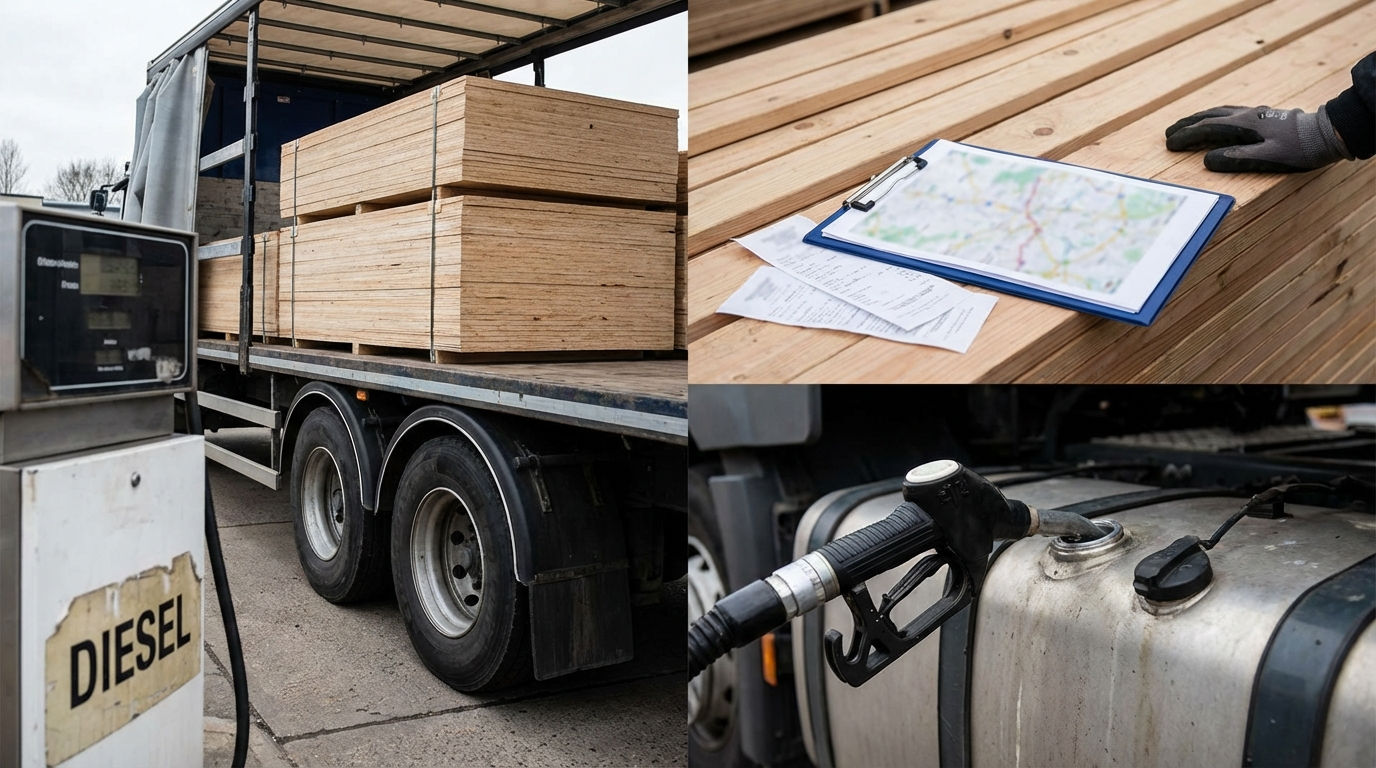
Diesel, the lifeblood of India's road transport fleet, forms the largest variable in plywood delivery costs. Trucks hauling full loads of plywood sheets—typically 18mm or 12mm thick, stacked in 40-50 sheet bundles—weigh heavily, amplifying fuel consumption per kilometer. A standard 20-tonne truck covering 500km might burn 200-300 liters of diesel, depending on load distribution, road conditions, and vehicle efficiency.
State-specific diesel pricing, influenced by central excise duties, state VAT (ranging 20-30%), and dealer margins, creates uneven baselines. As of late 2025, rates span from around ₹88 per liter in northern metros like Delhi to over ₹108 in southern states such as Andhra Pradesh. This variance alone can shift freight bills by 15-20% on inter-state routes.
| State/Region | Approx. Diesel Price (₹/liter, Dec 2025) | Impact on Long-Haul Freight |
|---|---|---|
| Delhi/NCR | ₹87-₹95 | Lower baseline for northern routes |
| Haryana (Yamunanagar hub) | ₹92-₹98 | Favorable for North India supply |
| Kerala/Karnataka | ₹95-₹102 | Higher for southern exports |
| Andhra Pradesh | ₹105-₹109 | Premium on eastward shipments |
| Assam/Northeast | ₹98-₹103 | Compounded by terrain challenges |
For a plywood consignment traveling 1,000km from a Yamunanagar factory to Tamil Nadu, a ₹10-15 per liter diesel differential could add ₹20,000-₹30,000 to the trucker's outlay. Manufacturers and dealers pass this on proportionally, often embedding it as 5-10% of the sheet's base mill price. In monsoon-prone seasons, detours or idling at weighbridges further inflate consumption, pushing costs higher.
Dissecting Freight Charges and Ancillary Logistics Fees
Beyond fuel, freight encompasses fixed components like driver wages (₹1,500-₹2,500/day), truck hire (₹25-₹50/km for 16-20 tonne capacity), and loading/unloading labor (₹5,000-₹10,000 per full truckload). Plywood's flat, rigid profile demands specialized strapping and ventilation to prevent warping, adding to handling expenses.
Toll plazas, numbering over 900 on national highways, extract another layer: a Delhi-Chennai run might incur ₹15,000-₹25,000 in fees, equivalent to 10-15% of total freight. FASTag has streamlined collections, but peak-hour queues still erode efficiency. Rail options exist for bulk moves—cheaper at ₹1-2/km/tonne versus road's ₹2-4/km/tonne—but plywood's low density and damage risks limit their use to 10-15% of volume.
- Full Truck Load (FTL) vs. Less Than Truck Load (LTL): FTL dominates plywood (₹1.5-₹3/km/tonne), while LTL for smaller orders spikes to ₹4-₹6/km/tonne due to consolidation delays.
- Seasonal Surges: Post-monsoon construction booms in October-March elevate rates by 20-30% amid truck shortages.
- Insurance and Documentation: Transit insurance (0.5-1% of cargo value) and GST on freight (5-12%) compound the bill.
From first principles, plywood's value density—low per cubic meter compared to steel—makes transport sensitivity acute: a 20% logistics hike erodes thin mill-gate margins, forcing retail adjustments.
Regional Disparities: How Distance from Hubs Amplifies Pricing
India's plywood ecosystem clusters production: Yamunanagar (Haryana) for poplar-based commercial grades; Kerala and Karnataka for rubberwood and teak veneers; Assam for softwood variants; Punjab and Gujarat as secondary nodes. Buyers distant from these hubs bear the brunt.
Northern markets (Delhi, UP, Punjab) enjoy proximity advantages, with transport adding just 5-10% to ex-factory costs. Southern consumers sourcing from the North face 20-30% premiums due to 1,500-2,000km hauls across the Deccan. Conversely, Kerala mills supply Mumbai/Chennai at 10-15% uplift, but Northeast deliveries from South balloon to 40%+ amid hilly routes.
| Production Hub | Key Supply States | Typical Distance (km) | Est. Transport Add-On (% of Mill Price) |
|---|---|---|---|
| Yamunanagar (Haryana) | Delhi, UP, Bihar | 200-800 | 5-15% |
| Yamunanagar | Maharashtra, Karnataka | 1,200-1,800 | 20-30% |
| Kerala/Karnataka | Tamil Nadu, AP | 400-900 | 8-18% |
| Kerala | North-East (Assam) | 2,500+ | 30-50% |
| Assam | West Bengal, Bihar | 500-1,200 | 12-25% |
Dealers in tier-2 cities like Jaipur or Bhubaneswar often blend local and distant stock, blending costs. Contractors in remote areas like J&K or Odisha see marine or shuttering plywood quotes swell disproportionately, as specialized grades ship in smaller volumes.
From Freight Bill to Retail Shelf: The Pricing Cascade
Mill-gate pricing covers raw materials (60-70%), processing (20-25%), and overheads, leaving slim room for logistics absorption. Transporters invoice dealers at 8-15% of invoice value for standard routes, scaling to 25%+ for extremes. Dealers, holding 15-30 day inventory, mark up 10-20% to cover their risks, passing 70-80% of transport escalation to buyers.
Consider a hypothetical 18mm MR plywood sheet: base mill cost uniform at ₹X/sqft. A 1,000km freight add-on of ₹Y/truck (40 sheets) translates to ₹Y/40 per sheet, or 5-8% uplift. Compounded by fuel spikes—e.g., 2025's 8% industry-wide price rise partly logistics-driven—retail variance emerges: North India 10-15% below South for equivalent specs.
Homeowners budgeting for wardrobes undervalue this; architects specifying ISI-marked BWP grades must factor interstate sourcing. Dealers in high-cost zones push volume grades from nearby hubs, sometimes compromising on veneer quality.
Buyer Strategies to Navigate Transport-Driven Price Fluctuations
Armed with logistics awareness, stakeholders can optimize:
- Source Locally: Prioritize hubs—e.g., Yamunanagar for North, Perumbavoor (Kerala) for South—to cap add-ons at 10%.
- Bulk and Consolidate: Contractors ordering 500+ sheets negotiate FTL rates 15-20% below spot; group purchases via dealer networks.
- Monitor Fuel Cycles: Time buys post-diesel dips (often monthly); use apps for real-time rates.
- Alternative Modes: Rail for 1,000km+ hauls saves 30-40%; inland waterways in East India emerging.
- Verify Quotes: Demand breakdown: insist on ex-mill + freight transparency to spot padded logistics.
Interior designers for high-rises should audit supplier routes via Google Maps, estimating tolls independently. In dealer ecosystems, volume commitments unlock mill-direct delivery, bypassing intermediary markups.
Emerging Trends and Long-Term Logistics Shifts
India's infrastructure push—Bharatmala highways, Gati Shakti—promises 10-20% freight deflation by 2030 via shorter routes and reduced idling. Electric trucks, though nascent, could slash fuel volatility; pilot fleets in Karnataka hubs signal change. Yet, rising tolls (3-5% annual hikes) and climate disruptions (flooded roads) pose counter-risks.
Branded players like those from Greenply or CenturyPly invest in regional plants, localizing supply to mute transport swings. Importers from Nepal/Vietnam face sea freight volatility, indirectly pressuring domestic prices. Buyers tracking Logistics Performance Index (LEADS) state rankings—Karnataka/TN lead—gain predictive edge.
Ultimately, transport's "hidden cost" underscores plywood as a regional commodity: uniform specs, divergent economics. By dissecting these mechanics, decisions align with actual value, sidestepping illusory bargains from distant low-quotes.
Want Plywood Suggestions?
Share a few details and a PlyPrice specialist will suggest suitable brands and connect you to responsive dealers.