Plywood vs Particle Board: Durability, Strength and Cost for Indian Homes
Plywood typically lasts decades while particle board lasts years, because plywood's cross-grained veneers resist moisture and load far better than compressed wood chips and resin. Particle board wins on upfront price, so it fits dry, low-load furniture.
Last updated: . Grades and standards checked against current BIS standards.
Core Construction Differences: Why Plywood and Particle Board Behave Differently
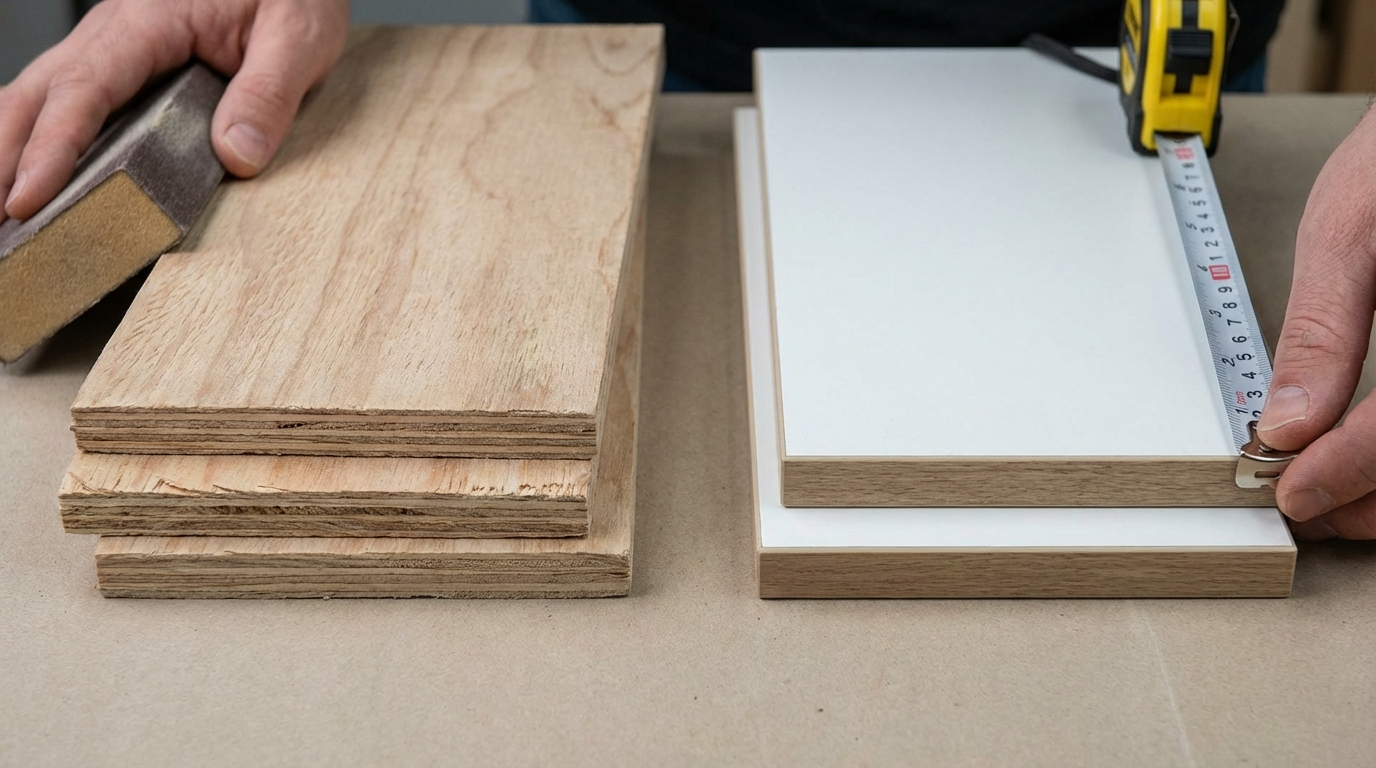
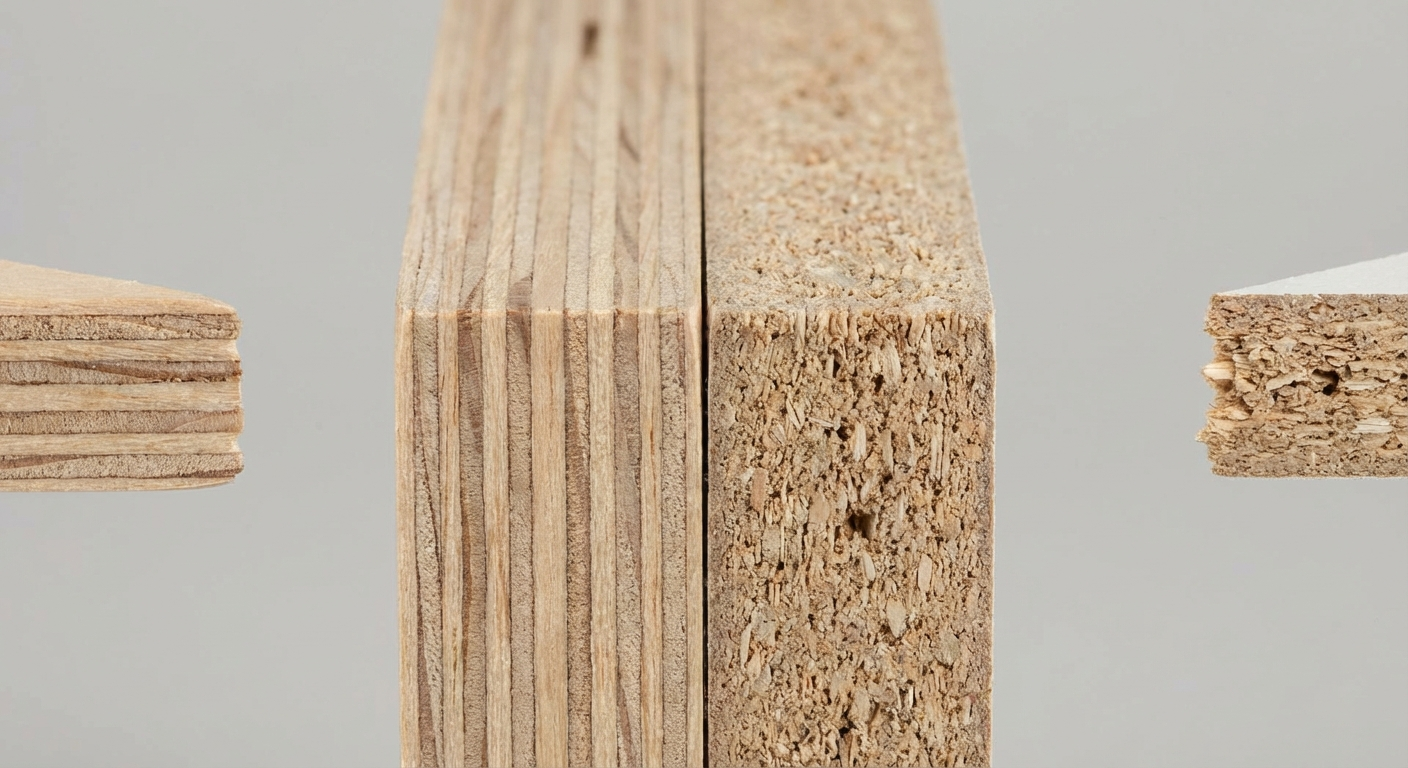
In Indian construction and furniture making, the choice between plywood and particle board hinges on their fundamental build. Plywood emerges from thin veneer sheets—typically from hardwoods like eucalyptus or poplar—glued cross-grain in alternating directions. This layering creates inherent strength, mimicking natural wood's flexibility while resisting warping. Particle board, an engineered alternative, compresses wood chips, shavings, and sawdust with synthetic resins under heat and pressure. The result is a uniform but denser panel reliant entirely on adhesive bonds.
From a first-principles view, plywood's cross-ply design distributes stress evenly, much like reinforced concrete in buildings. Particle board lacks this; its random particle orientation means loads concentrate on glue points, accelerating failure under flex or impact. In humid Indian climates, where ambient moisture swings from 20% in winters to 90% during monsoons, plywood's wood fibers breathe and stabilize, while particle board's resins absorb water, swelling the matrix irreversibly.
Raw Material Sourcing in India
Indian plywood draws from plantation timbers under controlled forestry, adhering to guidelines like those from the Indian Plywood Industries Research and Training Institute (IPIRTI). Particle board uses mill waste, making it a byproduct recycler but introducing variability in particle quality. Contractors often overlook how recycled content in particle board heightens formaldehyde emissions, a concern in enclosed homes with poor ventilation common in tier-2 cities.
Durability Reality: Decades for Plywood, Years for Particle Board
Plywood's longevity stems from its mechanical integrity. Boiling water-resistant (BWP) grades endure submersion without delamination, ideal for coastal Kerala homes or Mumbai high-rises facing salty air. Even moisture-resistant (MR) plywood holds up 5-10 years in wardrobes before noticeable sag, outlasting particle board's typical 2-4 year lifespan in similar spots.
Particle board shines in dry, low-stress interiors like office partitions but crumbles in kitchens. Homeowners report sagging shelves within 18 months under utensil weight, exacerbated by steam from cooking. In particle board-heavy budget flats in Delhi-NCR, replacement cycles every 3-5 years inflate true ownership costs beyond initial savings.
Real-world testing under Indian Standards (IS 303 for particle board, IS 710 for BWP plywood) reveals plywood retaining 80-90% strength post-cycling humidity tests, while particle board drops below 50% after fewer cycles. Architects specify plywood for load-bearing furniture; particle board suits non-structural panels where aesthetics trump endurance.
Impact of Indian Weather Patterns
- Monsoon Vulnerability: Particle board edges swell 10-15% in 80% RH, causing laminate peels; plywood limits to 2-4%.
- Termite Hotspots: Southern states like Tamil Nadu see plywood with preservatives outlasting untreated particle board by 5x.
- Heat in Rajasthan Summers: Plywood resists cracking; particle board's resins soften above 50°C.
Cost Analysis: Particle Board's Upfront Edge vs Plywood's Lifetime ROI
Particle board undercuts plywood by 40-60% per square foot at retail, appealing to cost-conscious homeowners furnishing 2BHKs in Pune or Bangalore suburbs. Dealers quote particle board starting lower for 18mm thickness, but factor in frequent replacements: a wardrobe redo every 4 years erases savings.
Plywood's premium reflects glue quality (urea-formaldehyde in MR vs phenolic in BWP) and veneer count (5-13 plies). Regional variations hit hard—North India's dealer networks inflate plywood 10-20% over South, where mills cluster. Contractors calculate total cost of ownership: plywood's one-time install vs particle board's labor repeats.
| Factor | Plywood (MR/BWR) | Particle Board | Long-Term Implication |
|---|---|---|---|
| Upfront Sheet Cost | Higher (base +20-50%) | Lower baseline | Particle wins short-term |
| Installation Labor | Similar | Similar | Neutral |
| Replacement Frequency | 10-20 years | 3-5 years | Plywood saves 2-3x over decade |
| Finishing Needs | Less edge banding | Heavy sealing required | Extra 10-15% for particle |
Strength and Structural Performance Head-to-Head
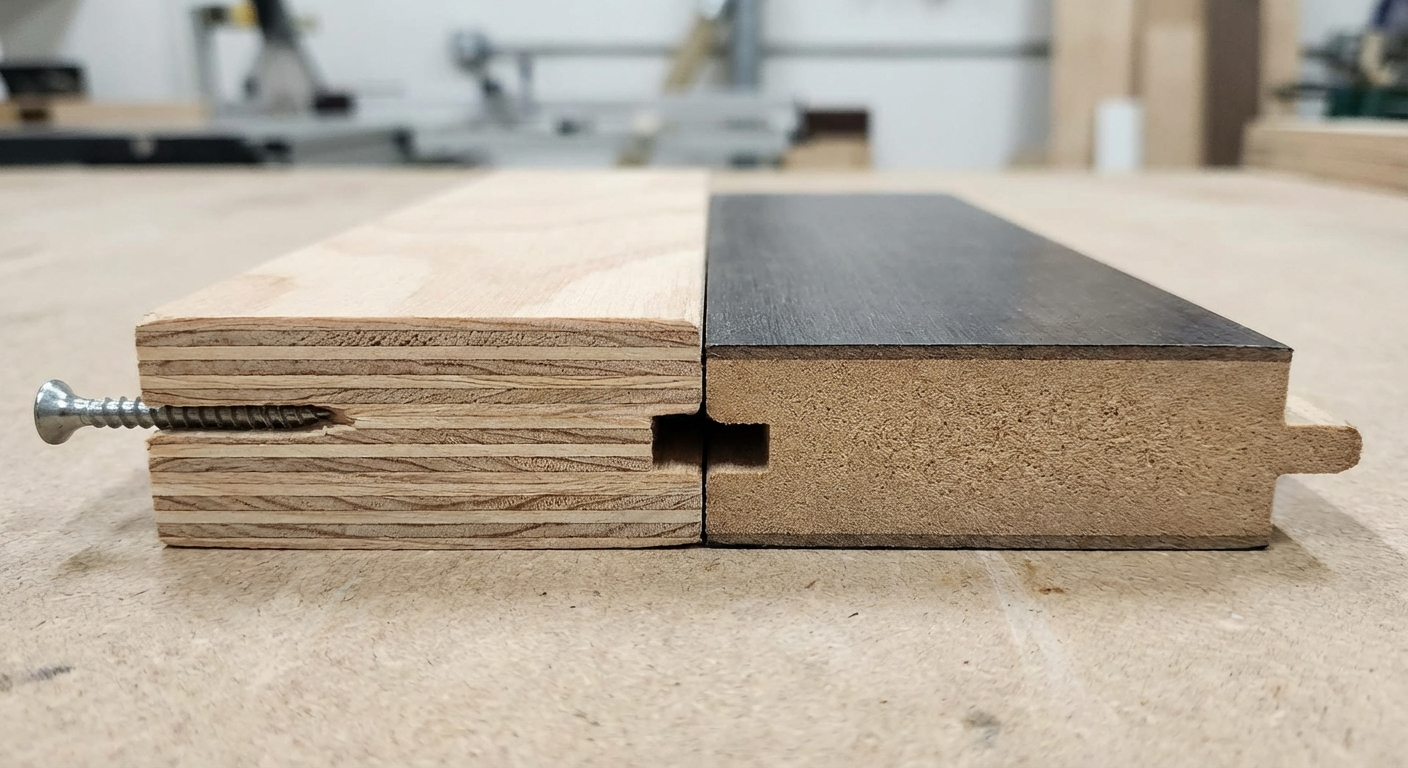
Screw-holding power defines furniture reliability. Plywood embeds screws into solid veneers, retaining grip after multiple insertions—critical for modular kitchens where adjustments happen. Particle board's crumbly core strips threads easily, demanding thicker panels or inserts, hiking material use by 20%.
Bending tests show plywood (18mm) supporting 100-150kg per sqm statically; particle board caps at 60-80kg before deflection. For contractors building lofts or cabinets in labor camps, plywood prevents collapses; particle board suits lightweight racks.
Load-Bearing Scenarios
In a typical Indian bedroom almirah:
- Plywood shelves: 20-30kg uniform load, no sag over 10 years.
- Particle board: 10-15kg limit, visible bow after 6 months.
Moisture Resistance: Plywood's Decisive Advantage
India's tropical humidity dooms unprotected particle board. Even with melamine facing, edges wick moisture, leading to core rot in bathrooms or laundry zones. Plywood grades scale: MR for dry areas, BWR for semi-wet, BWP for immersion like marine edges.
Practical test: Soak 18mm samples in water. Particle board swells and disintegrates; BWP plywood emerges intact after boiling. Interior designers in humid Chennai push plywood for vanities, saving callbacks.
Termite and Pest Dynamics in India
Subterranean termites ravage 50% of untreated wood annually in pest-prone belts like Uttar Pradesh. Plywood incorporates preservatives like copper chrome boron during manufacture, achieving IS 2202 compliance. Particle board's resins deter surface pests but fail internally as particles ferment.
Post-treatment options exist for both, but plywood's density slows infestation. Homeowners in termite-heavy Gurgaon opt for plywood wardrobes, avoiding the ₹10,000-20,000 remediation hit.
Installation and Customization Fit
Plywood machines cleanly with carbide tools, yielding precise miters for carpenters in modular setups. Particle board dusts excessively, dulling blades faster and requiring dust extraction—overlooked in site installs. For veneering or lamination, plywood's stable surface bonds better, reducing bubbles in humid workshops.
Architects note plywood's machinability supports intricate designs; particle board limits to flat panels.
Environmental Footprint and Indoor Air Quality
Particle board's urea-formaldehyde glues emit VOCs, risking E1-level off-gassing in unventilated bedrooms—worse in formaldehyde-sensitive households. Plywood uses less adhesive per volume, and eco-variants from certified mills reduce impact.
Sustainability angle: Particle board recycles waste, but plywood from managed plantations sequesters carbon longer due to durability. Buyers prioritizing green builds lean plywood despite higher upfronts.
Ideal Applications: Matching Material to Need
| Application | Best Choice | Reasoning |
|---|---|---|
| Wardrobes & Almiras | Plywood | Weight support, humidity tolerance |
| Kitchen Cabinets | Plywood (BWR/BWP) | Steam, spills, heavy loads |
| Office Partitions | Particle Board | Cost, non-structural |
| Ceiling Panels | Particle Board | Lightweight, paintable |
| Bathroom Vanities | Plywood (BWP) | Water immersion |
Decision Framework for Indian Buyers
Assess your scenario:
- Budget Cycle: Short-term (under 3 years)? Particle board. Long-haul? Plywood.
- Exposure Risks: Moisture/termites/high loads? Plywood mandatory.
- Space Type: High-traffic home vs static office? Scale accordingly.
- Dealer Check: Verify ISI marks; test samples for screw hold.
Contractors in Hyderabad prioritize plywood for resale value; homeowners in Lucknow weigh EMI affordability. Hybrid approaches—particle core with plywood framing—emerge in mid-range projects.
Common Pitfalls and Pro Tips
Avoiding Buyer Regrets
- Don't skimp on thickness: 18mm minimum for shelves.
- Edge-band particle board religiously; plywood needs less.
- Specify grades upfront: MR isn't BWP.
- Factor regional markups: Compare 3 dealers.
Testing at Site
Drop-test a sample: Plywood bounces; particle shatters. Flex by hand: Plywood resists; particle bows.
Plywood vs Particle Board: Key Takeaways Before You Buy
Plywood delivers multi-decade reliability across India's demanding conditions, justifying its premium through reduced maintenance. Particle board unlocks affordability for low-demand uses, but demands careful placement. Weigh your priorities—durability's edge grows with exposure risks. Consult local carpenters for hybrid insights tailored to your build.
Related guides on PlyPrice
Want Plywood Suggestions?
Share a few details and a PlyPrice specialist will suggest suitable brands and connect you to responsive dealers.