Plywood vs Bamboo Board: Bamboo Plywood Strength, Cost and Uses
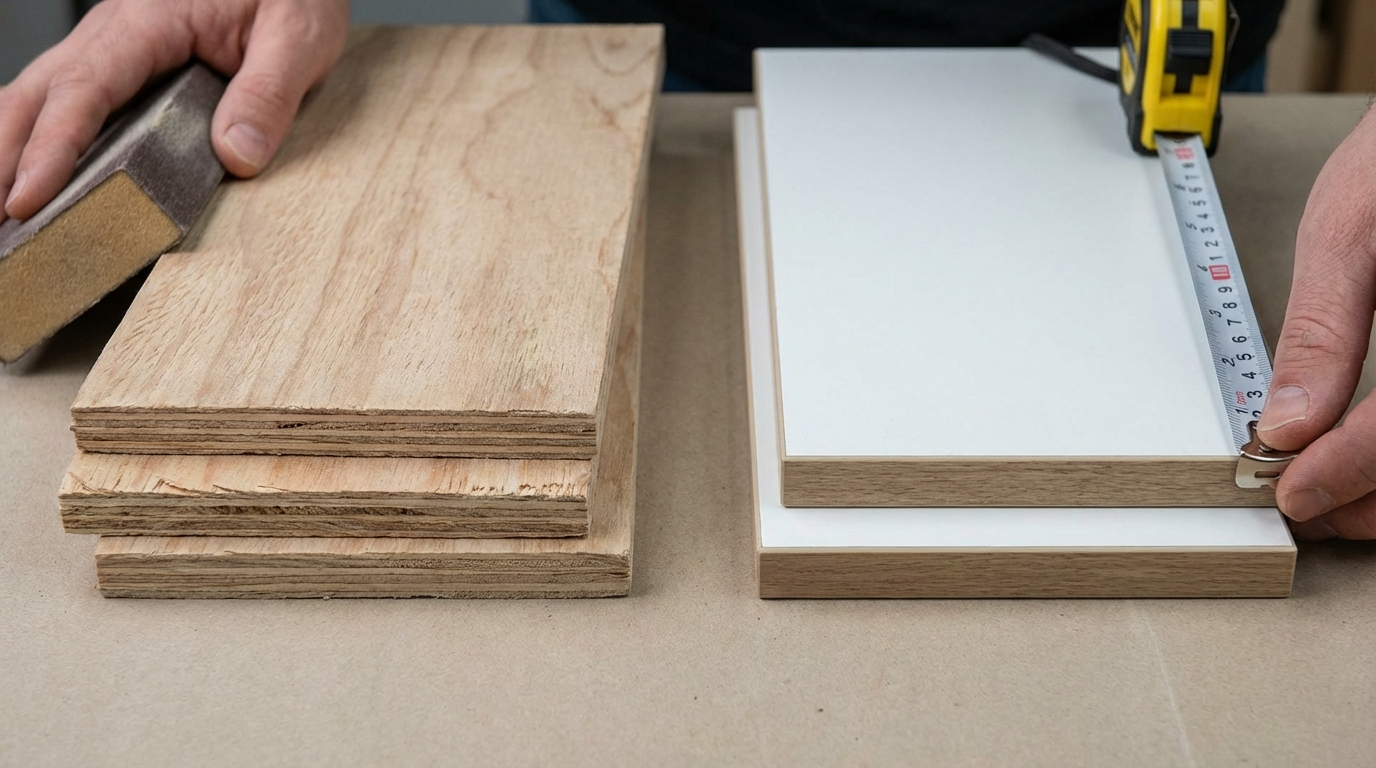
Bamboo plywood, sold in India mainly as bamboo mat board (BMB), is made by bonding layers of woven bamboo mats with resin instead of peeled wood veneers, which makes it a renewable alternative to regular plywood. Compare its strength, cost and termite resistance with MR, BWR and BWP ply.
Last updated: . Grades and standards checked against current BIS standards.
What Is Bamboo Plywood and How Does It Differ from Regular Ply?
In India's diverse construction landscape, where materials must withstand monsoons, termites, and varying humidity levels, builders and homeowners often weigh options like traditional plywood against emerging alternatives such as bamboo board. Traditional plywood, a staple in Indian projects, consists of thin veneers peeled from hardwood or softwood logs, glued cross-grain with adhesives like urea-formaldehyde (MR grade) or phenolic resins (BWR/BWP grades). This cross-lamination provides stability but depends heavily on wood sourcing, which faces deforestation pressures.
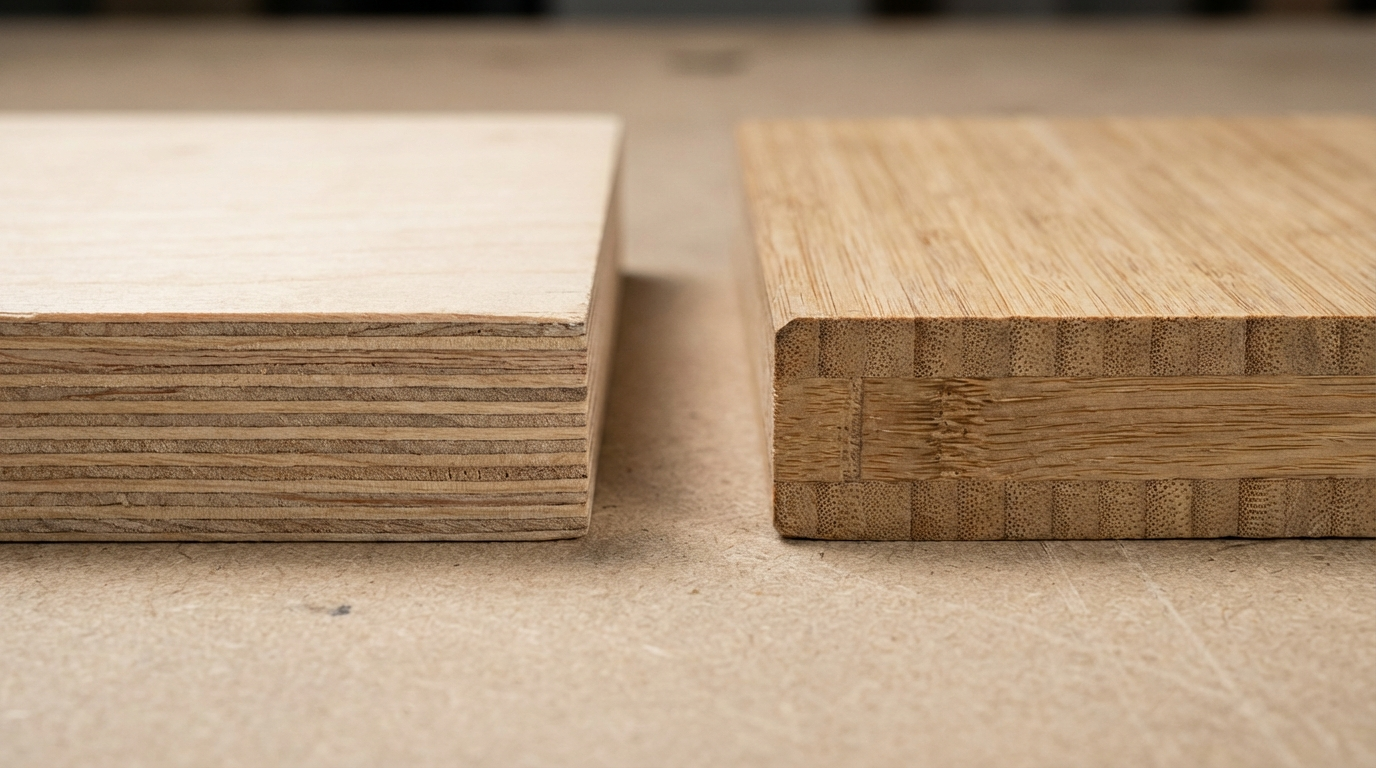
Bamboo board, particularly bamboo mat board (BMB) standardized under IS 13958 in India, diverges fundamentally. It uses slivers of bamboo culms woven into mats, impregnated with resins, and hot-pressed into panels. Variants include laminated bamboo plywood or strand-woven composites, where bamboo strips or fibers are densified under pressure. Unlike plywood's rotary-peeled veneers, bamboo board leverages the grass's natural fibrous structure—bamboo regenerates in 3-5 years versus decades for hardwoods—making it a renewable engineered composite tailored for panels from 3mm to 25mm thick.
This shift from wood veneers to bamboo mats alters not just sourcing but performance logic: plywood excels in uniform bending resistance due to alternating grains, while bamboo board harnesses longitudinal fiber strength akin to rebar in concrete.
Key Differences in Composition and Manufacturing
Plywood manufacturing starts with log debarking, veneer peeling, drying, and gluing in multi-layer assemblies, cured under heat and pressure. Indian producers adhere to IS 303 for MR, BWR and BWP plywood or IS 710 for marine, but quality varies by glue line count and face quality. Core defects like voids can compromise load-bearing in humid coastal regions like Kerala or Mumbai.
Bamboo board production begins with culm splitting into slivers (1-2mm thick), weaving into bidirectional mats for balance, resin dipping (often phenolic for water resistance), and pressing at 140-160°C. Indian facilities, concentrated in Northeast states like Assam and Tripura, produce BMB with densities of 0.8-1.2 g/cm³—higher than most commercial plywood (0.5-0.7 g/cm³). This densification yields panels with fewer voids, better screw-holding, and inherent silica content deterring borers.
| Aspect | Traditional Plywood | Bamboo Board |
|---|---|---|
| Raw Material | Hardwood/softwood veneers | Bamboo slivers/mats |
| Density (g/cm³) | 0.5-0.7 | 0.8-1.2 |
| Standard | IS 303, IS 710 | IS 13958 |
| Renewability | 20-50 years cycle | 3-5 years |
Is Bamboo Board Stronger Than Plywood? A Tensile Strength Deep Dive
Strength claims drive buyer decisions, especially for contractors in load-bearing applications like furniture carcasses or partitions. Traditional plywood's strength stems from veneer thickness and glue shear: BWP grades pass a 72-hour boil test, with MOR (modulus of rupture) around 40-60 N/mm² and tensile strength parallel to grain at 30-50 N/mm². However, cross-grain limits peak fiber utilization.
Bamboo board flips this: bamboo culms boast tensile strengths of 140-280 N/mm² along fibers, rivaling mild steel. In mat form, studies from Indian institutes like IWST show BMB exceeding plywood: tensile strength often 60-100 N/mm² vs. plywood's 40-60 N/mm², flexural strength 80-120 N/mm² vs. 50-70 N/mm². One comparative analysis found bamboo laminates outperforming plywood by 20-50% in flexural tests, attributed to uniform fiber orientation and higher density.
In practice, for Indian scenarios—a Kerala villa's wardrobe enduring 80% humidity or Delhi's dry heat warping plywood—bamboo board resists delamination better. Yet, plywood edges out in shear perpendicular to grain due to thicker cores. Verdict: Bamboo board is generally stronger in tension and flexure, ideal for spans, but test per IS norms for site-specific loads.
- Tensile Parallel: Bamboo board 60-100 N/mm²; Plywood 30-60 N/mm²
- Flexural: Bamboo 80-120 N/mm²; Plywood 40-70 N/mm²
- Compressive: Bamboo up to 60 N/mm²; Plywood 30-50 N/mm²
Real-World Strength Testing in Indian Labs
IPIRTI trials confirm BMB's edge: screw withdrawal force 2-3x higher, enabling thinner panels for same rigidity. For shuttering in Mumbai high-rises, bamboo withstands 50+ reuses vs. plywood's 10-20, cutting cycle costs despite premium upfront.
Eco-Benefits of Bamboo Board Over Traditional Plywood
India's green building push—IGBC certifications demand low embodied carbon—positions bamboo as a frontline contender. Plywood relies on mature trees, contributing to 13 million hectares deforested annually in tropics; processing emits VOCs from urea glues.
Bamboo, a grass, sequesters CO₂ 4x faster (35 tonnes/hectare/year vs. 6-12 for wood), with no replanting needed. Northeast India's 16 million hectares bamboo forests supply without ecological debt. BMB uses 30-50% less energy in production due to no peeling step, and phenolic resins enable low-formaldehyde grades (E1 class).
Life-cycle logic: A 18mm bamboo panel offsets plywood's impact in 2-3 years via durability. For architects chasing GRIHA stars, bamboo's traceability—from Tripura groves to panels—beats plywood's opaque chains.
Cost Analysis: Bamboo Board vs Plywood in India
Pricing hinges on grade, thickness, region, and volume. Commercial MR plywood (18mm, 8x4 ft) ranges lower due to scale—bulk dealers in Gujarat offer at base rates, escalating 20-30% retail in metros. BWP adds 40-60% for boil resistance.
Bamboo board commands a premium: 20-50% higher than equivalent plywood, driven by processing (weaving/resin dipping) and nascent supply chains. Northeast mills keep costs competitive; transport to South doubles it. Per sq ft, thin decorative bamboo (~6mm) undercuts veneer plywood, but structural 18mm rivals BWP.
Cost drivers:
- Volume: Contractors save 10-15% via direct mill buys.
- Thickness: Bamboo's strength allows thinner specs, amortizing over life.
- Region: Assam: lower; Mumbai: +30% logistics.
| Thickness (mm) | MR Plywood (₹/sheet) | BWP Plywood (₹/sheet) | Bamboo Board (₹/sheet) |
|---|---|---|---|
| 12 | Lower range | Mid-high | Mid range |
| 18 | Lower range | Higher range | Higher range |
Total ownership: Bamboo's longevity (termite resistance saves 5-10% maintenance) flips economics for 10+ year projects.
Performance Under Indian Conditions: Moisture, Termites, and Durability
Coastal humidity delaminates MR plywood; BWR/BWP fare better but cost more. Bamboo board's silica and density yield natural resistance—BMB passes 72-hour boil tests akin to BWP, with fungal ratings superior per lab data.
Termites plague Indian plywood (urea glues vulnerable); bamboo's phenolics and fibers deter without extra treatments. In Rajasthan's heat, bamboo stabilizes better, avoiding plywood's cupping.
Applications in Indian Construction and Furniture
Plywood dominates wardrobes, false ceilings, formwork. Bamboo board shines in eco-furniture (Northeast exports), wall panels (Delhi malls), doors (bamboo frames per IS 4021). Contractors use for partitions in humid Goa hostels; homeowners opt for kitchen cabinets valuing aesthetics.
- Structural: Partitions, shelves (bamboo's span advantage).
- Interiors: Veneer alternative, flooring underlay.
- Not Ideal: Heavy exterior exposure without over-lamination.
Pros and Cons: Side-by-Side Decision Matrix
| Plywood Pros | Plywood Cons | Bamboo Board Pros | Bamboo Board Cons | |
|---|---|---|---|---|
| Strength | Balanced shear | Lower tension | Higher tensile/flex | Costlier thick panels |
| Eco | Recyclable grades | Deforestation | Fast renew | Transport emissions |
| Cost | Cheaper base | Replacements | Longer life | Premium upfront |
Practical Buying Guide for Indian Buyers
Homeowners: Prioritize ISI-marked BMB for modular kitchens; check density >0.9 g/cm³.
Contractors: Bulk-test MOR; Northeast for savings, hybrids (bamboo face/ply core) for balance.
Architects: Spec for IGBC; verify resin (PF over UF).
Inspect: Uniform weave, no resin lumps, <1% water absorption. Dealers in Indore/Chennai stock limited—source via Assam missions.
When Bamboo Board Wins Over Plywood
Opt for bamboo in sustainability mandates, tensile-critical spans, or termite zones. Plywood suits budget formwork. Hybrids bridge gaps. In India's evolving market, bamboo board's edge grows with supply maturity—test samples for your project's logic.
Related guides on PlyPrice
Want Plywood Suggestions?
Share a few details and a PlyPrice specialist will suggest suitable brands and connect you to responsive dealers.