Particle Board vs MDF: Which Is Better for Budget Furniture?
MDF is denser and smoother than particle board, so it holds screws better and takes paint or laminate more cleanly, while particle board, called chipboard locally, is made from wood chips and sawdust and costs less. Compare density, moisture behaviour and cost for Indian furniture.
Core Differences in Material Makeup
In India's furniture and interior market, both MDF (Medium Density Fiberboard) and particle board serve as go-to engineered wood options for cost-conscious projects. Understanding their foundational differences starts with how they're produced, which directly influences performance in humid climates like Mumbai's monsoons or Delhi's winters.
Particle board, often called chipboard locally, begins with wood chips, shavings, and sawdust sourced from fast-growing species like eucalyptus or poplar—common in Indian mills. These are broken down, mixed with resins (usually urea-formaldehyde), and compressed at lower densities under heat. The result is a uniform but coarser panel.
MDF, by contrast, refines the process further. Wood fibers are separated into finer strands via steam explosion, blended with higher-grade resins (often including wax for added stability), and hot-pressed into a much denser sheet. This fiber-level uniformity explains why Indian carpenters prefer MDF for precision work, while particle board suits basic shelving.
Why Manufacturing Choices Matter for Indian Buyers
Homeowners in tier-2 cities like Pune or Jaipur often face dealer push for cheaper particle board, but the finer fibers in MDF reduce voids, leading to fewer defects during humid storage. Contractors value particle board's quicker production cycles, aligning with tight project deadlines in apartment renovations.
Density Breakdown: Stability Under Load
Density defines how these boards handle weight and flex in furniture like wardrobes or kitchen cabinets. Particle board typically ranges from 600-750 kg/m³, making it lighter and easier to handle on-site but prone to sagging over time—especially under heavy loads like stacked utensils in Indian households.
MDF clocks in higher at 700-850 kg/m³ (often 800+ in quality Indian grades), providing superior rigidity. This matters in real-world use: a particle board shelf might warp after 2-3 years in a coastal Kerala home, while MDF holds shape longer.
| Property | Particle Board | MDF |
|---|---|---|
| Average Density (kg/m³) | 600-750 | 700-850 |
| Weight per sqm (18mm thick) | Lighter (easier transport) | Heavier (better load distribution) |
| Flex Resistance | Moderate; sags under sustained load | High; minimal deflection |
For architects specifying in high-rise projects, MDF's density reduces vibration transmission, a subtle edge in urban India.
Screw Holding Strength: Assembly Reliability
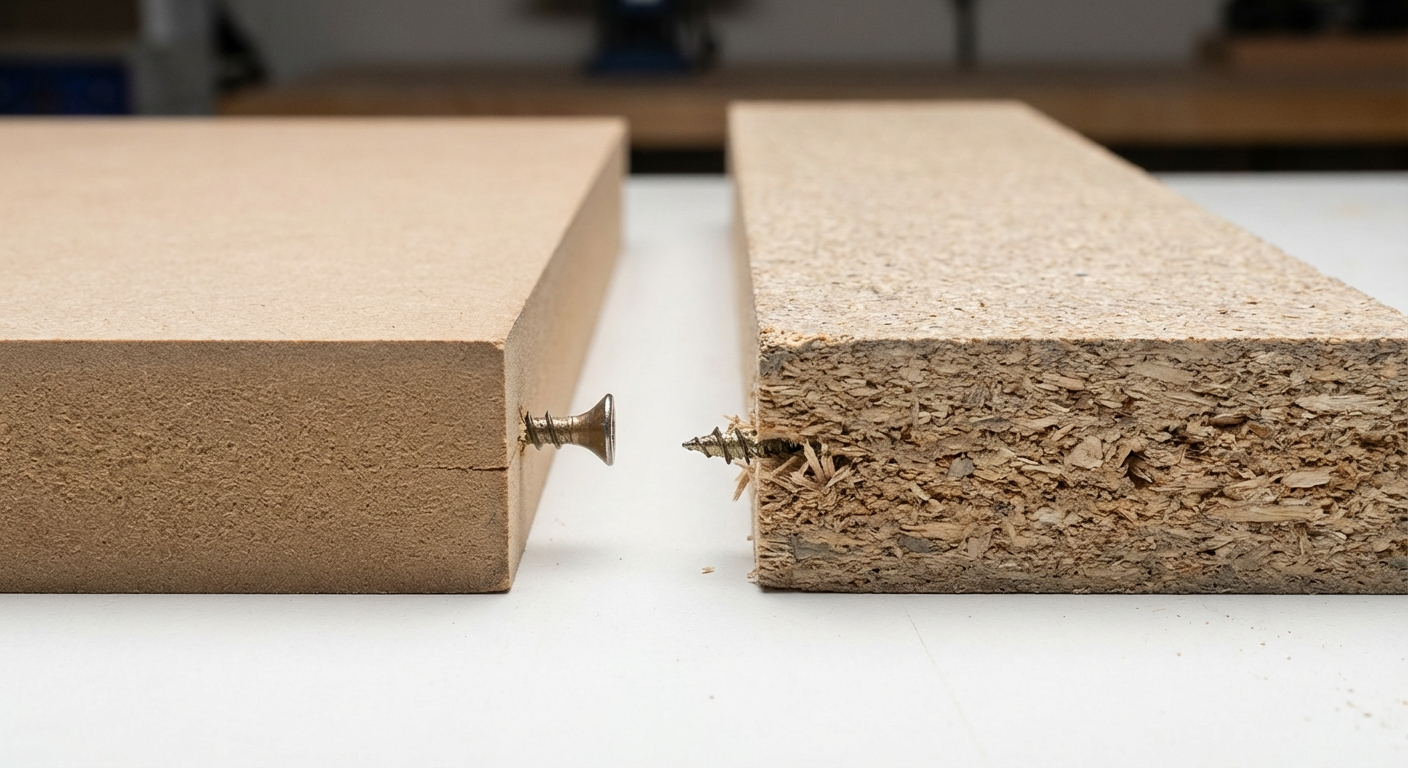
One of the most practical tests for furniture makers is screw retention. Particle board's chunkier particles create weak grip points, leading to stripped screws after repeated assembly—common when homeowners disassemble beds for Diwali cleaning.
MDF's dense fiber matrix excels here, holding screws 20-40% tighter based on independent pull-out tests relevant to Indian hardware like brass hinges. In workshops from Coimbatore to Kanpur, this means fewer callbacks for loose fittings in modular kitchens.
Real-World Screw Holding Scenarios
- Cabinets: MDF supports heavy doors without pilot holes; particle board often needs inserts.
- Wardrobes: Particle board adequate for light clothing shelves; MDF for laminated heavy-use sections.
- Edge Banding: Both work, but MDF's grip prevents peeling in humid Bangalore.
Contractors note: Reinforce particle board edges with PVC tapes early to mimic MDF performance at lower cost.
Surface Finish and Smoothness: Painting and Laminating Edge
Smoothness determines final aesthetics, crucial for India's veneer and laminate-heavy interiors. Particle board's rougher texture from larger particles demands thicker primers, adding labor costs in small carpentry shops.
MDF's glass-like surface accepts paints, PU finishes, or laminates with minimal sanding—ideal for glossy white kitchens trending in Gurugram apartments. This translates to faster turnaround and fewer bubbles in humid conditions.
| Finish Aspect | Particle Board | MDF |
|---|---|---|
| Surface Texture | Coarse; visible particles | Smooth; fiber uniformity |
| Primer Layers Needed | 2-3 for even paint | 1 or direct laminate |
| Laminate Adhesion | Good with prep; prone to telegraphing | Excellent; no show-through |
Interior designers favor MDF for curved moldings, where particle board cracks under router bits.
Moisture and Durability in India's Varied Climate
India's 70-90% monsoon humidity exposes weaknesses. Standard particle board (MR grade) swells 10-15% when wet, unsuitable for exposed bathroom vanities without heavy lamination.
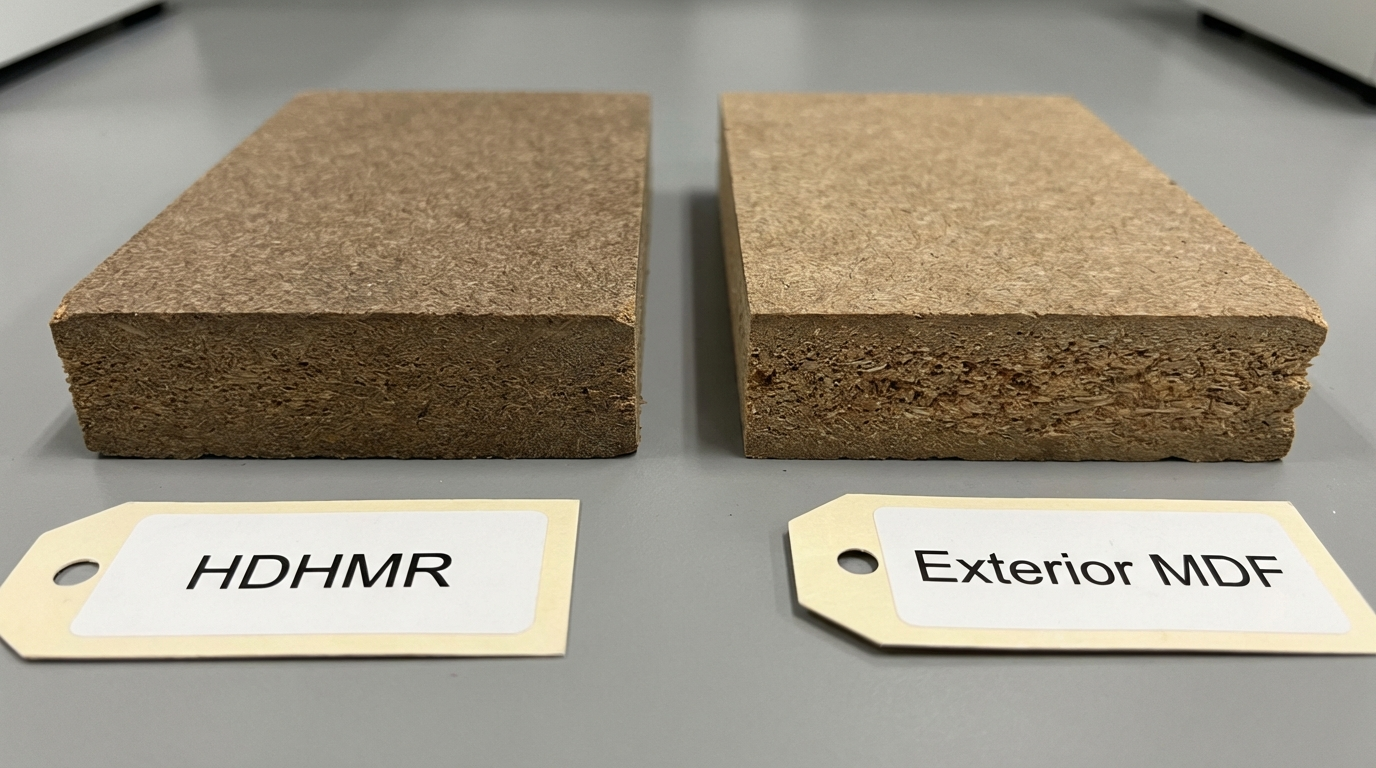
MDF offers better dimensional stability (5-8% swell), but both pale against HDHMR or plywood for wet areas. In dealer yards from Chennai to Lucknow, unsealed particle board warps fastest during rains, inflating replacement costs.
Longevity Expectations
Under normal indoor use:
- Particle board: 5-8 years in dry interiors.
- MDF: 8-12 years, extending with edge sealing.
Tip for buyers: Opt for E1/E0 emission boards to minimize formaldehyde in poorly ventilated homes.
Cost Factors: True Budget Breakdown
Particle board undercuts MDF by 20-40% per sheet, driven by cheaper raw fibers and faster pressing. However, total project costs equalize when factoring extras:
- Particle board: +Labor for sanding/priming, +Hardware inserts.
- MDF: Direct savings on finishes, fewer repairs.
Regional swings: Southern mills offer tighter spreads due to abundant agro-waste; northern prices rise with transport. Dealers quote per sq ft, so compare 18mm thicknesses apples-to-apples.
Volume buyers (contractors) negotiate better on particle board; homeowners save via MDF's longevity.
Side-by-Side Pros and Cons
| Criteria | Particle Board Pros | Particle Board Cons | MDF Pros | MDF Cons |
|---|---|---|---|---|
| Strength/Density | Lightweight | Lower load capacity | High rigidity | Heavier to install |
| Screw Holding | Affordable basics | Poor retention | Superior grip | Requires sharp bits |
| Finish Quality | Works with laminates | Needs heavy prep | Flawless surface | Costlier base |
| Cost Efficiency | Lowest upfront | Higher maintenance | Better lifecycle value | Initial premium |
| Applications | Shelving, partitions | Not for high-wear | Cabinets, moldings | Avoid direct water |
Ideal Use Cases in Indian Furniture Projects
Choose Particle Board When:
- Temporary setups like PG hostels or rental flats.
- Non-structural backs or fillers in budget wardrobes.
- High-volume contractor bids prioritizing speed.
Choose MDF When:
- Exposed painted surfaces or premium laminates.
- Heavy-duty cabinets in middle-class homes.
- Architect-specified interiors needing precision cuts.
For hybrid projects, layer particle board cores with MDF faces—a dealer trick for balancing cost and finish.
Practical Buying Guide for Indian Markets
- Inspect Quality: Tap for uniform sound; check edges for delamination. Avoid overly cheap imports with high void content.
- Thickness Selection: 18mm for furniture; 12mm for doors. Test weight for density clues.
- Source Wisely: Direct from mills in Perambalur (Tamil Nadu) or dealers in Delhi's Bhagirath Palace for competitive rates.
- Seal Immediately: Apply edge bands and melamine polish post-cutting to combat humidity.
- Compare Alternatives: HDHMR for semi-wet areas; plywood for premium durability.
Ask dealers for lab reports on density and emissions—essential for health-conscious families.
Decision Framework: Best Low-Cost Pick?
Neither wins universally; particle board suits ultra-budget, low-stress roles where weight savings matter. MDF edges ahead as the smarter low-cost choice for most furniture, delivering 30-50% better lifespan per rupee spent when finishes are factored.
For homeowners: MDF if budget allows 20% more upfront. Contractors: Particle board for margins, MDF for client-facing work. Test small samples in your climate— the proof is in real-use flex and grip.
Related guides on PlyPrice
Want Plywood Suggestions?
Share a few details and a PlyPrice specialist will suggest suitable brands and connect you to responsive dealers.