Fire Retardant Plywood vs BWP: IS 5509 vs IS 303 and IS 710 Compared
Yes, some plywood is made to both IS 5509 for fire retardance and a boiling water proof standard (IS 303 BWP or IS 710 marine), but not all FR plywood is waterproof and standard BWP has no fire treatment. Compare both grades, dual FR BWP options and which to pick for high-rises or humid coastal sites.
Last updated: . Grades and standards checked against current BIS standards.
Can Plywood Be Both Fire Retardant and Waterproof?
In India's diverse construction landscape, where humid coastal regions meet fire-prone urban high-rises, buyers often face a dilemma: prioritize flame resistance for safety or superior moisture barriers for longevity. Fire retardant plywood under IS 5509 and boiling water proof (BWP) plywood per IS 303 or IS 710 (marine) represent two specialized grades addressing distinct risks. The short answer is yes—certain engineered plywoods combine both properties through sequential treatments or advanced formulations, meeting the performance criteria of both standards simultaneously.
However, not all FR plywood is inherently waterproof, and standard BWP lacks fire-retardant additives. Achieving dual compliance involves impregnating base plywood with fire chemicals (like ammonium phosphates for IS 5509 Type 1) before or alongside phenolic resins for BWP bonding. This dual-grade option suits high-stakes projects like hotel kitchens or Mumbai apartments, but it commands a premium due to complex manufacturing. For most homeowners or contractors, the choice hinges on site-specific threats: fire hazards in crowded buildings versus monsoon deluges in Kerala.
Breaking Down Fire Retardant Plywood (IS 5509)
IS 5509:2021, the latest revision from the Bureau of Indian Standards (BIS), specifies fire retardant plywood as regular plywood infused with chemicals to inhibit ignition and flame spread. Unlike "fireproof" myths, it doesn't prevent burning entirely but chars on the surface, forming an oxygen barrier that slows fire progression—critical in India's NBC 2016 (National Building Code) compliant structures.
Key specs from first principles: Treatment retention targets 40-60 kg/m³ depending on chemical type (e.g., Type 1 ammonium-based for cost-effectiveness). Tests mandate low flame spread (Class 1 or 2 per BS 476), minimal smoke, and no after-glow. Base plywood often starts as MR or BWR grade, upgraded via vacuum pressure impregnation.
In practice, Indian architects specify IS 5509 for public areas like theaters, hospitals, or partition walls in Tier-1 cities where fire audits are routine. A contractor in Delhi might select it for false ceilings to buy evacuation time during Diwali hazards, reasoning that untreated wood ignites 5-10 times faster.
Understanding BWP (IS 303) and Marine (IS 710) Plywood
IS 303:2024 defines BWP as a boiling water proof grade (IS 710:2024 covers marine plywood), engineered for extreme moisture, using fully waterproof phenolic resins throughout glue lines and veneers. It passes a 72-hour boil test without delamination, far surpassing BWR's three 8-hour boil cycles or MR's three 3-hour soaks in 60°C water.
Structurally robust for load-bearing (shear strength >13 N/mm²), thicknesses span 3-25 mm with Gurjan or Eucalyptus cores common in India. Reasoning from adhesives: Phenol formaldehyde creates cross-linked bonds impermeable to water vapor, vital in humid belts like Chennai where ambient RH hits 90%.
Homeowners favor BWP for submerged applications—kitchen sinks, bathroom vanities—where steam and spills erode cheaper grades. Contractors in Goa projects calculate it offsets rework costs from monsoon warping.
Direct Comparison: Fire Retardant (IS 5509) vs BWP (IS 303) or Marine (IS 710)
Both elevate standard plywood, but diverge in core engineering and risk mitigation. Below is a side-by-side analysis tailored to Indian decision-makers:
| Parameter | Fire Retardant (IS 5509) | BWP (IS 303) or Marine (IS 710) |
|---|---|---|
| Primary Protection | Flame retardancy (chars, low spread) | Boiling water resistance (72+ hrs) |
| Base Resin/Glue | MR/BWR often; urea/melamine | 100% phenolic (waterproof) |
| Moisture Resistance | Moderate (not boiling-tested) | Superior (marine-grade) |
| Fire Performance | BS 476 Class 1/2 compliant | Standard wood (flammable) |
| Structural Strength | Per IS 303 base; variable | High shear (>13 N/mm²) |
| Typical Indian Use | Partitions, ceilings in hotels/schools | Kitchens, bathrooms, exteriors |
| Treatment Method | Chemical impregnation (40-60 kg/m³) | High-pressure phenolic bonding |
| Compliance Testing | Flame/smoke tests | Cyclic boiling/delamination |
This table highlights trade-offs: FR excels in ignition delay (2-5x slower spread), while BWP prevents hydrolytic failure in wet zones.
Dual-Grade Options: FR BWP Plywood in India
Manufacturers like Greenply or CenturyPly offer FR BWP variants, treating a BWP (IS 303) or marine (IS 710) base with fire-retardant chemicals post-bonding to meet IS 5509. These pass both boiling cycles and flame tests, ideal for hybrid risks like coastal hotels (humidity + cooking fires). Logic: Sequential processing retains BWP integrity while adding 10-20% fire char time.
Availability spans organized dealers in metros; verify BIS dual-marking to avoid pseudo-claims. Architects weigh this for premium modular kitchens, where one sheet handles steam and sparks.
Real-World Performance in Indian Conditions
India's microclimates dictate choices. In Rajasthan's dry heat, FR plywood shines for low-moisture fire walls without BWP overkill. Contrastingly, Assam's 2000mm annual rain demands BWP to combat fungal decay absent in FR grades.
Durability logic: FR treatments leach slightly in high humidity (5-10% retention loss over 5 years), eroding fire efficacy unless sealed. BWP holds bonds indefinitely but burns rapidly if ignited. Field data from post-fire audits (e.g., Mumbai high-rises) shows FR partitions containing blazes longer, aiding escape.
Contractor insight: Pair FR with intumescent paints for theaters; reserve BWP for structural beams in flood-prone Bihar.
Cost Drivers and Relative Pricing
Pricing varies 30-50% above MR baselines due to resins/chemicals. FR plywood typically ranges lower than BWP because phenolic glues cost more than fire salts, but dual variants spike 20-40% higher.
Factors influencing dealer quotes:
- Thickness: 12-18mm common, adding ₹ per sqm per mm.
- Source wood: Imported Gurjan inflates vs Poplar.
- Region: Coastal Kerala 15-20% premium for BWP logistics.
- Volume: Contractors negotiate 10-15% off retail.
Homeowners calculate ROI: FR prevents ₹5-10 lakh fire claims; BWP avoids ₹2-5 lakh remodels from warping. Always compare per sqm loaded costs at local yards.
Application Scenarios: Matching Plywood to Project Needs
Choose FR Plywood When...
- Fire codes mandate (schools, malls per NBC Part 4).
- Proximity to flames: Kitchen hoods, staircases.
- Budget prioritizes safety over submersion.
Opt for BWP When...
- Constant wet exposure: Showers, laundry.
- Structural demands: Roofing sheathing in rains.
- Longevity trumps fire risk.
Choose Dual FR BWP Plywood When...
- High-end hospitality: Spice-splash kitchens in Goa resorts.
- Urban apartments: Modular units with gas risks.
Interior designers in Bangalore often spec BWP carcasses with FR doors for balanced logic.
Practical Buying Guide for Contractors and Homeowners
1. Assess risks: Map humidity (psychrometer test) vs ignition sources (gas stoves?).
2. Demand BIS labels: IS 5509 test certs for FR; IS 303 (or IS 710 for marine) boil reports for BWP.
3. Inspect visually: Uniform color, no voids; tap-test for delams.
4. Source wisely: Organized mills (Greenply ecosystem) over unbranded for traceability.
5. Edge-seal always: Varnish boosts both by 20-30% lifespan.
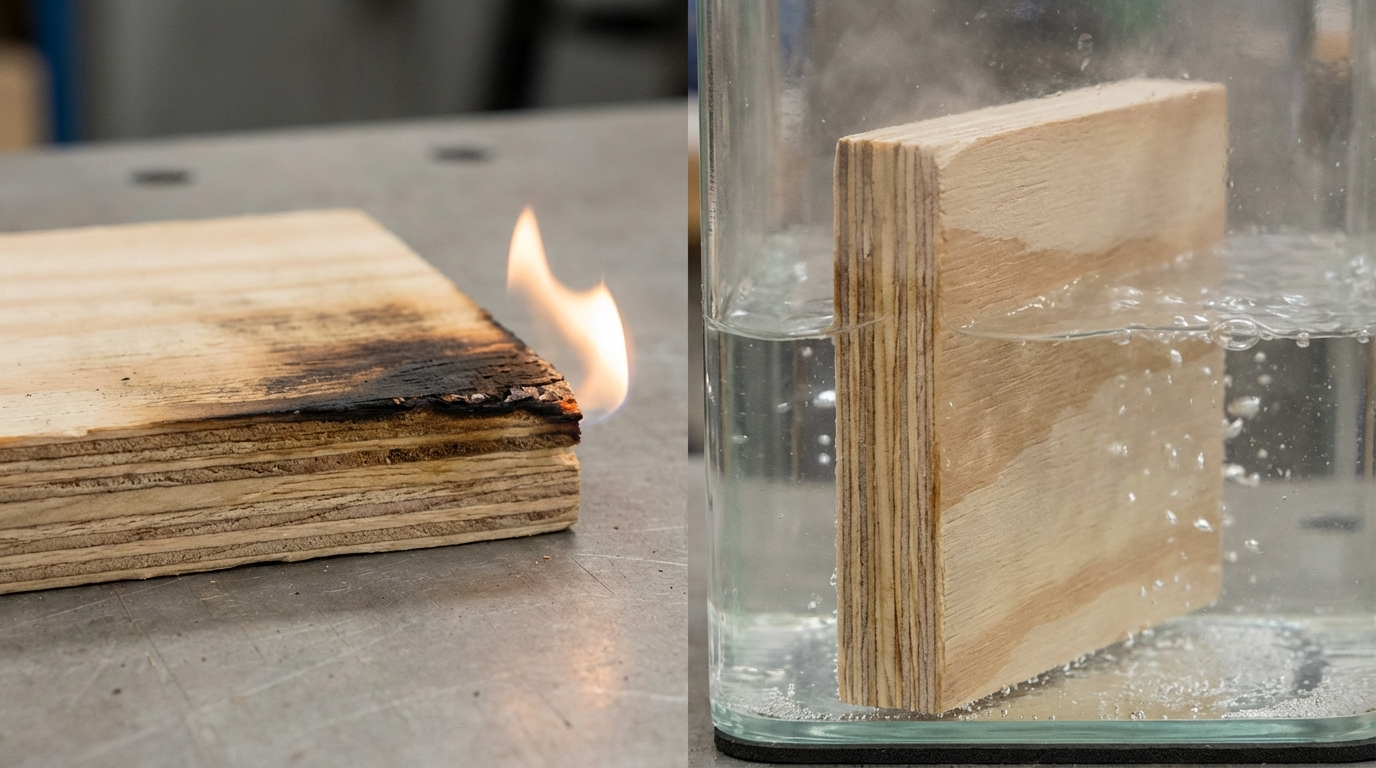
Dealer tip: Bulk buys yield samples—boil-test BWP, torch-test FR on-site.
Debunking Myths Around FR and BWP Plywood
Myth 1: FR is fully fireproof. Reality: Retards only; needs sprinklers.
Myth 2: BWP handles fire via density. Reality: Burns like MR without treatment.
Myth 3: Dual-grade compromises strength. Reality: Meets/exceeds both if certified.
Myth 4: Chemicals in FR harm health. Reality: Low-emission per E1 norms post-cure.
India-specific: Unverified "FR" from roadside dealers often just painted MR—always probe standards.
Prioritizing Safety or Moisture: Your Decision Framework
Score your project: Fire threat (0-10) + Moisture exposure (0-10). >15 total? Dual FR BWP. Fire-dominant? IS 5509. Moisture-heavy? IS 710.
Final reasoning: In fire, seconds save lives—FR buys them. In water, bonds fail silently—BWP prevents. For 80% Indian homes, BWP suffices with FR accents; upscale/commercial flips it. Consult local bylaws, test samples, and balance with sealant strategies for optimal outcomes.
Related guides on PlyPrice
Want Plywood Suggestions?
Share a few details and a PlyPrice specialist will suggest suitable brands and connect you to responsive dealers.