Commercial Ply vs MR Ply: Is Commercial Plywood the Same as MR Grade?
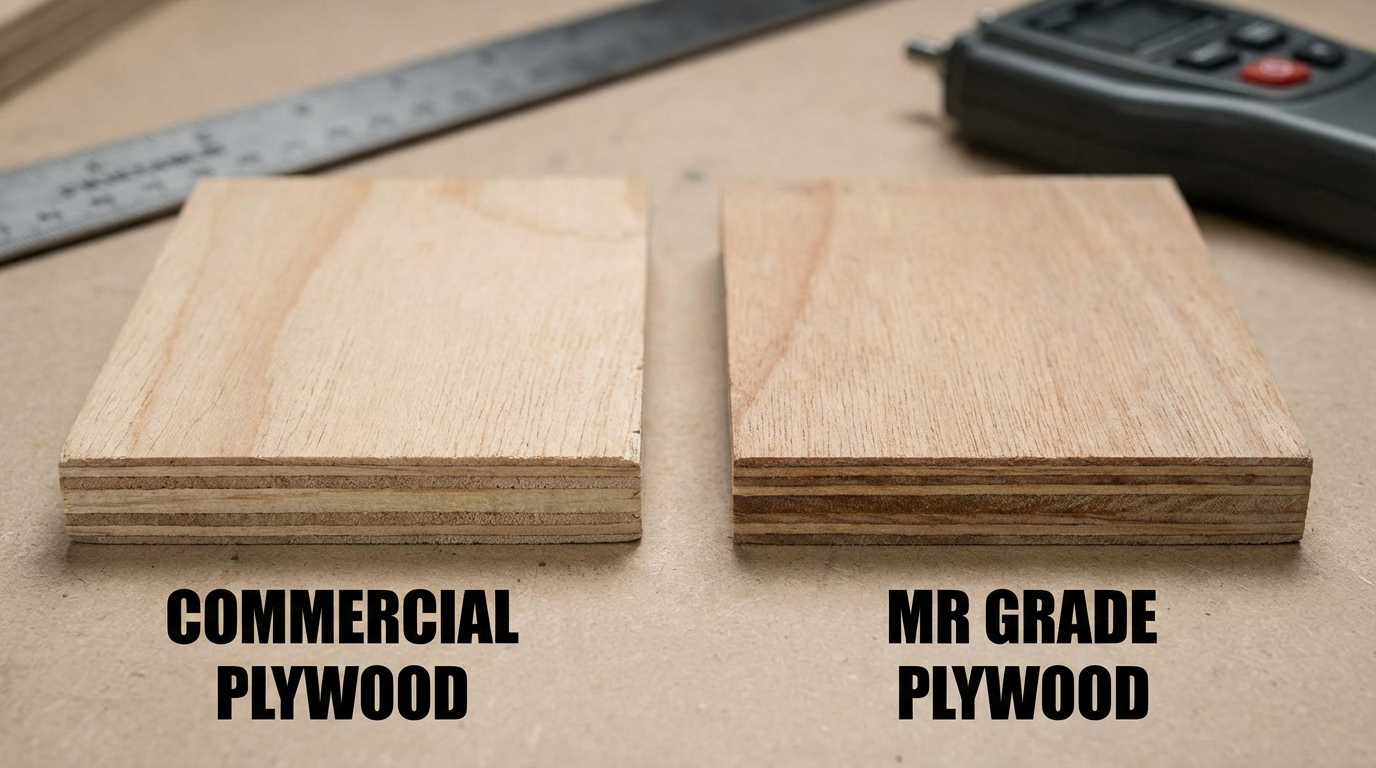
Commercial plywood and MR plywood overlap but are not the same thing: commercial is a general-purpose market label for affordable sheets, most often 12mm or 18mm, while MR is a moisture-resistance grade bonded with urea-formaldehyde resin for dry interiors.
Last updated: . Grades and standards checked against current BIS standards.
Is Commercial Plywood the Same as MR Grade?
In the Indian plywood market, confusion often arises around terms like "commercial plywood" and "MR grade plywood." At first glance, they seem interchangeable, especially in dealer conversations or hardware store signage. However, a closer examination reveals they are not identical, though they overlap significantly in everyday use.
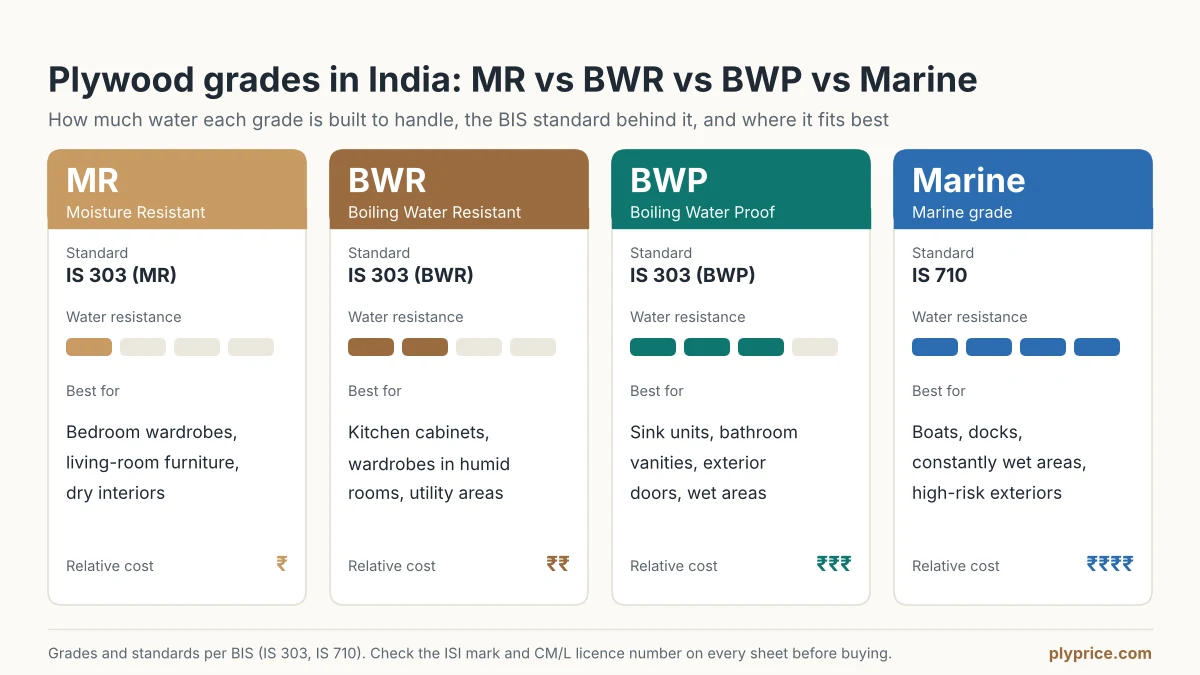
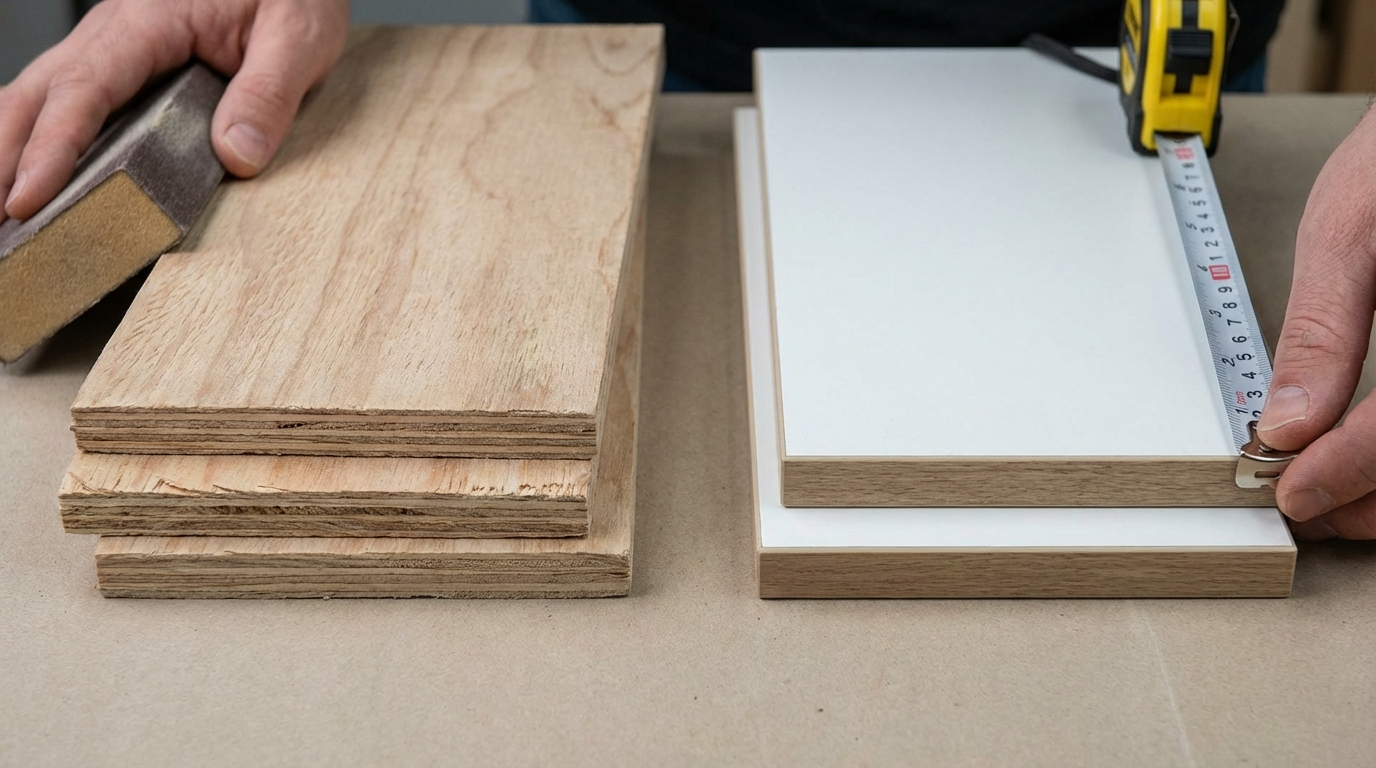
Commercial plywood typically refers to standard-grade plywood designed for non-structural, general-purpose applications. It is produced in thicknesses from 3mm to 25mm, commonly 12mm or 18mm, and prioritizes affordability and availability for bulk buyers like contractors and furniture makers. In practice, most commercial plywood sold in India falls under the MR (Moisture Resistant) category as per ISI standards (IS 303), meaning it uses urea-formaldehyde (UF) resin for gluing veneers.
MR plywood, on the other hand, is a specific performance grade defined by its ability to withstand moderate humidity without delamination. The "MR" designation guarantees passing three cycles of a 3-hour soak in 60°C water and 8-hour drying at 65°C under controlled conditions, but it does not imply waterproofing. Not all commercial plywood carries formal MR certification—some cheaper variants skip rigorous testing—but reputable manufacturers align commercial offerings with MR specs to meet market expectations.
The key takeaway for Indian buyers: Treat them as largely synonymous for interior, dry-use scenarios, but verify ISI marking and test certificates. In humid regions like Mumbai or Kerala, assuming equivalence without checking resin type or boil test results can lead to early failures during monsoons.
Decoding the Terms: Breaking Down Commercial and MR Plywood
To make informed decisions, buyers must understand the manufacturing and grading logic behind these labels. Indian plywood production follows Bureau of Indian Standards (BIS) guidelines, where grades like MR, BWR (Boiling Water Resistant), and BWP (Boiling Water Proof) dictate resin choice and performance thresholds.
Defining Commercial Plywood
Commercial plywood emerges from the need for economical sheet material in India's vast construction and furniture sectors. It uses softwood or hardwood veneers (often poplar or eucalyptus cores) glued with synthetic resins. Core characteristics include:
- Face veneers with BWR/BWP-grade quality for aesthetics, but core veneers may have knots or plugs.
- Standard emission levels of formaldehyde (E1 or better under voluntary norms).
- Suitability for painting or laminating in wardrobes, cabinets, and false ceilings.
In dealer ecosystems from Delhi's Bhagirath Palace to Chennai's hardware hubs, "commercial ply" signals mid-tier pricing—higher than whiteboard but below marine grades. Regional variations matter: Northern mills favor denser cores for load-bearing, while southern ones emphasize smoother faces for humid climates.
Defining MR Plywood
MR stands for Moisture Resistant, a BIS-specified grade (IS 303) tested via three cycles of a 3-hour soak in 60°C water and 8-hour drying at 65°C. It must retain structural integrity post-immersion, with no more than 10% thickness swelling. Key specs:
- UF resin with at least 40% glue line solids.
- Minimum 8-10 cycles of dry-wet conditioning.
- Markings like "MR GRADE" stamped per sheet.
Architects and interior designers specify MR for semi-exposed interiors, knowing it handles bathroom vanities or kitchen cabinets better than plain commercial without certification. Homeowners often overlook this, leading to warping in uncoated applications.
Urea-Formaldehyde Resin: The Core Differentiator
At the heart of both commercial and MR plywood lies urea-formaldehyde (UF) resin, a thermosetting adhesive derived from urea and formaldehyde. This low-cost glue dominates India's plywood industry due to its fast curing (under heat and pressure) and strong bonding with tropical hardwoods.
UF resin's chemistry involves polymerization, forming a cross-linked matrix that traps veneers. In commercial plywood, it provides baseline adhesion; in MR grade, higher solids content (45-50%) and additives like extenders enhance moisture tolerance. Why does this matter?
- Bonding Strength: UF delivers shear strength of 1000-1500 PSI, adequate for furniture but inadequate for structural beams.
- Formaldehyde Emissions: E1 compliance (the lower-emission BIS class) reduces health risks in homes, though unbranded sheets from roadside mills exceed safe limits.
- Cost Efficiency: UF is 30-50% cheaper than phenolic resins in BWR/BWP, keeping commercial ply accessible for tier-2 city contractors.
In India's hot-pressing kilns (140-180°C), UF ensures flat panels, but improper mixing leads to "telegraphing" (core voids showing through faces). Buyers should probe manufacturers on resin sourcing—imported UF from China or Malaysia outperforms local variants in consistency.
| Resin Property | Standard Commercial Ply | Certified MR Grade |
|---|---|---|
| Solids Content | 35-40% | 40-50% |
| Moisture Tolerance (Soak Test) | Basic (24-48 hrs) | 72 hrs minimum |
| Cost Impact | Baseline | 10-20% higher |
| Common Failures | Edge swelling in humidity | Delamination only post-prolonged exposure |
Moisture Resistance: Real-World Performance in Indian Conditions
Moisture resistance isn't binary—it's a spectrum influenced by resin, veneer density, and pressing quality. Commercial plywood with MR traits handles relative humidity (RH) up to 70-80%, common in air-conditioned homes. True MR grade extends to 85-90% RH, critical during India's monsoon peaks (June-September).
How Moisture Affects Plywood
Water ingress swells cellulose fibers in veneers, weakening glue lines. First-principles: UF resin hydrolyzes above 12% moisture content, causing bond failure. In coastal Gujarat or Assam's tea estates, untreated commercial ply warps within weeks; MR grade, when edge-sealed, lasts 2-3 years.
Test logic per BIS: MR must pass a ply-adhesion test after three cycles of a 3-hour soak in 60°C water and 8-hour drying at 65°C, versus commercial's informal benchmarks. Practical implications:
- Homeowners: For wardrobes in Mumbai apartments, MR prevents musty odors from humidity spikes.
- Contractors: Partitions in Noida offices tolerate AC drip without sagging.
- Designers: Avoid both in showers—opt for BWR.
Factors Influencing Resistance Levels
- Veneer Quality: Gurjan faces in MR hold water better than poplar cores.
- Thickness: 18mm commercial resists flexing more than 6mm.
- Post-Treatment: Varnish or laminate boosts both by 20-30%.
- Storage: Dealer yards in Kolkata expose stacks to rain, degrading even MR.
Regional buyer tip: In Rajasthan's dry heat, commercial suffices; Kerala demands verified MR to counter 90%+ RH.
Key Differences: A Side-by-Side Comparison
| Aspect | Commercial Plywood | MR Plywood |
|---|---|---|
| Primary Resin | UF (standard) | UF (enhanced) |
| ISI Standard | Often IS 303, not always certified | Strict IS 303 compliance |
| Ideal RH Range | 50-70% | 60-85% |
| Durability Expectancy | 5-8 years interior dry | 8-12 years semi-humid |
| Typical Applications | Furniture, shelves | Cabinets, wardrobes |
| Price Range Driver | Lower due to volume production | Higher for testing/certification |
This table highlights why contractors stock both: Commercial for quick jobs, MR for client warranties.
Cost Factors: Why Prices Vary Between Them
Pricing hinges on raw material volatility (eucalyptus logs up 15-20% yearly) and regional logistics. Commercial plywood starts lower, reflecting simpler production—no mandatory lab tests inflate MR costs by 15-25%.
Drivers include:
- Size/Thickness: 8x4 ft 18mm commercial costs less per sq ft than MR equivalent.
- Brand Tier: Unorganized mills undercut organized ones like Greenply or Kitply.
- Location: Punjab dealers offer bulk discounts; transport to Northeast adds 10-15%.
Decision logic: For a 200 sq ft wardrobe, opt commercial if budget-constrained and dry site; MR saves rework costs in humid zones.
Best Use Cases: Matching Plywood to Indian Scenarios
Where Commercial Plywood Excels
- False ceilings and wall paneling in AC-cooled spaces (Bengaluru IT parks).
- Basic furniture like beds or tables in villas (Pune suburbs).
- Shuttering alternatives for low-rise pours (tier-3 towns).
Optimal Applications for MR Plywood
- Kitchen modulars exposed to steam (Hyderabad homes).
- Office partitions with occasional spills (Gurgaon).
- Vanity units in attached baths (avoid direct water).
Avoid both for exteriors or immersion—BWP marine is essential there.
Buyer Decision Framework
- Assess site humidity: >75% RH? Choose MR.
- Load requirements: Static? Commercial ok.
- Budget vs longevity: MR's upfront cost yields 20-30% lifecycle savings.
- Verify: Demand BIS hologram, not just labels.
Common Myths and Buyer Pitfalls
Myth 1: All commercial is MR. Reality: Test informally by soaking edge—swelling >5mm signals subpar.
Myth 2: Painting makes it waterproof. Reality: Seals surface, not core.
Pitfall: Ignoring core voids. Tap sheets—hollow sounds mean weak spots.
Practical Buying Advice for Indian Markets
Visit mills near Hoshiarpur or Yamunanagar for direct sourcing. Dealers in Sadar Bazaar (Delhi) push volumes—negotiate 5-10% off for cash. Architects: Specify "IS 303 MR" in BOQs. Homeowners: Pair with laminates for hybrid performance.
Final note: In India's diverse climates, neither is universal—match to exposure for regret-free choices.
Related guides on PlyPrice
Want Plywood Suggestions?
Share a few details and a PlyPrice specialist will suggest suitable brands and connect you to responsive dealers.