BWR vs Commercial Plywood: Which to Use in Kitchens and Wardrobes
Use BWR plywood in kitchens and commercial (MR) plywood only in dry areas such as wardrobes: MR's urea-formaldehyde glue resists boiling for only about 1-2 hours, while BWR uses modified or phenolic resins built for longer boil tests. Compare failure modes, costs and a room-by-room matrix.
Last updated: . Grades and standards checked against current BIS standards.
What Defines BWR and Commercial Plywood in Indian Contexts?
In India's diverse climate zones—from humid coastal regions like Mumbai and Chennai to the dry interiors of Rajasthan—plywood selection hinges on how well the material withstands everyday exposures. Commercial plywood, often labeled as MR (Moisture Resistant), uses urea-formaldehyde adhesives that provide basic protection against occasional dampness. These glues bond the veneers under standard pressure, achieving a boil test resistance of around 1-2 hours, suitable for low-moisture interiors.
BWR (Boiling Water Resistant) plywood, on the other hand, employs modified resins or phenolic-formaldehyde glues engineered for extended boil tests (three cycles of 8-hour boiling and 16-hour drying) under ISI standards like IS:303. This makes BWR a step up in cross-linking density within the adhesive matrix, where molecular bonds resist hydrolysis from prolonged water immersion. For Indian buyers, this distinction matters because construction practices often expose plywood to site moisture during monsoons or installation delays.
From a first-principles view, both start with similar hardwood veneers (e.g., poplar or eucalyptus cores common in North India), but the glue's chemical stability dictates longevity. Commercial ply delaminates faster in cyclic wetting-drying scenarios, a frequent issue in poorly ventilated Indian homes.
Glue Chemistry and ISI Grading Breakdown
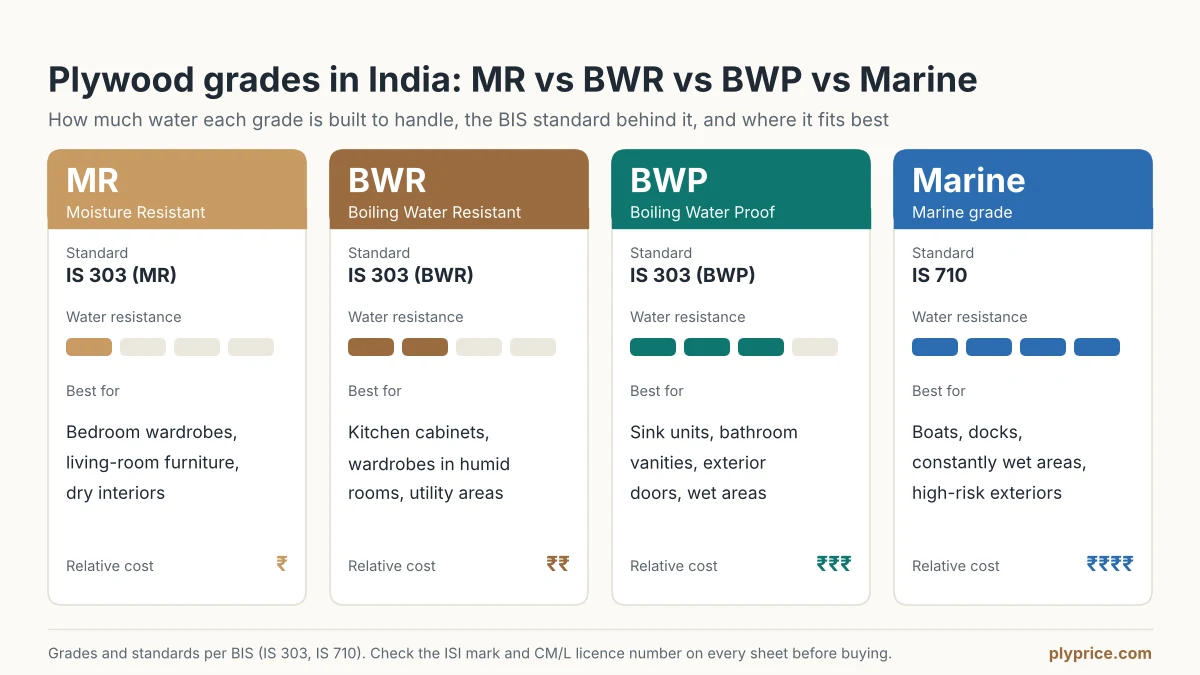
ISI norms classify plywood by boiling water resistance cycles:
- MR Grade: Single boil cycle; urea glue swells and weakens beyond 20-30% moisture.
- BWR Grade: Multiple boil cycles; phenolic glues maintain shear strength above 70% even after immersion.
In practice, unbranded commercial ply from local dealers may skip rigorous testing, leading to variability. Architects specify BWR for semi-exposed areas, reasoning from glue's hydrolysis resistance rather than surface coatings alone.
Why Commercial Plywood Compromises in Kitchen Setups
Kitchens in Indian households endure a unique triad of stresses: steam from cooking curries and tadkas, frequent spills of water or oil, and high humidity spikes during monsoon seasons. Commercial plywood, despite its affordability, unravels under these conditions due to adhesive migration and veneer swelling.
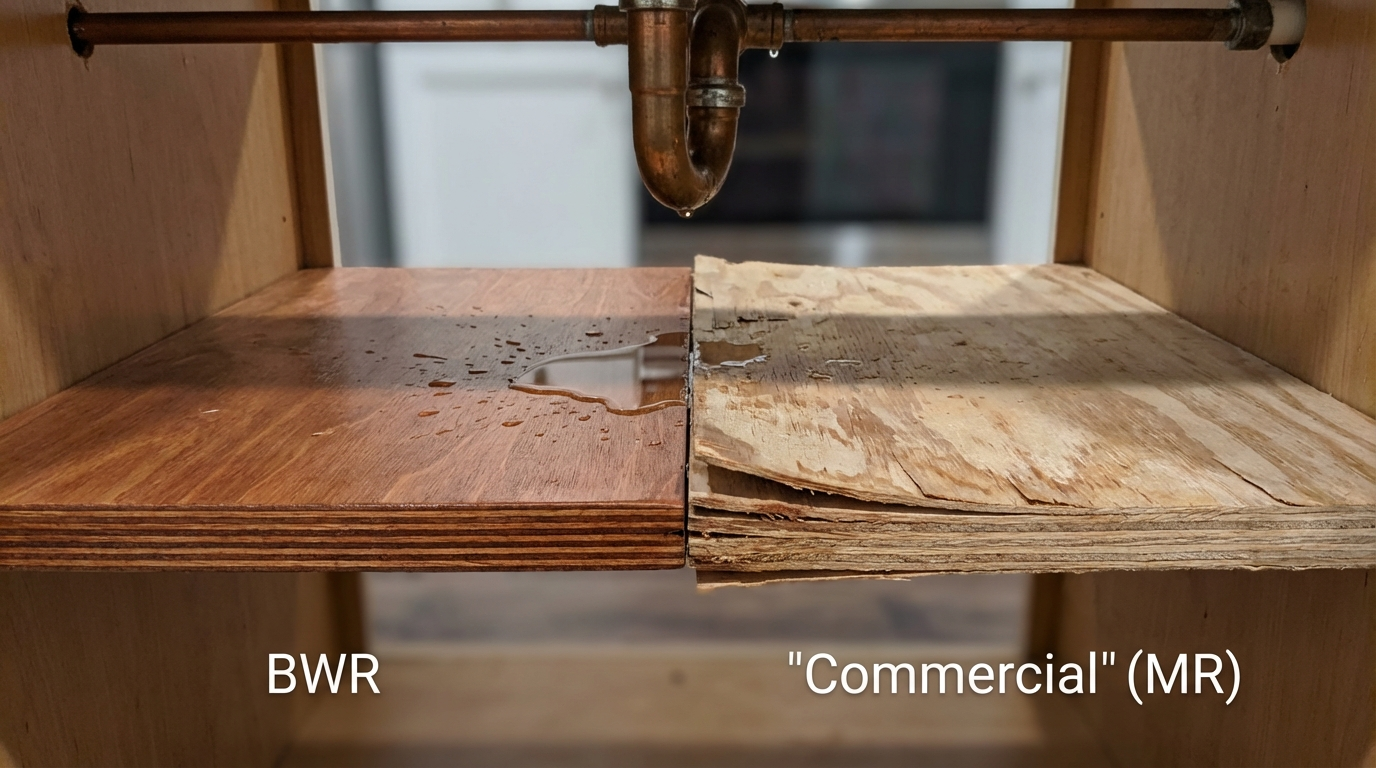
Consider a typical Mumbai modular kitchen: Counterbacks face 60-80% relative humidity daily, plus direct splashes. MR glue absorbs water, causing core layers to expand differentially—edges warp by 5-10mm within months, cracking laminates or paint finishes. Homeowners report sagging shutters after 1-2 years, forcing costly replacements amid rising labor rates.
Contractors often push commercial ply to cut budgets by 20-30%, but this shortsightedly ignores lifecycle costs. A warped cabinetry frame disrupts alignment, amplifying issues in adjacent modules. In contrast, BWR's denser glue matrix limits expansion to under 2%, preserving structural integrity through 5-7 years of heavy use.
Real-World Failure Modes Observed in Indian Installations
- Delamination at Edges: Commercial ply edges fray from sink proximity, exacerbated by alkaline cleaners like harpic.
- Bulging Under Laminates: Steam penetrates micro-cracks, swelling the core and lifting HPL sheets.
- Mold Growth: Trapped moisture in MR glue fosters fungal attack, common in Tier-2 cities with inconsistent ventilation.
Interior designers advise against commercial ply here, citing post-installation callbacks that erode trust. Data from field surveys in Delhi-NCR shows 40-50% higher failure rates for MR in kitchens versus dry areas.
Application Suitability: Kitchens Demand BWR, Wardrobes Tolerate Commercial
Matching plywood to room function aligns with buyer decision logic—prioritizing durability where exposure is high, and economy where it's low. Kitchens qualify as "wet zones" due to vapor transmission from gas stoves and wet grinding, while wardrobes in bedrooms remain in stable 40-50% humidity.
For wardrobes, commercial plywood suffices in paneling or carcasses away from direct water. Its lighter weight aids handling during assembly, and basic moisture resistance handles occasional dusting or humidity fluctuations. In air-conditioned master bedrooms, MR ply maintains flatness, avoiding the premium for BWR.
However, even wardrobes benefit from BWR if near attached bathrooms or in humid belts like Kerala—where ambient moisture exceeds 70%. Homeowners upgrading to walk-ins factor this, balancing aesthetics with hidden durability.
Zone-Based Usage Matrix for Indian Homes
| Application Zone | Recommended Plywood | Key Stress Factors | Expected Lifespan |
|---|---|---|---|
| Kitchen Cabinets & Counter Frames | BWR | Steam, spills, 60-80% RH | 7-10 years |
| Wardrobe Carcasses (Dry Bedroom) | Commercial (MR) | Low humidity, no direct water | 5-8 years |
| TV Units / Shelves | Commercial (MR) | Occasional dusting | 6-9 years |
| Bathroom Vanities | BWR (or BWP) | High moisture, splashes | 8-12 years |
Head-to-Head Performance Metrics: BWR Outperforms in Critical Tests
Beyond labels, empirical tests reveal BWR's edge. Tensile strength post-boiling averages 20-30% higher for BWR, resisting shear forces from heavy utensils in drawers. Screw holding capacity drops 40% faster in soaked MR samples, critical for adjustable shelving.
In India's heat-humidity cycles (e.g., 35°C/80% RH in summer monsoons), BWR exhibits lower formaldehyde emission post-exposure, addressing VOC concerns in enclosed kitchens. Formaldehyde levels in MR can spike 2-3x under stress, prompting health-conscious buyers in metros to opt up.
Detailed Comparison Table
| Parameter | Commercial (MR) Plywood | BWR Plywood |
|---|---|---|
| Boil Test Resistance | 3-hour soak at 60°C, three cycles | 8-hour boil, three cycles |
| Moisture Absorption (24 hrs) | 15-25% | 8-12% |
| Warp Resistance (Cyclic Humidity) | Moderate (5-8mm) | High (<3mm) |
| Screw Holding (Post-Wet) | 60-70% retention | 85-95% retention |
| Typical Thickness Range | 6-19mm | 6-19mm |
| Formaldehyde Emission (ISI) | E1/E0 variable | Consistent E1 |
Cost Dynamics: When BWR's Premium Pays Off
Commercial plywood retails 20-40% lower than BWR due to cheaper urea glues and less processing. A 18mm BWR sheet from a branded source commands a relative premium driven by resin costs and ISI certification overheads. Regional variations amplify this: North India (UP/Bihar mills) sees tighter spreads from local production, while South sees 10-15% uplifts from transport.
Dealers quote per sheet, but savvy contractors calculate per sq.ft. installed. For a 10x8 ft kitchen, BWR adds upfront costs but slashes rework by 30-50%, amortizing over 7 years. Homeowners in villas weigh this against resale value—durable kitchens signal quality to buyers.
Volume buyers negotiate via distributors, where unbranded commercial floods markets but BWR sticks to certified channels. Always verify BIS stamps, as fakes inflate short-term savings with long-term losses.
Factors Influencing Price Gaps
- Core Wood Quality: Poplar-heavy commercial vs. mixed hardwoods in BWR.
- Thickness & Size: Premiums rise non-linearly above 16mm.
- Dealer Margins: Retail 25-35% vs. wholesale 10-15%.
- Certification: ISI adds 10-20% validation cost.
Practical Buying Guide for Homeowners, Contractors, and Designers
Approach selection methodically: Assess exposure first—kitchens and laundry zones mandate BWR. Inspect samples: Tap for density (solid thud indicates uniform core), check edges for glue squeeze-out (gaps signal poor bonding).
For contractors: Bulk BWR from mills cuts costs, but test batches for consistency. Designers: Specify BWR with 710gsm laminates for kitchens, MR for wardrobes. Homeowners: Prioritize thickness (min 18mm for shutters) over brand hype.
Regional tips: In coastal areas, pair BWR with edge-banding; inland, MR ventilates well. Avoid mixing grades in one project—thermal expansion mismatches cause cracks.
Step-by-Step Decision Framework
- Map Exposures: List water/steam contacts.
- Budget Lifespan: Calculate total ownership cost.
- Verify Specs: Demand test certificates.
- Source Wisely: Dealer networks over roadside.
- Post-Buy: Seal edges, ensure ventilation.
Debunking Myths: Beyond Surface Assumptions
Myth 1: "Laminates make any ply waterproof." Reality: HPL protects surfaces but not cores—water seeps via edges.
Myth 2: "Commercial ply is fine with paint." Reality: Swelling undermines adhesion, leading to peeling.
Myth 3: "BWR is overkill for Indian wardrobes." Reality: Humidity gradients in non-AC homes justify it selectively.
Architects counter these with layered specs: BWR base + moisture barriers for hybrids.
Which Rooms Need BWR and Which Can Use Commercial Ply?
For budget modular kitchens, default to BWR carcasses with MR internals. Upscale projects: Uniform BWR for seamlessness. Contractors in high-volume apartments standardize BWR to minimize variants and callbacks.
Long-term: As India's interior market matures, BWR adoption rises with awareness—shifting from price-led to performance-led buys. Consult local norms, but let exposure dictate: Commercial for dry, BWR for damp.
Related guides on PlyPrice
Want Plywood Suggestions?
Share a few details and a PlyPrice specialist will suggest suitable brands and connect you to responsive dealers.