Plywood Price in India 2026: Rates by Grade, Thickness and Brand
In October 2026, 18-19mm plywood in India cost about ₹45-130 per sq ft for MR, ₹45-160 for BWR and ₹78-175 for BWP or marine, from local ISI sheets to national brands. An 8x4 sheet is 32 sq ft, so 18mm BWP runs about ₹2,500-5,600 a sheet; CenturyPly lists Sainik 710 at ₹122 per sq ft including GST.
Last updated: . Prices, grades and standards checked against brand websites, BIS standards and dealer listings.
Plywood price in India today: quick answer (October 2026)
Plywood in India is priced per square foot, and a standard 8x4 ft sheet is 32 sq ft. In October 2026, 18-19mm sheets cost about ₹45-130 per sq ft for MR, ₹45-160 for BWR and ₹78-175 for BWP or marine, from local ISI-marked sheets at the low end to national brands at the top. CenturyPly, the only major brand with one national price, lists Sainik 710 (BWP) at ₹122 and Club Prime (marine) at ₹171 per sq ft, both including GST.
| Grade (18-19mm) | Local or unbranded ISI (₹/sq ft) | Branded (₹/sq ft) | 8x4 sheet, local to branded (₹) | Where it fits |
|---|---|---|---|---|
| MR | 45-80 | 85-130 | 1,440-4,160 | Bedrooms, wardrobes, TV units and other dry areas |
| BWR | 45-85 | 95-160 | 1,440-5,120 | Kitchen uppers and humid rooms away from direct water |
| BWP or marine | 78-113 | 120-175 | 2,496-5,600 | Sink units, bathroom vanities, exteriors and wet areas |

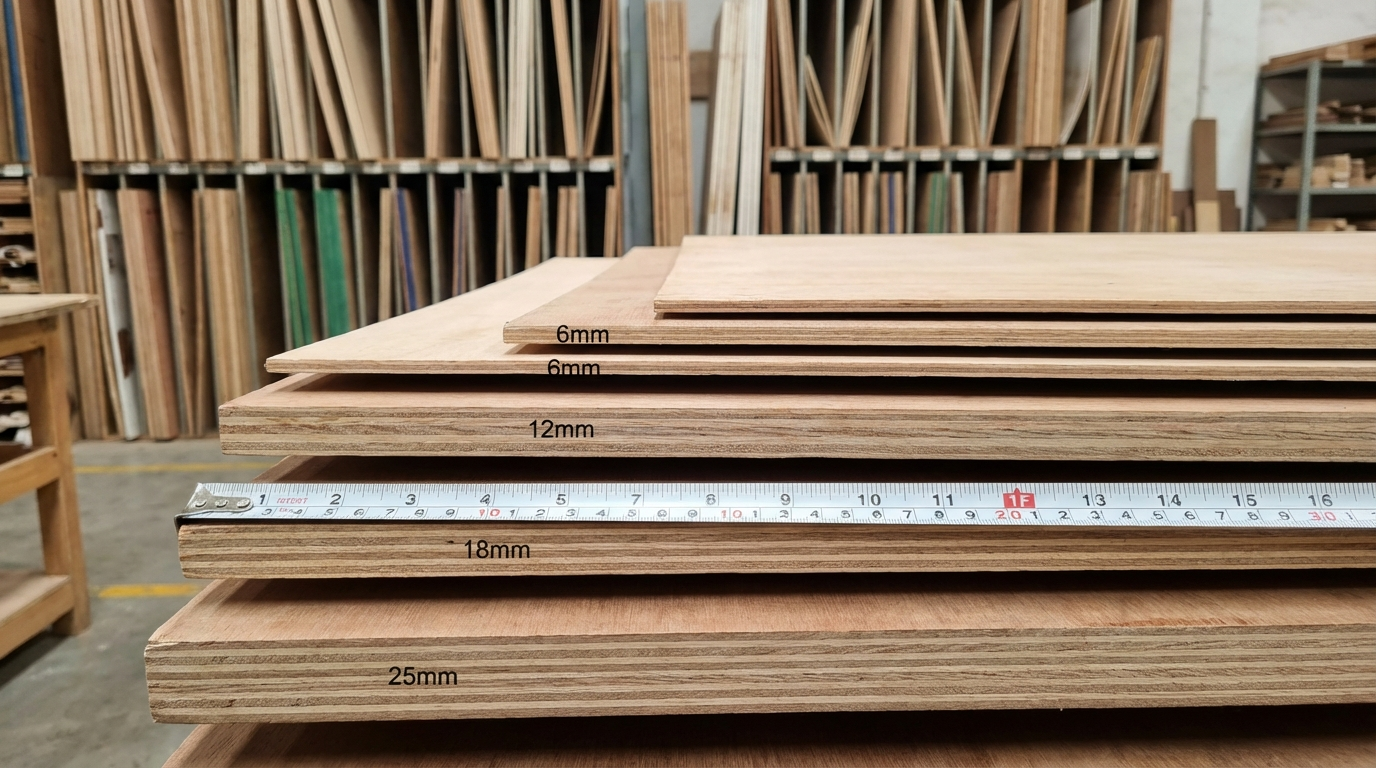
Thinner sheets cost less: a 6mm sheet costs roughly half as much per sq ft as an 18-19mm sheet of the same series. Branded sheets often sell 10-25% below MRP at dealers, and GST on plywood is 18%.
Plywood price by thickness (2026)
Greenply is one of the few brands that publishes thickness-wise prices. Its April 2026 guide gives these indicative rates, which show how the price steps up with thickness:
| Thickness | Greenply 710 Marine (₹/sq ft) | Greenply Gold BWP (₹/sq ft) | Gold, 8x4 sheet (₹) |
|---|---|---|---|
| 4mm | 52 | 55 | 1,760 |
| 6mm | 60 | 64 | 2,048 |
| 9mm | 71 | 76 | 2,432 |
| 12mm | 88 | 94 | 3,008 |
| 16mm | 112 | 116 | 3,712 |
| 19mm | 125 | 134 | 4,288 |
| 25mm | 194 | 206 | 6,592 |
Applying the same thickness steps to the 18-19mm bands gives a working range for branded sheets of each grade. Use it to budget, not as a quote; local ISI sheets usually sit below these ranges.
| Thickness | MR (₹/sq ft) | BWR (₹/sq ft) | BWP or marine (₹/sq ft) |
|---|---|---|---|
| 6mm | 40-60 | 45-75 | 55-85 |
| 9mm | 50-75 | 55-90 | 70-100 |
| 12mm | 60-90 | 65-110 | 85-125 |
| 16mm | 75-115 | 80-140 | 105-150 |
| 18-19mm | 85-130 | 95-160 | 120-175 |
| 25mm | 130-200 | 145-245 | 185-270 |
Detailed thickness guides:
- MR: 6mm, 9mm, 12mm, 16mm, 18mm, 25mm
- BWR: 6mm, 9mm, 12mm, 16mm, 18mm, 25mm
- BWP: 6mm, 9mm, 12mm, 16mm, 18mm, 25mm
Plywood brand price list (October 2026)
Brands publish prices in different ways, so the table labels each number. CenturyPly lists national prices including GST, Greenply publishes guide prices and most other brands leave pricing to dealers.
| Brand and line | Grade | Price (₹/sq ft) | What the number is |
|---|---|---|---|
| CenturyPly Sainik 710 | BWP (IS 303) | 122 per unit (1 sq ft) | Brand list price incl. GST, same across India |
| CenturyPly Club Prime | Marine (IS 710) | 171 per unit (1 sq ft) | Brand MRP incl. GST |
| Greenply Gold, 19mm | BWP (IS 710) | about 134 | Greenply price guide, April 2026 |
| Greenply 710 Marine, 19mm | Marine (IS 710) | about 125 | Greenply price guide, April 2026 |
| Greenply MR 303 | MR (IS 303) | from 45 | Brand entry price, thinnest sheet, excl. tax |
| Kitply Gold, 18-19mm | Marine BWP | about 111-140 | Dealer listings, Oct 2026 |
| Kitply Vista MR, 18mm | MR | about 73-98 | Dealer listings, Oct 2026 |
| Duro Plus, 18mm | Made per IS 710 | about 109 | Duroply's own storefront, Oct 2026 |
| Archidply, 19mm | Not stated | about 110 | Dealer listing, Oct 2026 |
| Sylvan Ply | Not stated | about 123-129 | Dealer listings, Oct 2026 |
| Austin | IS 710, BS 1088 lines | No reliable price found | Ask for a written dealer quote |
| Action TESA HDHMR, 18mm | HDHMR board, not plywood | about 70-104 | Dealer listings, Oct 2026 |
For warranties, standards and how the brands compare, see the best plywood brands in India.
What moved plywood prices in 2026
Resin chemicals drove most of the change this year. Phenol and formaldehyde, the raw materials for BWR and BWP glue, rose sharply in March and April 2026, and the large brands passed it on: CenturyPly raised plywood prices by about 7% in April and Greenply by about 4-5%. MDF makers announced increases of around 15% from April, but most of those were rolled back by August. GST on plywood stays at 18%, unchanged by the September 2025 rate changes. More context: why plywood prices fluctuate and GST on plywood.
MR, BWR or BWP: which grade is worth paying for?
Grade moves the price more than brand does. IS 303:2024 sets three grades by how well the glue survives water, and IS 710:2024 covers marine plywood:
| Grade | Standard | Water test set by BIS | Typical use |
|---|---|---|---|
| MR | IS 303:2024 | Soaked 3 hours in water at 60°C, then dried, for three cycles | Dry interiors |
| BWR | IS 303:2024 | Boiled 8 hours, then dried 16 hours, for three cycles | Humid rooms, kitchen uppers |
| BWP | IS 303:2024 | 72 hours in boiling water, then tested wet | Sink units, bathrooms |
| Marine | IS 710:2024 | 72-hour boil plus minimum glue strength and preservative treatment | Boats, exteriors, constantly wet areas |
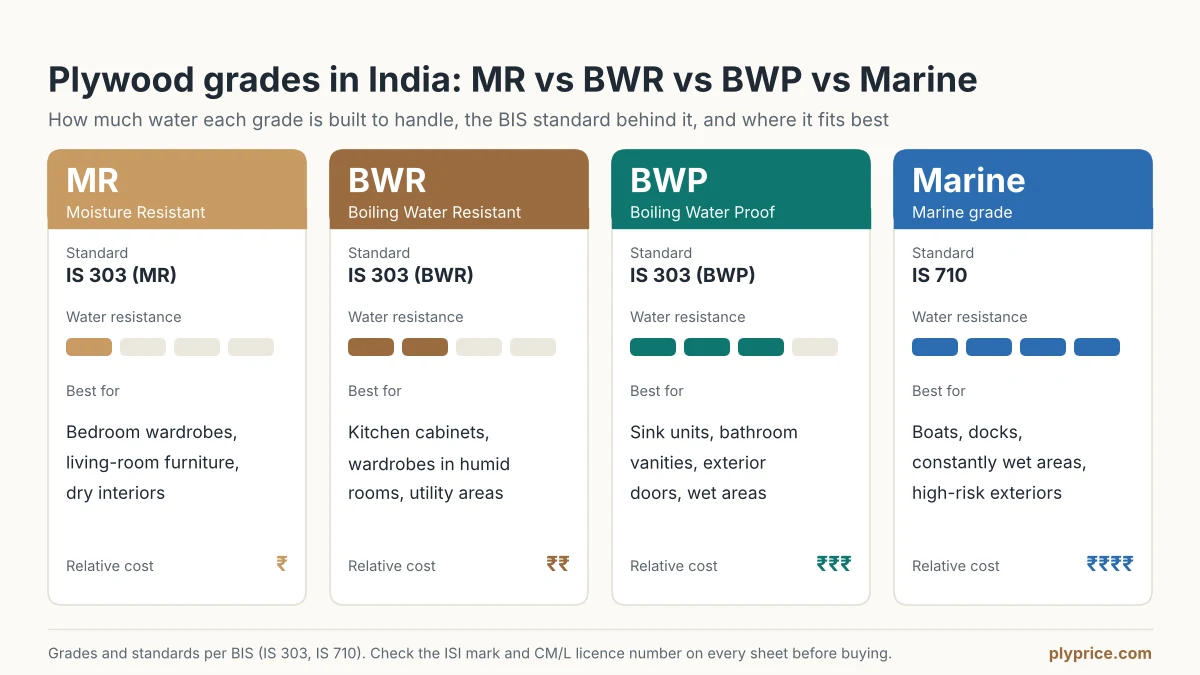
Use MR in dry rooms, BWR where there is humidity but no standing water, and BWP or marine wherever water reaches the sheet, such as the sink base. Branded BWP costs roughly 35-40% more per sq ft than branded MR at 18-19mm, so using it everywhere raises the bill without adding much in dry rooms. See MR vs BWR vs BWP.
Why the same sheet has different prices
- List price vs dealer price: MRPs and list prices usually include GST; dealer quotes often exclude it. Ask which one you are being given.
- Brand series: one brand's entry and top series can differ by about ₹50 per sq ft, as CenturyPly's Sainik 710 (₹122) and Club Prime (₹171) show. Compare the same series, not just the brand.
- Order size and delivery: small orders often pay transport and loading on top; bulk orders get better rates.
- City: freight from plywood clusters such as Yamunanagar in Haryana, and local demand, move rates between cities.
- Calibration and finish: calibrated sheets, decorative faces and fire-retardant grades cost more. See calibrated plywood price.
The full chain from factory to your site is explained in how dealer margins work and how plywood prices are decided.
How to calculate plywood cost for your project
Multiply the number of sheets by 32 (sq ft per 8x4 sheet) and by the rate per sq ft, then add GST if the quote excludes it. Example: 12 sheets of 18mm BWP at ₹125 per sq ft come to 12 x 32 x 125 = ₹48,000 before GST, or ₹56,640 with 18% GST. Ask your carpenter for a cutting list with sheet counts by thickness, and keep 5-10% extra for wastage.
Plywood price by city
Rates differ between cities because of freight, local demand and dealer competition. Our city guides cover grade-wise ranges and buying tips for 80 cities:
- Delhi NCR: Delhi, Noida, Gurugram (Gurgaon), Ghaziabad, Faridabad
- Haryana: Panipat, Sonipat, Karnal, Kurukshetra, Hisar, Rohtak
- Punjab: Ludhiana, Amritsar, Jalandhar, Patiala, Bathinda
- Rajasthan: Jaipur, Jodhpur, Udaipur, Ajmer, Bikaner, Alwar
- Gujarat: Ahmedabad, Surat, Vadodara, Rajkot
- Maharashtra: Mumbai, Pune, Nagpur, Nashik, Aurangabad, Kolhapur, Solapur, Sangli
- Madhya Pradesh and Chhattisgarh: Indore, Bhopal, Raipur, Bhilai, Durg, Bilaspur
- Bihar, Jharkhand and West Bengal: Patna, Gaya, Ranchi, Jamshedpur, Dhanbad, Bokaro, Kolkata
- Karnataka: Bengaluru, Mysuru, Mangaluru, Manipal, Udupi, Hubballi, Dharwad, Belagavi, Davangere, Shivamogga, Ballari
- Tamil Nadu: Chennai, Chengalpattu, Coimbatore, Madurai, Tiruchirappalli (Trichy), Salem, Erode, Tiruppur, Vellore, Hosur, Krishnagiri
- Telangana and Andhra Pradesh: Hyderabad, Warangal, Visakhapatnam (Vizag), Vijayawada, Guntur, Nellore, Tirupati, Chittoor, Kadapa, Kurnool, Anantapur
How to get a fair plywood price
- Fix the grade and thickness first, then collect written quotes for the same series from two or three dealers. See how to negotiate plywood prices.
- Check the ISI mark and the CM/L licence number (CM/L followed by 10 digits), and verify it in the BIS Care app. See how to check the ISI mark on plywood.
- Ask whether the rate includes GST, transport and loading.
- Get a GST invoice that names the brand series, grade and thickness.
- Be wary of "710" sheets priced far below the BWP band. See how to identify fake plywood.
Frequently asked questions
What is the price of plywood per sq ft in India?
For 18-19mm sheets in October 2026: about ₹45-80 per sq ft for local MR and ₹85-130 for branded MR, ₹45-85 and ₹95-160 for BWR, and ₹78-113 and ₹120-175 for BWP or marine. Thinner sheets cost less. See plywood price per sq ft.
What is the price of an 8x4 plywood sheet?
Multiply the per sq ft rate by 32. An 18-19mm MR sheet costs about ₹1,440-4,160, BWR about ₹1,440-5,120 and BWP or marine about ₹2,500-5,600, local to branded. See plywood sheet price.
Which plywood is best in India?
The best plywood is the right grade with a valid ISI licence: MR for dry rooms, BWP or marine for kitchens and bathrooms. Among brands, CenturyPly and Greenply are the largest national names; see our comparison of the best plywood brands in India.
Is plyboard the same as plywood?
Not always. Dealers use "plyboard" loosely: some mean plywood, many mean blockboard, which has a core of wooden strips between veneers. Ask which one you are being quoted. See what plyboard means and plywood vs blockboard.
Does the plywood price include GST?
Brand MRPs and list prices, such as CenturyPly's, usually include GST. Dealer quotes often exclude it. GST on plywood is 18%, so ₹100 per sq ft before tax becomes ₹118.
Can I buy plywood without the ISI mark?
Not legally from a dealer. Since February 2025, a BIS Quality Control Order requires plywood sold in India to carry the ISI mark under a valid licence. If a dealer offers unmarked sheets, walk away.
When are plywood prices likely to change?
Watch resin chemical costs, timber supply and brand price announcements. In 2026, resin costs drove the April increases. See the plywood price forecast for 2026.
Sources and method: brand price pages and guides (CenturyPly Club Prime, Greenply marine plywood price guide, April 2026), dealer and B2B listings on IndiaMART (August to October 2026), online retail listings (October 2026), BIS standards IS 303:2024 and IS 710:2024, and analyst reports on Century Plyboards and Greenply (2026). Thickness-wise ranges marked as estimates are PlyPrice calculations from the 18-19mm bands and Greenply's published thickness steps. Prices are indicative, checked on 15 October 2026, and vary by city, dealer, brand series, thickness and order size. PlyPrice is an independent buyer's guide and is not affiliated with any brand.
Related guides on PlyPrice
Want Plywood Suggestions?
Share a few details and a PlyPrice specialist will suggest suitable brands and connect you to responsive dealers.