How to Identify Fake Plywood: 5 Checks for ISI Mark, CM/L and Core
You can identify fake plywood by checking the ISI mark details, verifying the CM/L licence number online and inspecting the core and edges for gaps before a knock-and-weight test. Fakes are often passed off as premium MR, BWR or BWP grades.
Last updated: . Grades and standards checked against current BIS standards.
Why India's Plywood Market Demands Vigilance Against Fakes
In India's fast-paced construction and interior design sectors, plywood forms the backbone of furniture, cabinets, wardrobes, and structural elements. With urban housing booms in cities like Mumbai, Delhi, and Bengaluru, demand surges during monsoons and festive seasons. Yet, this creates opportunities for substandard or adulterated sheets—often passed off as premium MR, BWR, or BWP grades. Homeowners face warping wardrobes after the first rain; contractors deal with delamination callbacks costing weeks of labor. From first principles, plywood's strength relies on uniform hardwood veneers cross-banded with quality adhesives under pressure. Fakes compromise this by using softwood cores, excess fillers, or weak glues, leading to early failure in humid, termite-prone conditions typical across India.
Buyers—homeowners prioritizing longevity, architects specifying for projects, or contractors sourcing bulk—must understand deception tactics. Dealers might quote "ISI-certified" verbally while stocking unmarked sheets. Regional variations amplify risks: coastal Kerala sees more moisture fakes, while northern markets battle termite-infested rejects. This guide outlines a practical 5-step check, grounded in Bureau of Indian Standards (BIS) norms and field-tested observations, empowering decisions without lab access.
Step 1: Scrutinize the ISI Mark and Accompanying Details
The ISI mark, overseen by BIS, signals compliance with standards like IS 303 (for MR, BWR and BWP grades) or IS 710 (for marine plywood). But fakes abound—printed logos without validation. Genuine marks are embossed or ink-stamped clearly on the sheet's surface and edges, often multiple times for traceability.
- Key identifiers: Look for the full marking: "ISI" symbol + standard code (e.g., IS:303) + 7-digit CM/L number (Certification Marks License). This unique license ties to a licensed manufacturer.
- Fake clues: Blurry, painted-on logos; missing CM/L; generic "ISI" without code; spelling errors like "1S1" instead of "ISI".
Why it matters: in India's decentralised supply chain, from mills to dealers in Tier-2 cities, unlicensed fakes skip the BIS tests on glue strength and formaldehyde limits. Homeowners in humid Pune might buy "BWP" without an IS 303 or IS 710 mark, only for kitchens to swell.
| Genuine ISI Marking | Fake Imitation |
|---|---|
| Clear emboss: ISI + IS:303 or IS:710 + CM/L-XXXXXXXXXX (10 digits) + thickness/grade | Sticker or faint print: Just "ISI Certified" or mismatched code |
| Appears on all four edges | Surface-only, easily peeled |
| Matches BIS database | No verifiable license |
Pro tip for contractors: Insist on markings before loading trucks—rejects spike 20-30% in bulk buys without this.
Step 2: Verify the CM/L Number Online for Manufacturer Traceability
The CM/L number isn't decorative; it's a direct link to BIS records. Each licensed producer has one, verifiable instantly via the free BIS Care App (Android/iOS) or website (services.bis.gov.in).
- Locate the 7-digit code under the ISI mark.
- Enter it in the app/site's "Verify Licence" section.
- Confirm details: Manufacturer name, valid expiry, product scope (e.g., BWP up to 25mm).
If invalid or expired, walk away—it's fake. This step catches 40-50% of market deceptions, per industry dealer feedback. Architects specifying for high-rises use it to audit suppliers; homeowners scan at retail yards. In regions like Gujarat's plywood hubs, cross-verification exposes relabeled rejects from failed mills.
Assumptions in trends: Enforcement varies—stronger in metros, laxer rurally—but buyer diligence shifts dynamics. No app access? Request the dealer's BIS certificate copy; genuine suppliers provide it.
Step 3: Inspect Core Layers and Edge Profile for Structural Integrity
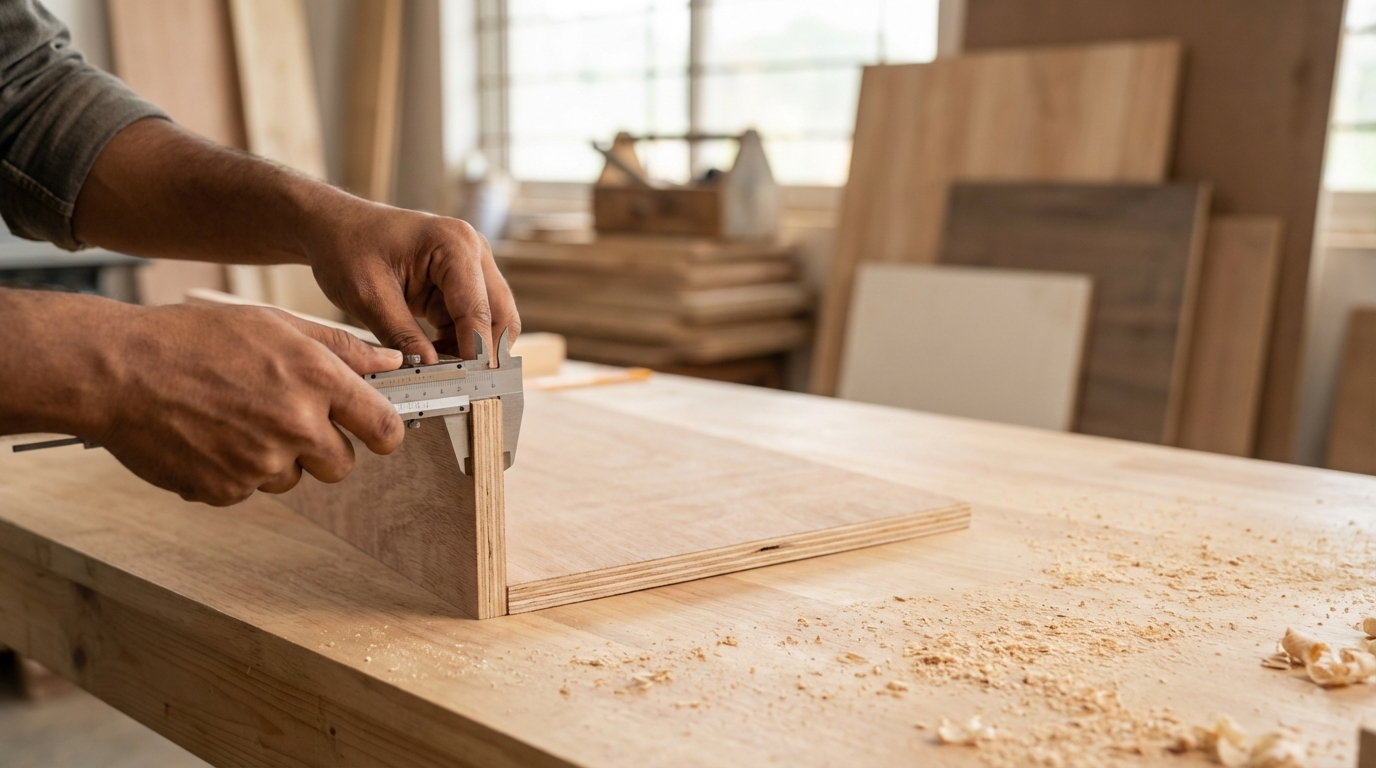
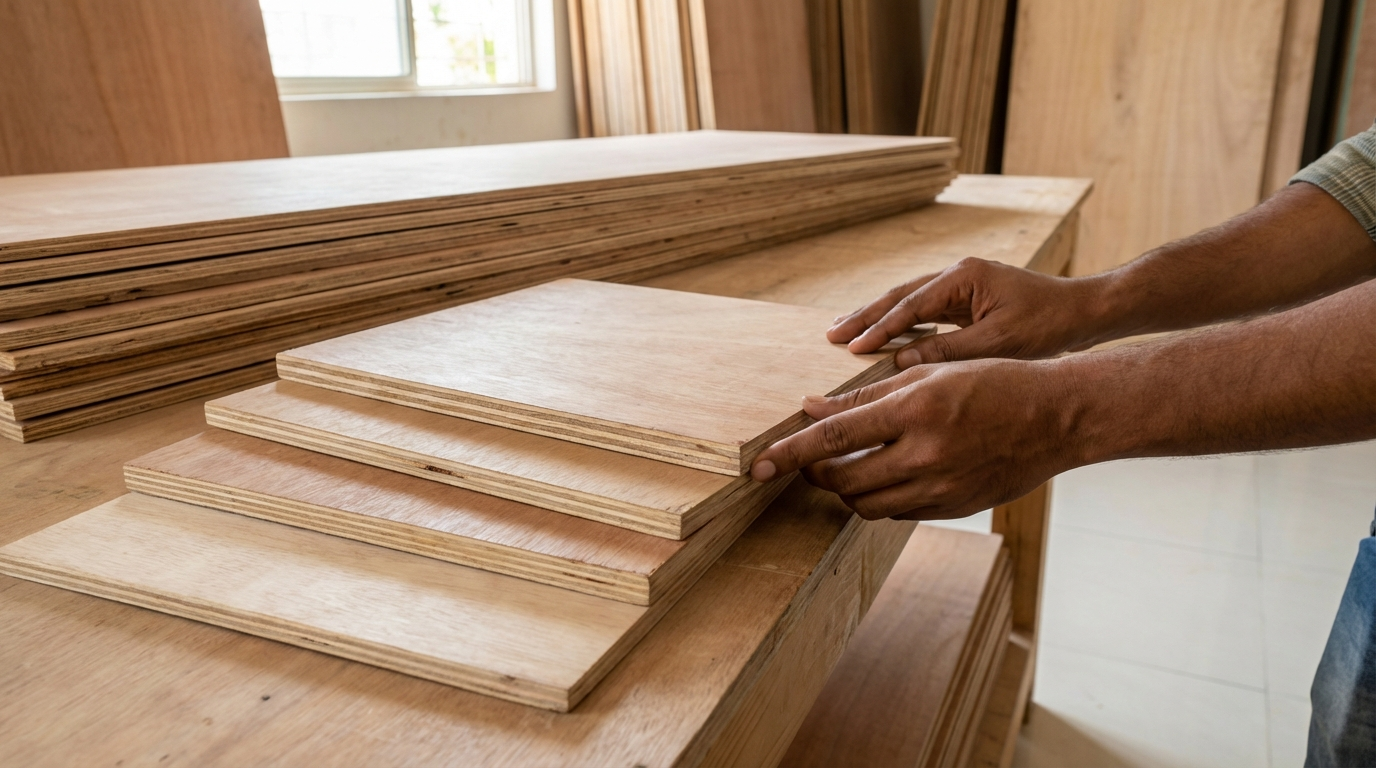
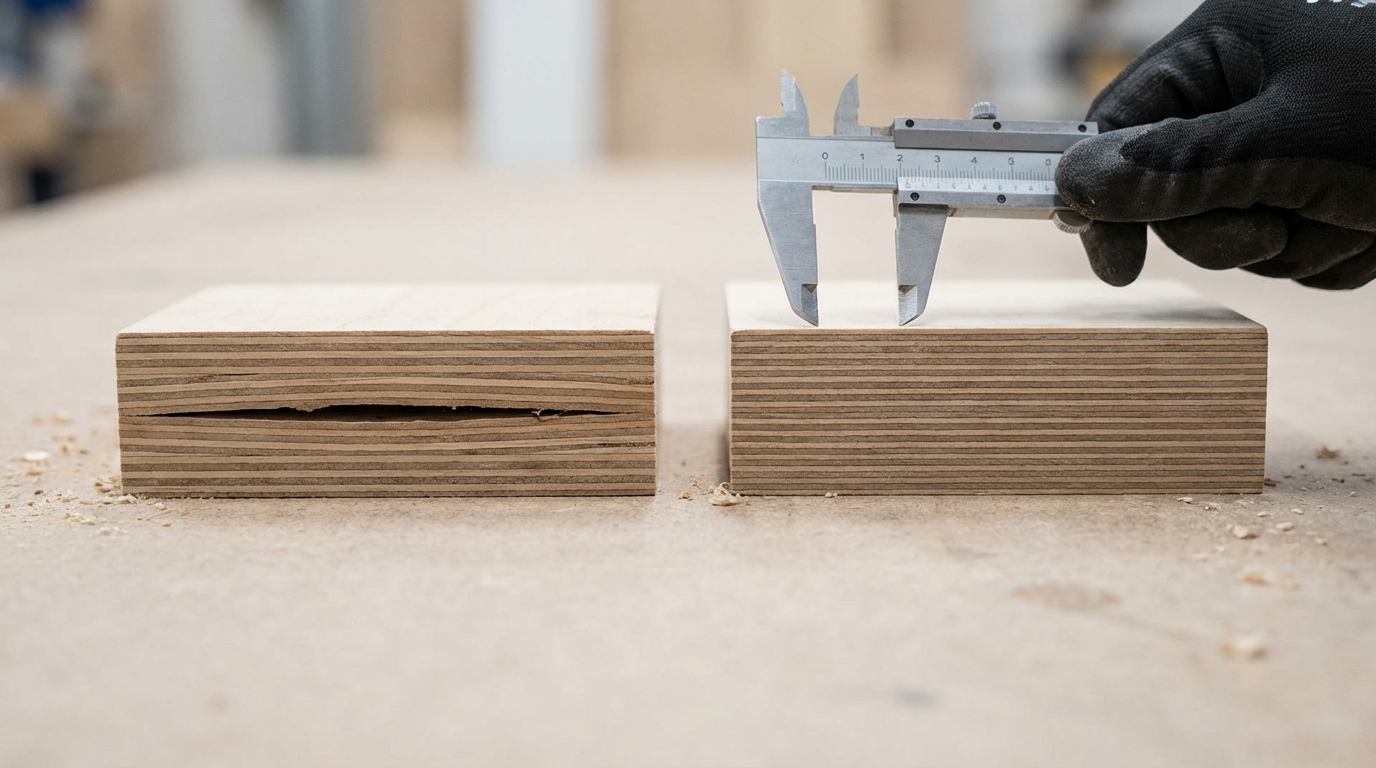
Plywood's core dictates 70% of durability. Slice an edge view (or examine pre-cut samples): Genuine sheets show 5-13 uniform hardwood plies (veneers), cross-banded at 90 degrees, with tight glue lines—no gaps wider than 1mm.
- Visual hallmarks of genuine: Alternating grain directions; smooth, parallel edges; calibrated thickness (even ±0.5mm tolerance); dense core (gurjan/eucalyptus for premium).
- Red flags in fakes: Core gaps/voids (air pockets from poor pressing); overlapping veneers; softwood/mango fillers; wavy layers; exposed knots.
In India's climate, gaps trap moisture, fostering delamination and termites—common in Bengaluru apartments post-monsoon. Contractors tap edges: Solid feel vs. spongy. For blockboard/MDF contrasts, plywood cores avoid particle fillers, but fakes mimic with cheap composites.
Step 4: Conduct the Knock and Weight Test for Density Clues
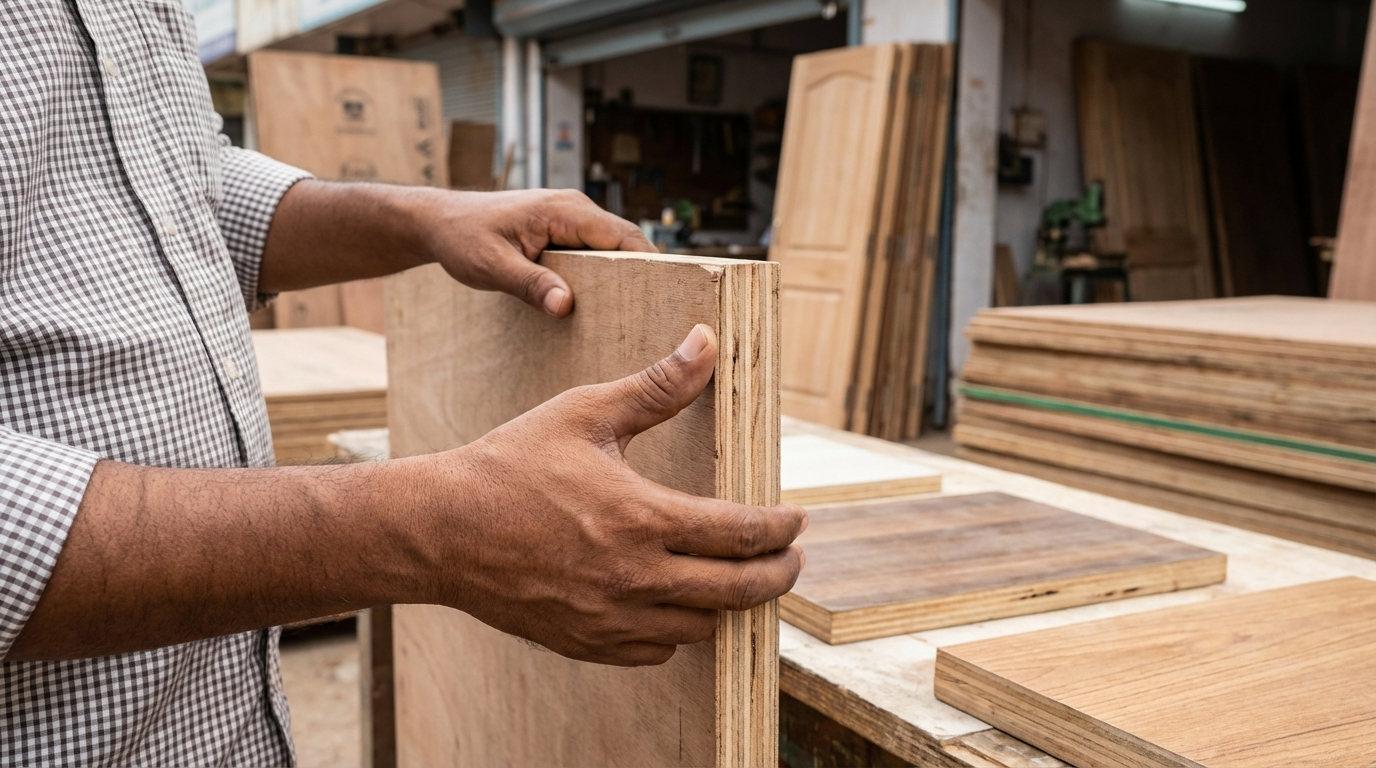
Physics-based checks reveal hidden flaws without tools. Genuine plywood's dense hardwood core yields a solid, uniform "thud" when knuckle-tapped across the surface—like rapping a solid door.
- Knock test: Start center to edges/corners. Hollow "tok-tok" signals voids; uneven tone indicates patchy glue.
- Weight check: Heft a corner—premium BWP feels heavier per sqm due to hardwood and phenolic resins. Fakes, lightened by poplar/softwood, tip off bulk buyers.
Buyer logic: Homeowners compare stacks at dealers; contractors weigh samples against specs (e.g., 18mm BWP ~50-60kg/sheet). In humid Kolkata, light fakes fail first under laminate weight.
| Test | Genuine Response | Fake Indicators | Why It Fails Later |
|---|---|---|---|
| Knock | Solid thud everywhere | Hollow echoes | Voids swell in humidity |
| Weight (18mm sheet) | Heavy, balanced | Feels light | Poor screw hold, sags |
| Flex (lift corner) | Minimal bend | Sags easily | Weak for shelves |
Step 5: Sensory Checks and Contextual Validation
Combine smell, surface, and deal context. Genuine emits faint wood aroma; fakes reek of urea-formaldehyde (harsh chemical whiff, health risk in enclosed spaces). Surface: Sanded smooth, uniform color—no patches, blisters, or repair fillers.
- Additional validators: Printed brand name/logo on edges; warranty sticker (5-50 years for premium); no excessive shine (fake overlays).
- Dealer audit: Ask for lab test reports (glue line shear, mycological tests). Bulk? Demand site visit to authorized depot.
For interiors in Chennai's salty air, this catches coastal fakes. Architects note: Pair with non-destructive bend test—genuine resists warping.
Beyond the Basics: Advanced Red Flags in India's Dealer Ecosystem
Dealers push fakes via "local brand bargains" or "export rejects." Watch for: Prices 20-40% below peers (cheap cores/glue); verbal "ISI" claims sans marks; mismatched grades (MR sold as BWR); bundled "discounts" hiding subpar stock. Regional logic: North India's cold-stored sheets hide dry rot; South's monsoon stacks breed mold fakes.
Contractor scenario: For 100-sheet orders, sample 5% on-site. Homeowner tip: Buy from BIS-listed mills' depots, not roadside godowns.
Digital Tools for On-the-Spot Verification
Leverage tech: BIS Care App scans CM/L instantly, showing license status, scope, expiry. Brand apps (e.g., for major players) verify QR codes. No internet? Screenshot markings for later check. This empowers Tier-2 buyers in Jaipur or Coimbatore.
Grading Standards Explained: MR, BWR, BWP Realities
IS 303 covers MR (interior dry), BWR (boiling water resistant, 3-cycle boil pass) and BWP (72-hour boil); IS 710 is for marine (72-hour boil plus preservative treatment). Fakes fake grades—test via dealer sample boil (BWP survives 72hrs intact). Durability logic: More plies + phenolic glue = better humidity resistance, vital for Indian wardrobes.
Decision Framework for Buyers: Homeowner vs Contractor
| Buyer Type | Priority Checks | Risk if Ignored | Mitigation |
|---|---|---|---|
| Homeowner (modular kitchen) | ISI/CM/L, core gaps, smell | Swelling post-monsoon | Retail sample inspect |
| Contractor (bulk apartments) | Weight/knock, BIS verify, reports | Callback delays, rework | Third-party audit |
| Architect (spec projects) | All 5 steps + boil test | Liability claims | Pre-approved vendors |
Cost drivers: Genuine commands premium due to hardwood sourcing, BIS audits—varies 15-30% by region (higher South). Always factor lifecycle: Fakes cost 2-3x in replacements.
Common Myths and Missteps to Avoid
- Myth: Thicker = better. No—quality plies matter over bulk fillers.
- Myth: All ISI is equal. Verify CM/L; some licenses lapse.
- Myth: Visual perfection suffices. Internal voids hide under polish.
- Misstep: Skipping edges. Surface beauty masks core flaws.
In conclusion, these steps transform buying from gamble to informed choice. Regular checks sustain India's growing engineered wood market integrity, benefiting all stakeholders.
Related guides on PlyPrice
Want Plywood Suggestions?
Share a few details and a PlyPrice specialist will suggest suitable brands and connect you to responsive dealers.