Best Plywood for Study Table: Grade, Thickness and Finish Guide
The best plywood for a study table is an interior-grade sheet with a smooth, defect-free face for writing and a dense core that grips drawer screws; full waterproof grades are rarely needed. Thickness should match the span and the weight of books.
Last updated: . Grades and standards checked against current BIS standards.
Key Demands of a Study Table on Plywood Performance
Study tables endure daily rigors in Indian homes: heavy textbooks stacked on the top, repeated drawer pulls, and occasional spills from coffee mugs or rainy season humidity seeping in. Homeowners building or refurbishing for students prioritize plywood that resists warping under load while providing a flawless writing surface. Unlike kitchen counters demanding full waterproofing, study tables call for balanced interior-grade durability—focused on surface finish for pens gliding smoothly and core strength to grip screws without stripping during assembly or repairs.
Load-Bearing Realities in Home Study Setups
A typical study table supports 20-40 kg on the desktop alone, with drawers adding dynamic stress from sliding mechanisms. In humid regions like Mumbai or Kerala, even air-conditioned rooms see 60-70% relative humidity spikes, testing plywood's glue line integrity. First-principles logic: plywood's layered construction distributes weight across veneers and core, but weak adhesives delaminate under moisture, causing sagging edges that ruin the level writing plane.
Why Screw Holding Trumps Surface Veneer Alone
Drawers rely on precise screw placement into plywood sides and fronts. Soft cores like poplar crumble under torque, leading to loose fittings after months. Dense hardwood cores, conversely, compress fibers around screws, maintaining grip through 50-100 cycles of use—critical for modular designs where carpenters adjust heights or add shelves.
Smooth Surface: Prioritizing Writing Comfort Over Flashy Finishes
The desktop demands a glass-like finish for uninterrupted note-taking. Rough grains snag paper, and uneven sanding causes pen skips during exams. Optimal plywood features 0.5-1mm thick face veneers from species like gurjan or eucalyptus, cross-banded for stability, and factory-sanded to 180-220 grit.
Grading Standards for Surface Quality
- MR Grade: Basic interior use, suitable for dry rooms but risks bubbling in monsoon-prone areas.
- BWR Grade: Boiling water resistant glue elevates smoothness retention, ideal for 70% of Indian households with variable AC usage.
- Pre-Laminated Sheets: Factory-applied melamine offers inherent smoothness but limits custom staining—better for quick DIY assemblies.
Architects specify BWR because it passes the IS 303 cyclic boil test (8-hour boil, 16-hour dry, three cycles), ensuring the face stays taut without veneer lifting, even after wipe-downs with damp cloths.
Testing Smoothness in Dealer Yards
Run your fingernail across the surface: no drags mean quality sanding. Check cross-grains under light for fills—minimal patching preserves ink flow. In Delhi-NCR dealers, insist on ISI IS:303 certified sheets, where face grading (S=select, A=next) guarantees uniformity.
Sturdy Screw Holding: Core Strength for Drawer Durability
Screws into plywood must withstand 10-15 kg pull-out force per fastener for drawer slides. Core material dictates this: softwood like pine yields low density (400-500 kg/m³), while hardwood mixes hit 600-700 kg/m³, doubling retention.
Core Types and Their Assembly Performance
| Core Material | Density Range (kg/m³) | Screw Holding (Relative) | Best For Study Tables | India-Specific Notes |
|---|---|---|---|---|
| Softwood (Pine/Poplar) | 400-500 | Low (strips easily) | Budget frames only | Common in North India mills; avoids in humid South |
| Hardwood Mix (Eucalyptus/Gurjan) | 550-650 | Medium-High | Drawer sides, legs | Stable in 60% RH; dealer favorite for carpentry |
| HDHMR (High-Density) | 700-850 | High (superior grip) | Full table builds | Moisture-resistant; rising in Tier-2 cities |
| Blockboard | 500-600 | Medium (solid strips) | Heavy-duty tops | Thicker cores suit laminated finishes |
HDHMR edges out traditional plywood here, with resin-infused fibers resisting screw enlargement over time—vital for particle board alternatives that crumble.
Thickness Choices: Balancing Strength and Weight
Study tables favor 18mm for desktops (handles 50kg+ without deflection) and 12mm for drawer components (reduces overall heft for easy relocation). Thinner 9mm suits partitions but bows under laptops. In practice, contractors layer 12mm + 6mm for custom heights, gluing with PVA for seam invisibility.
Deflection Math for Informed Sizing
Simple beam formula guides: deflection = (load x span³) / (plywood modulus x thickness³). Doubling thickness from 12mm to 18mm cuts sag 8x—explaining why 18mm BWR commands 20-30% premium in pricing logic.
Top Recommendations: Matching Plywood to Study Table Designs
For standard rectangular desks, BWR commercial plywood with hardwood core delivers the sweet spot. Modular L-shapes benefit from HDHMR panels for uniform screw response across joints.
Scenario-Based Picks
- Kids' Study Table (Compact): 12-15mm MR BWR, smooth gurjan face. Cost driver: face quality adds 10-15% over basic.
- Adult Workstation (With Drawers): 18mm HDHMR or blockboard core. Excels in screw-dense assemblies; humidity tolerance suits coastal apartments.
- DIY Corner Unit: Pre-laminated BWR sheets. Instant smoothness, but verify glue line for edge banding adhesion.
| Design Type | Ideal Plywood | Smoothness Score (1-10) | Screw Strength Score (1-10) | Moisture Suitability | Relative Cost |
|---|---|---|---|---|---|
| Basic Rectangle | BWR Commercial | 8 | 7 | Medium (Interior) | Baseline |
| Drawer-Heavy | HDHMR | 9 | 9 | High | 20-40% Higher |
| L-Shaped Modular | Blockboard + Veneer | 7 | 8 | Medium-High | 15-25% Higher |
India's Climate Challenges and Plywood Resilience
Monsoon swells (June-Sept) demand BWR over MR to prevent glue failure, especially in non-AC bedrooms. Southern states favor HDHMR for its 24-hour submersion tolerance without core swell. Northern dry zones tolerate MR, but always pair with edge sealing via putty or tape to block moisture wicking.
Regional Dealer Insights
In Gujarat hubs like Ahmedabad, mills push eucalyptus-core BWR at tighter margins due to volume. Kerala prioritizes marine-grade facings unnecessarily—overkill for study use, inflating costs 30-50%. Test via tap: resonant tone signals dense core; dull thud warns of voids.
Assembly Tips for Maximum Longevity
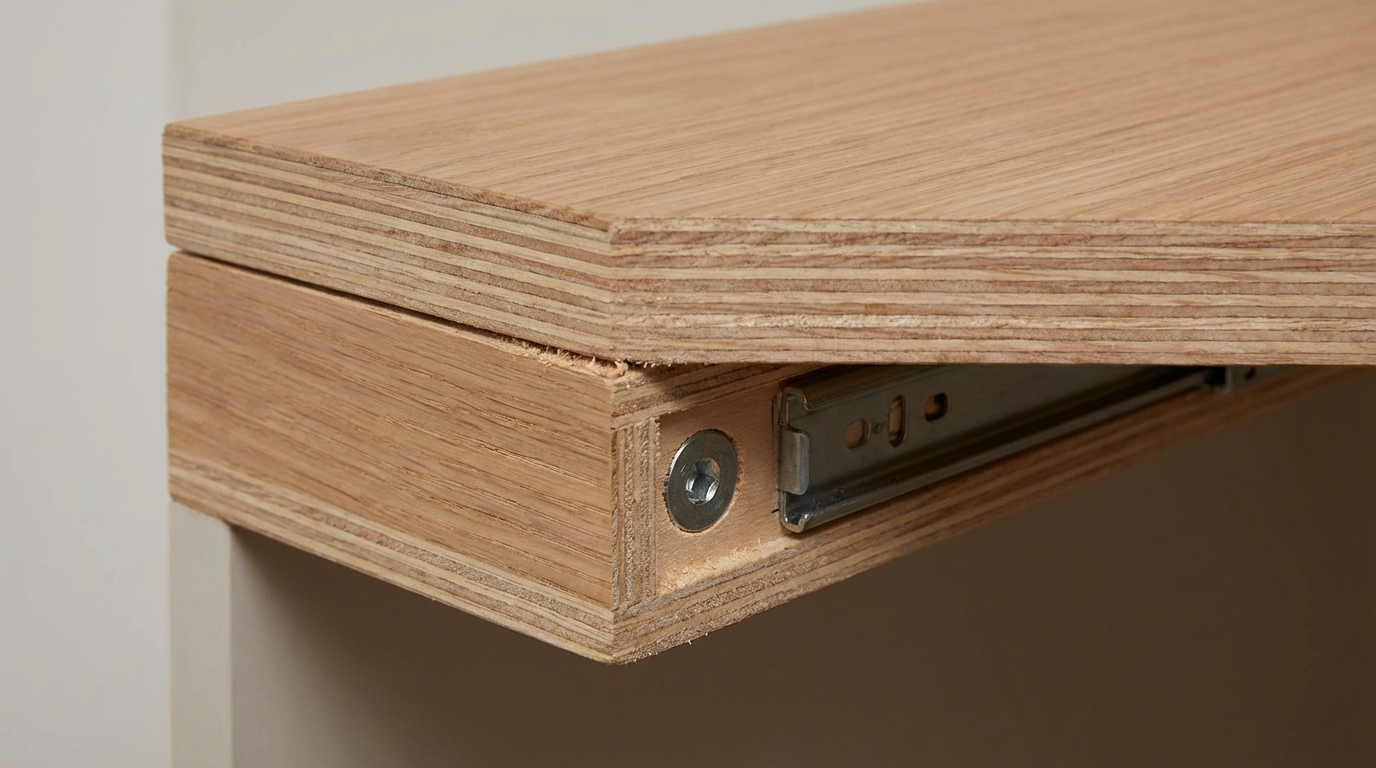
Pre-drill screws (3-4mm pilot) to align fibers, use 45mm No.8 woodscrews for 18mm ply. Apply 2-pack PU polish post-assembly for surface sealing. For drawers, reinforce with dovetail joints over butt alone—plywood's strength amplifies here.
Common Pitfalls to Avoid
- Oversanding faces: erodes veneer, roughens writing area.
- Skipping cross-bracing: leads to top racking under uneven loads.
- Ignoring grain direction: mismatches cause cupping in humidity swings.
Cost Drivers and Value Assessment
Pricing hinges on core density, face grade, and grade (MR baseline, BWR +15-25%, HDHMR +30-50%). Thickness scales linearly: 18mm doubles 12mm sheet cost. Dealers in Mumbai quote per sq ft, factoring transport—add 10-20% for branded ISI over generics. Value metric: prioritize screw tests over aesthetics; a Rs. 100/sqft premium on HDHMR saves rework costs.
Budget vs Premium Breakdown
| Budget Level | Plywood Spec | Expected Lifespan | When to Choose |
|---|---|---|---|
| Entry (MR Softcore) | 12mm, Basic Face | 3-5 Years | Temporary student setups |
| Mid (BWR Hardwood) | 18mm, Select Face | 7-10 Years | Family heirloom tables |
| Premium (HDHMR) | 18mm, Laminated | 10+ Years | High-use professional desks |
Final Buying Checklist for Study Table Plywood
- Verify ISI mark and grade stamp (IS:303 for commercial).
- Inspect 5+ sheets for consistent thickness (±0.5mm tolerance).
- Conduct screw test: drive/remove 3 screws per edge.
- Negotiate bundles: 4x8ft sheets suit table cuts with minimal waste.
- Pair with quality fittings: soft-close slides amplify plywood virtue.
This approach ensures a study table that withstands semesters of use, blending ergonomic smoothness with unyielding structure.
Related guides on PlyPrice
Want Plywood Suggestions?
Share a few details and a PlyPrice specialist will suggest suitable brands and connect you to responsive dealers.