Best Plywood for Flooring Base: BWP vs BWR Subfloor Grades and Thickness
BWP plywood is the best base for wooden, laminate or engineered floors in Indian homes because it resists the spills and monsoon humidity that make subfloors buckle, with BWR as a balanced middle option. Avoid MR plywood under floors altogether.
Last updated: . Grades and standards checked against current BIS standards.
Understanding the Role of Plywood as a Flooring Base
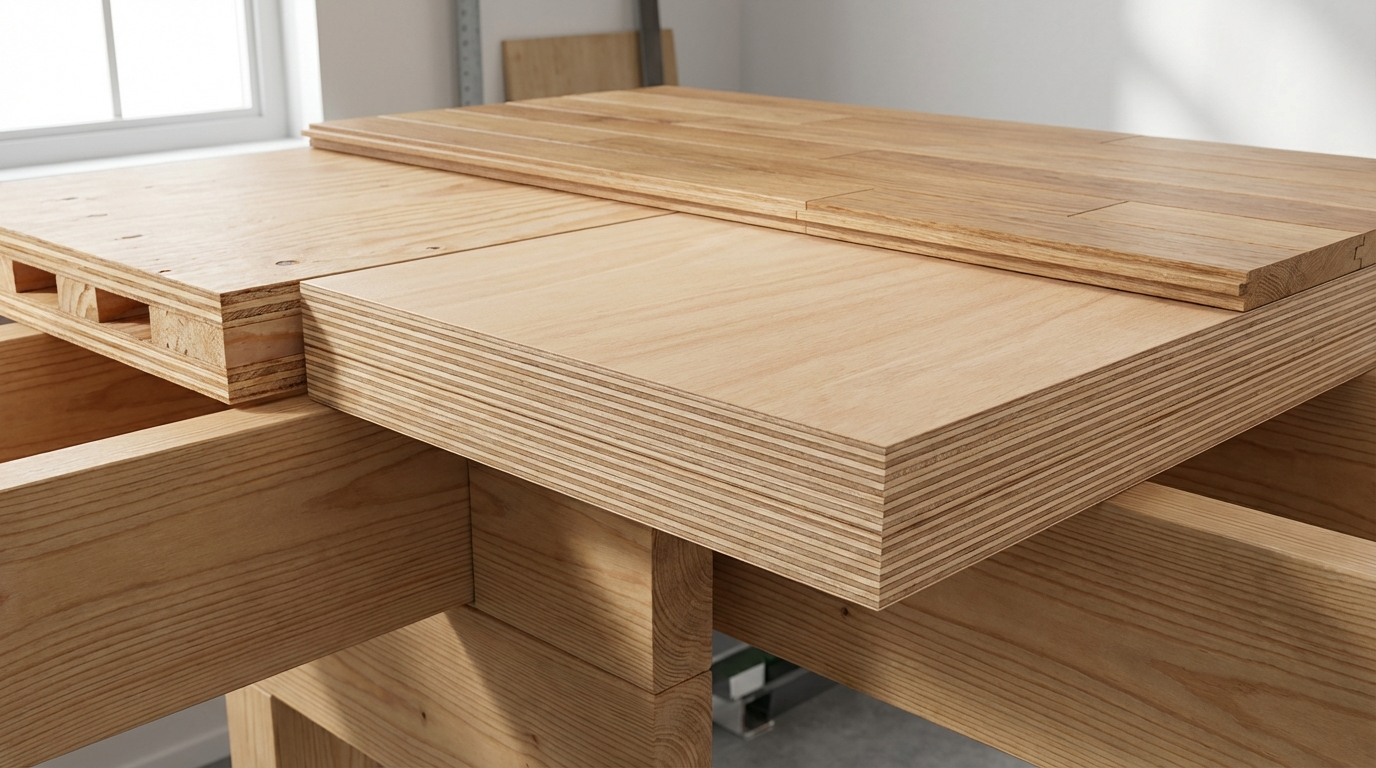
In Indian construction, where wooden flooring overlays laminate, engineered wood, or parquet, the subfloor plywood acts as the critical structural layer. It bears foot traffic loads, bridges floor joists or concrete screeds, and resists warping under humidity swings common in monsoon-prone regions. A weak base leads to squeaks, bounces, or outright failure, especially in multi-story apartments or villas with open-plan layouts.
Selecting the right plywood starts with recognizing that not all sheets suit subfloor demands. Standard interior grades buckle under spills or steam cleaning, while flooring-specific options prioritize screw-holding strength, dimensional stability, and glue-line integrity. Homeowners in Mumbai's coastal humidity or Delhi's dry winters need bases that maintain flatness without delaminating.
Essential Properties for Subfloor Plywood
Subfloor plywood must excel in load distribution, moisture tolerance, and fastener retention. Here's the breakdown:
- Structural Integrity: High bending strength (measured in MPa) to span gaps between supports without sagging. Indian norms like IS 303 emphasize modulus of elasticity for this.
- Moisture Resistance: Glue bonds that withstand cyclic wetting-drying, vital in kitchens or bathrooms adjacent to living areas.
- Surface Flatness: Minimal void content and consistent thickness to ensure even overlay adhesion.
- Screw-Holding Power: Dense face veneers that grip screws firmly, preventing pull-out under dynamic loads like furniture shifting.
- Termite and Decay Resistance: Often enhanced with preservatives, as subfloors trap moisture in crawl spaces or over slabs.
Contractors favor sheets certified under IS 710 (for marine plywood) or IS 303, as these guarantee performance in load-bearing tests.
Plywood Grades Ranked for Flooring Base Performance
Indian plywood grades—MR, BWR, BWP—differ primarily in adhesive type and boil-test cycles, dictating subfloor suitability. BWP leads for demanding applications, but logic varies by site conditions.
Boiling Water Proof (BWP) Plywood: The Top Choice
BWP uses phenolic resins that pass a 72-hour boil test without separation, ideal for subfloors exposed to plumbing leaks or high humidity. In Kerala homes or Hyderabad apartments, it prevents delamination from monsoon ingress through micro-cracks in tiles or overlays.
Strengths include superior shear strength for wide spans (up to 610mm joist spacing) and stability in 90%+ RH environments. Architects specify BWP (IS 303) or marine (IS 710) plywood for floating floors over concrete, where it doubles as vapor retarder.
Caveats: Higher upfront cost suits long-term projects; overkill for fully enclosed, dry interiors.
Boiling Water Resistant (BWR) Plywood: Balanced Alternative
BWR passes three cycles of 8-hour boiling and 16-hour drying, offering good resistance for semi-exposed subfloors like those under laminate in living rooms. Common in Tier-2 cities like Pune or Jaipur, where moderate humidity prevails.
It provides adequate screw retention (Type-1 glue) at lower cost than BWP, with bending strength matching most residential loads. Suitable for renovations over existing slabs, but pair with sealants in wet zones.
Limitations: Less forgiving in coastal areas; monitor for edge swelling if not edge-sealed.
Moisture Resistant (MR) Plywood: Avoid for Subfloors
MR (urea-formaldehyde glue) suits cabinets but fails subfloor tests after brief exposure. In Indian villas with underfloor heating or AC drips, it warps, causing overlay failures.
Use only in ultra-dry climates like Rajasthan deserts, and even then, upgrade for safety.
Other Options: Shuttering and Film-Faced Plywood
Shuttering plywood (IS 4990) delivers raw strength for concrete formwork but lacks refined faces for overlays. Film-faced variants add water repellency, useful in industrial floors or coastal godowns repurposed as homes.
Blockboard tempts for flatness but crumbles under point loads; reserve for partitions.
Thickness Guide for Optimal Subfloor Performance
Thickness dictates span capability and overlay compatibility. Thinner sheets suit close joists; thicker handle wider gaps or heavier traffic.
| Joist Spacing | Recommended Thickness | Load Type | Best Grade | India Use Case |
|---|---|---|---|---|
| 300-400mm | 12-15mm | Residential foot traffic | BWR | Apartment bedrooms over screed |
| 400-610mm | 18-20mm | Medium spans, furniture | BWP | Villas with wooden joists |
| 610mm+ | 25mm+ | Commercial or heavy loads | BWP/Structural | Hallways in bungalows |
Rule: Multiply span by 24-32 for minimum thickness in mm. Test deflection under 1.5kN load per IS standards.
Performance Comparison Table
| Property | BWP | BWR | MR | Shuttering |
|---|---|---|---|---|
| Boil Cycles | 72+ | 4-8 | 1-2 | Variable |
| Modulus of Elasticity (GPa) | 6-8 | 5-7 | 4-6 | 7-9 |
| Span Capability | Excellent | Good | Poor | Good |
| Cost Relative to MR | 1.8-2.5x | 1.3-1.8x | 1x | 1.1-1.5x |
| Best for Indian Humidity | Coastal/High | Moderate | Low/Dry | Construction phase |
India-Specific Challenges and Solutions
Monsoons amplify subfloor risks: Mumbai sees 90% RH for months, promoting mold under vinyl overlays. Solutions include BWP with HMR cores for density, or edge-taping sheets before install.
Inland like Lucknow, termites target untreated subfloors; opt for IS-certified treated plywood. Over concrete slabs (common in RCC frames), use 18mm BWP to bridge undulations from poor leveling.
Dealer ecosystems vary: Metro wholesalers stock full BWP ranges; rural markets push MR—verify BIS stamps on-site.
Installation Guidelines for Longevity
- Prep Substrate: Level joists or slabs to <3mm/2m variance; apply primer if damp.
- Layout Sheets: Stagger seams 300mm, tongue-groove edges for continuity.
- Fastening: Screws at 150mm edges, 300mm field; pre-drill to avoid splits.
- Sealing: Epoxy edges and gaps; vapor barrier under in humid zones.
- Overlay Timing: Install flooring within 48 hours to minimize exposure.
Pro tip for contractors: Acclimate plywood 7 days at site RH to prevent cupping.
Cost Drivers and Value Assessment
Plywood pricing hinges on core material (hardwood vs poplar), face quality, and grade. BWP commands premiums due to resin costs and boil-proofing, varying 20-50% by region—coastal dealers charge more for marine stocks.
Relative costs: BWP exceeds BWR by 30-60%, but lifecycle savings from zero callbacks offset this in rentals or flips. Factor wastage (5-10% for cuts) and transport (higher for bulk from mills in Punjab/Assam).
Homeowners: Prioritize grade over thin discounts; contractors: Bulk dealer negotiations yield 10-15% off list.
Buyer Decision Framework
Assess your project:
- High moisture/span? BWP 18mm+.
- Budget residential? BWR 15mm.
- Verify: BIS mark, core density >550kg/m³, no dead knots.
- Ask dealers: Recent boil-test reports? Treatment certificates?
For architects: Specify per IS 303/710; interiors pros: Sample deflection tests pre-order.
Common Pitfalls to Avoid
Undersizing thickness causes 80% of bounce complaints. Skipping acclimation warps premium sheets. Relying on visual grade alone ignores glue-line failures—always probe cores.
In renovations, mismatched old-new plywood accelerates issues; full replacement ensures uniformity.
Which Flooring Base Plywood Fits Your Project?
| Scenario | Top Pick | Thickness | Why |
|---|---|---|---|
| Coastal apartment kitchen | BWP | 18mm | Leak/steam resistance |
| Inland villa living room | BWR | 15-18mm | Cost-effective stability |
| Budget flat bedroom | BWR | 12mm | Close joists suffice |
| Commercial hallway | BWP Shuttering | 20mm+ | Heavy traffic |
Related guides on PlyPrice
Want Plywood Suggestions?
Share a few details and a PlyPrice specialist will suggest suitable brands and connect you to responsive dealers.