Best Plywood for Bed Frame: 18mm Grades, Load Capacity and Termites
A bed frame needs plywood that carries 200-400 kg of distributed load for years without warping, which in practice means good-quality 18mm sheets with termite-treated cores. Grade choice then depends on local humidity and termite risk in your city.
Structural Integrity: The Foundation of Safe Bed Frames
In Indian households, where bedrooms often double as family hubs, a bed frame's reliability directly impacts daily rest and safety. Collapses from weak materials can lead to injuries, especially with varying family weights—from children jumping to adults sharing double beds. Plywood selection hinges on its ability to handle dynamic loads without warping or cracking, particularly under India's humid climates that accelerate material fatigue.
High-strength plywood ensures the frame supports 200-400 kg distributed loads over time, factoring in mattress weight and movement. Termite-proof variants add longevity, as subterranean termites thrive in tropical soils common across Uttar Pradesh to Tamil Nadu, devouring untreated wood in months.
Load Dynamics in Real Bedroom Scenarios
Bed frames face static loads (body weight) and dynamic stresses (sitting, rolling). A typical adult bed requires plywood to withstand 150-250 kg per side slat without deflection exceeding 2-3 mm. In multi-person households, queen-size frames demand balanced support across 6-8 ft spans.
Termite Resistance: Protecting Your Investment Long-Term
Termites cause over 70% of wood damage claims in India, targeting sapwood in softwood cores of budget plywood. For bed frames elevated slightly off floors, vapors from soil-transmitted termites still pose risks without barriers.
Opt for plywood treated with preservatives like copper ammonium quaternary (CAQ) or boric acid compounds, penetrating 10-15 mm deep. These resist Formosan and native species, unlike surface sprays that wear off. Boiling water resistance (BWR) grades often incorporate such treatments, extending life to 15-20 years versus 3-5 for moisture-resistant (MR) types.
Verification Tips for Buyers
- Check for ISI BIS 303:2018 certification stamps indicating delamination tests.
- Inspect core uniformity—void-free sheets resist tunneling better.
- Avoid green-tinted cores unless lab-verified; natural color variations signal poor treatment.
Load Capacity Analysis: Engineering Beds That Last
Load capacity derives from plywood's modulus of elasticity (MOE) and bending strength. For bed frames, prioritize sheets with MOR (modulus of rupture) above 40-50 N/mm², tested per IS 303 standards. Span tables guide sizing: an 18mm sheet over 900mm unsupported span holds 300 kg with minimal sag.
| Load Type | Recommended Min. Strength (N/mm²) | Span Limit (mm) for 18mm Thick | Failure Risk in India |
|---|---|---|---|
| Static (Sleep) | 35-45 | 1200 | Low if BWR grade |
| Dynamic (Movement) | 45-60 | 900 | Medium in humid areas |
| Edge Support (Slats) | 50+ | 600 | High without gussets |
This table uses first-principles: thicker veneers distribute stress, cross-bands prevent shear failure. In practice, coastal Kerala homes see 20% faster degradation from salt-laden air, dropping capacity by 15-20% over 5 years.
Durability Deep Dive: 18mm Sheets Under Indian Stressors
18mm emerges as the sweet spot for bed frames—balancing rigidity and weight. Thinner 12-15mm suits kids' beds but deflects under adults; 21mm adds bulk without proportional gains. Durability metrics include screw-holding strength (above 1000N) and cyclic moisture exposure.
Moisture and Humidity Challenges
India's 60-90% RH swings cause swelling in MR plywood (upto 12% thickness gain), leading to creaks. BWR grades limit this to 8%, BWP (boiling water proof) to 5%. For monsoon-prone regions like Mumbai, pair with elevated legs and ventilated slats.
Termite and Fungal Durability
18mm allows deeper preservative infusion versus thinner sheets. Lab tests simulate 2-3 years exposure; quality sheets retain 90% strength post-immersion. Field data from Delhi-NCR shows untreated frames failing in 2 years, treated ones holding 10+.
Plywood Grades Ranked for Bed Frame Performance
Not all plywood equals bedroom duty. Here's a reasoned hierarchy based on glue lines, face quality, and core density.
| Grade | Glue Type | Load Capacity Suitability | Termite/Moisture Resistance | Best For |
|---|---|---|---|---|
| MR (Moisture Resistant) | Urea Formaldehyde | Low-Moderate | Poor | Budget kids' beds, dry interiors |
| BWR (Boiling Water Resistant) | Phenol Formaldehyde | High | Good | Family beds, humid areas |
| BWP (Boiling Water Proof) | Extended PF | Very High | Excellent | Coastal/heavy-use frames |
| HDHMR (High-Density) | Premium PF | High (Uniform) | Very Good | Modern minimalist designs |
BWR 18mm offers optimal value—stronger glue survives boiling cycles, mimicking laundry spills or sweat. HDHMR shines in uniform density but costs 20-40% more due to compression processes.
Frame Design Factors Influencing Plywood Needs
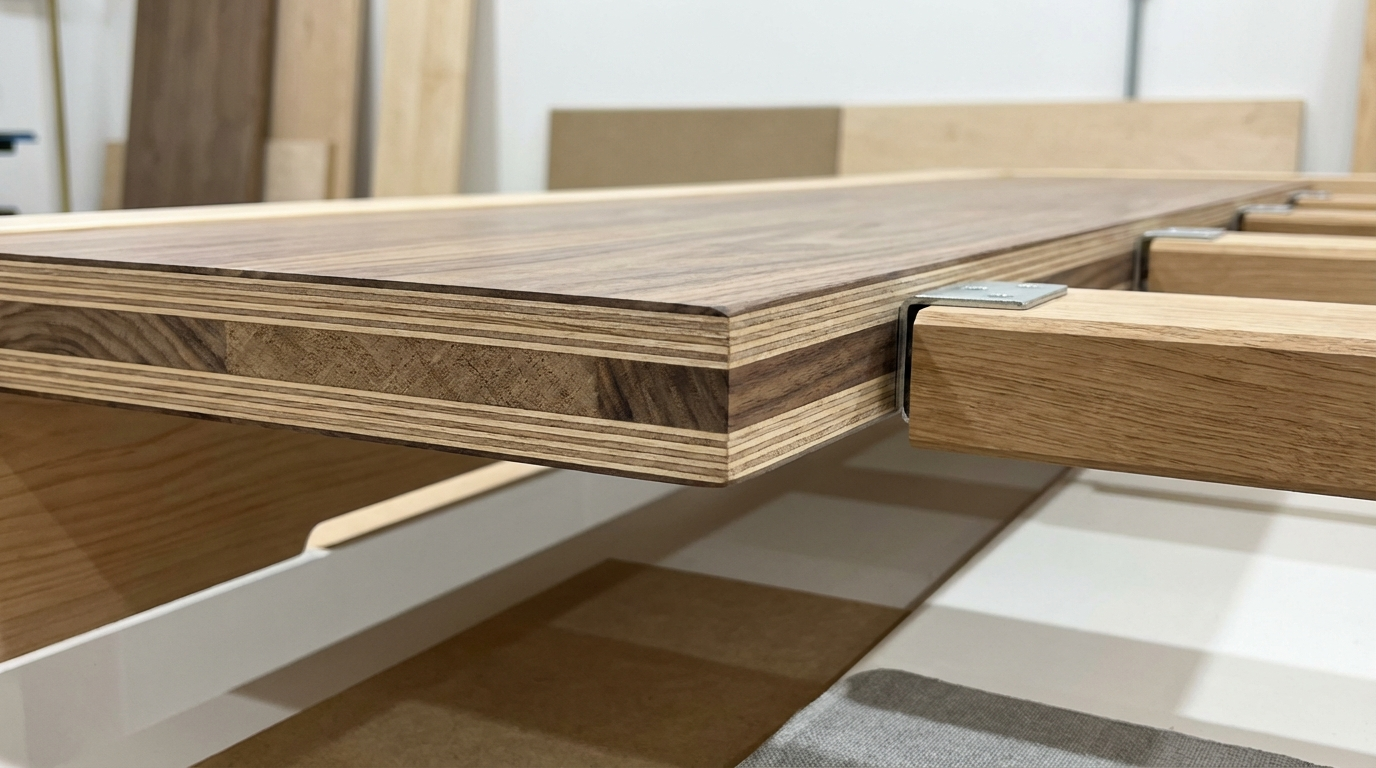
Beyond sheet specs, design amplifies performance. Platform beds with full-sheet bases need less thickness; slatted designs demand stiffer plywood.
- Support Spacing: 200-300mm centers prevent hammocking.
- Joint Types: Dowels or brackets boost capacity 30% over butt joints.
- Finish: Laminate or polish seals edges against moisture ingress.
In contractor-built homes, prefab frames use 18mm gussetted plywood for 400kg ratings.
Cost Drivers and Value Assessment
Expect BWR 18mm at higher mid-range pricing due to phenolic resins and multi-layer veneers. Factors inflating costs: brand certification, southern rubberwood cores (denser), or imported hardwoods. Regional variance—Kerala mills undercut Delhi by 10-15% on volume.
Value equation: Initial outlay x longevity. A premium sheet saves replacement costs every 5-7 years. Dealers push MR for margins; insist on core samples.
Practical Buying Checklist for Homeowners and Designers
- Measure span/load: Simulate with weights pre-purchase.
- Source ISI-marked BWR/BWP 18mm from reputed mills.
- Test edges: No delams on knife cuts.
- Budget 15-20% extra for treatments if not pre-applied.
- Consult architects for custom spans exceeding 1m.
For interior pros, specify void-free cores in BOQs to avoid callbacks.
Common Pitfalls and Longevity Boosters
Avoid: Exposed end grains (seal them), overloading top bunks, floor contact without barriers. Boosters: Annual borate sprays, dehumidifiers in bathrooms-adjacent rooms. In termite hotspots like Pune, integrate metal mesh bases.
Alternatives to Traditional Plywood Frames
Blockboard suits curved headboards but warps under load. MDF/HDHMR for upholstered bases—less termite-prone but needs lamination. Metal hybrids cut weight 50% with plywood infills.
Selecting high-strength, termite-proof 18mm plywood aligns strength with India's real-world demands, ensuring frames that support restful nights for years.
Related guides on PlyPrice
Want Plywood Suggestions?
Share a few details and a PlyPrice specialist will suggest suitable brands and connect you to responsive dealers.