Flexi Ply: Flexible Plywood for Curved Furniture Design
Complete flexi ply guide - how flexible plywood works, bending radius, prices & applications. Create curved furniture, reception desks & architectural elements.
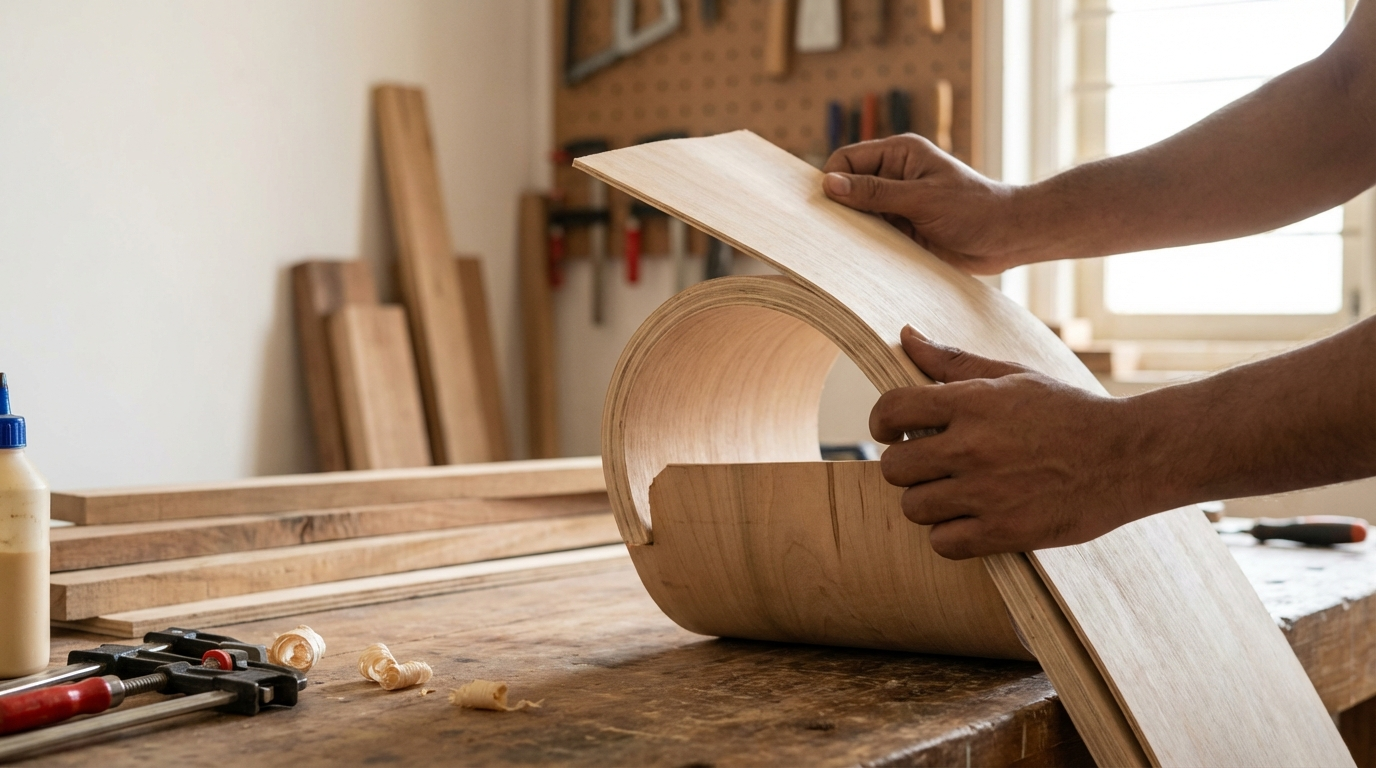
Quick Answer: What is Flexi Ply in 30 Seconds
Flexi ply (flexible plywood) is a specialty engineered wood product designed specifically to bend and curve without cracking, chipping, or breaking. Flexible plywood is constructed from several veneers all running in the same direction, giving it unmatched flexibility. This makes it the ideal substrate for creating curved furniture, reception desks, architectural columns, and decorative interior elements that standard rigid plywood simply cannot achieve.
In simple terms, flexi ply works because all its wood grain layers run parallel rather than perpendicular. Flexible bending plywood is achieved by laying each individual layer (ply) with the grain direction running the same way on all the layers. Unlike regular plywood where the grains of each layer are pressed in a perpendicular direction in a cross-grain design, the grain direction of flexi ply endows the sheets with its unrivalled pliancy.
- Bendable plywood doesn't need heat or moisture to bend into tight curves
- Standard sizes available: 8 x 4 feet with thicknesses ranging from 4mm to 18mm
- Price range in India: ₹35-130 per sq ft depending on thickness and brand
- Once the flexible plywood is glued, laminated or veneered, it will hold its shape without any additional support or structure
- No special equipment required to bend, fabricate or laminate. Can be effortlessly molded into desired shapes
- Best applications: Curved cabinets, reception counters, column cladding, and designer furniture
- Available from major brands: Greenply, Duro, Wigwam, and specialty manufacturers
What Exactly is Flexi Ply (Flexible Plywood)?
Flexi ply is a specialty plywood engineered for bending applications where standard rigid plywood fails. Flexible plywood, also known as bending plywood or flexi ply, is a special type of plywood which can be curved and rounded in different shapes, unlike regular plywood which tends to break. This special ability of flexible plywood makes it more multi-functional and durable in usage.
According to plyprice.com's material database, flexi ply represents one of the most innovative solutions for modern Indian interior design, enabling curved aesthetics that were previously possible only through expensive custom carpentry or solid wood steam-bending techniques.
How Flexi Ply Manufacturing Differs from Regular Plywood
Bendable plywood is a lightweight, non-structural plywood sheet specifically designed for tight radius bending. It's made by gluing together veneer layers in the same grain direction—unlike traditional plywood that alternates grain layers for strength. This parallel grain structure allows the panel to bend along a single axis while maintaining surface integrity.
Flexi plywood is crafted using specially treated softwood veneers. These veneers are arranged in such a way that the grain structure allows bending. The layers are bonded using high-quality adhesives that maintain flexibility without losing strength. The flexibility is typically unidirectional, meaning the board bends easily in one direction (along the grain) while remaining stable in the other.
Flexi Ply Full Form and Terminology
Trade names for flexible plywood include Flexply, flexoply, flexible plywood, bendy plywood, bending plywood, super form, bendable plywood, curve-ply, and wacky wood. In Indian markets, you'll commonly hear carpenters refer to it simply as "flexi ply" or "bendable ply."
Types of Flexi Ply Available in India
Flexible plywood is available in both long grain ('column wrap') and cross grain ('barrel wrap') orientation. Understanding these types is crucial for selecting the right product for your specific application.
| Type | Bend Direction | Best Applications | Price Range (₹/sq ft) | Availability |
|---|---|---|---|---|
| Long Grain Flexi Ply | Bends along the length (8ft direction) | Tall columns, vertical curves | ₹45-95 | Widely available |
| Cross Grain Flexi Ply | Bends along the width (4ft direction) | Barrel shapes, wide curves, reception desks | ₹50-100 | Available at specialty dealers |
| Gurjan Flexi Ply | Either direction based on construction | Premium furniture, high-end interiors | ₹75-130 | Major metro cities |
| Hardwood Flexi Ply | Either direction | Commercial projects, durable applications | ₹55-90 | Industrial suppliers |
| Pre-veneered Flexi Ply | As per veneer application | Finished furniture, direct use | ₹90-150 | Limited, specialty dealers |
Which Type for Reception Desks and Commercial Counters?
Barrel cabinets and radius corners are frequently seen in reception counters, kitchen islands, and bar fronts. For reception desks requiring horizontal curves, cross-grain flexi ply (barrel wrap) is the preferred choice. Plyprice.com recommends 8mm or 12mm thickness for commercial reception applications, ensuring adequate structural support after lamination.
Which Type for Columns and Pillars?
Long band flexi ply bends along the 2440mm length - ideal for creating tall columns up to 2440mm high. When cladding structural columns or creating decorative cylindrical pillars, long grain flexi ply provides seamless vertical curves without visible joints.
Which Type for Curved Furniture?
Curved furniture applications are ideal for curved cabinets, wardrobes, bed headboards, and tables. The choice between long grain and cross grain depends on your specific design—consult with your carpenter to determine the curve direction before ordering.
Technical Specifications Explained
Flexi ply thicknesses range from 3mm to 16mm. The bending radius will vary according to the thickness of the sheet. Understanding these specifications helps you select the right product for your project requirements.
| Thickness (mm) | Minimum Bending Radius | Best Use Cases | Weight (approx kg/sheet) | Screw Holding |
|---|---|---|---|---|
| 3-4mm | 80-150mm (very tight curves) | Decorative panels, model making, lamp shades | 4-6 kg | Poor - needs backing |
| 5-6mm | 150-250mm | Furniture curves, cabinet shutters, columns | 7-9 kg | Moderate with reinforcement |
| 8mm | 250-340mm | Reception desks, bar counters, cladding | 10-12 kg | Good with proper edge banding |
| 12mm | 340-500mm (gradual curves) | Structural curved elements, large furniture | 14-18 kg | Very good |
| 15-18mm | 500mm+ (gentle curves only) | Heavy-duty applications, curved carcasses | 20-25 kg | Excellent |
The recommended minimum bending radius for flexi bending plywood is approximately 340mm for standard variants, while European bending plywood is approximately 110mm for 8mm sheet thicknesses and 80mm for 5mm sheet thicknesses.
Standard Sizes Available in India
The most common sizes in India are 8' x 4' (8 feet by 4 feet). Some manufacturers also offer 7x4 feet sheets, though these are less common. When ordering, always confirm whether you need long grain (8x4) or cross grain (4x8) orientation based on your curve direction.
Top Brands Manufacturing Flexi Ply in India
According to plyprice.com's analysis of 100+ brands, several manufacturers have established strong reputations in the flexible plywood segment. Here's how they compare:
| Brand | Product Name | Thickness Options | Price Segment | Key Features | Availability |
|---|---|---|---|---|---|
| Greenply | Club Flexiply | 4mm, 12mm, 19mm | Premium | Borer & termite proof, fire resistant, BWP, E0 | Pan-India |
| Duro | Duroflex | 3mm, 6mm, 8mm, 12mm, 16mm | Mid-Premium | MR & BWR grades available | Pan-India |
| Wigwam | Wigwam Flexi Ply | Multiple options | Mid-Range | Good flexibility, value pricing | South & West India |
| PEEL Ply | Flexi Ply | Various | Premium | Manufactured from Burmese Gurjan wood | Metro cities |
| V.I. Ply | Flexiply | Multiple | Mid-Range | ISI Mark Certified, 100% Gurjan Face, Termite & Borer Proof | Select cities |
| Archer Ply | Gurjan Flexible Ply | 4-18mm | Mid-Range | Gurjan and hardwood options | Mumbai, Western India |
Note: This is independent editorial content. Plyprice.com is not affiliated with any of these brands. Please verify current specifications and prices with authorized dealers.
Common Misconceptions About Flexi Ply Cleared
Plyprice.com's research reveals several widespread myths about flexible plywood that lead to wrong purchasing decisions:
Myth 1: Flexi ply needs steaming or soaking before bending
Reality: Bendable plywood doesn't need heat or moisture to bend into tight curves. It bends cold, right out of the package.
Myth 2: Flexi ply is weak and won't last
Reality: Despite its flexibility, plywood is a strong and durable material. When appropriately bonded and finished, flexible plywood can withstand significant wear and tear.
Myth 3: You need special tools to work with flexi ply
Reality: One of the main advantages of flexible plywood is that it doesn't need any special tools for installation. And even shaped easily without a lot of woodworking experience. This makes it an excellent option for both DIYers and professionals.
Myth 4: Flexi ply can bend in any direction
Reality: Flexible plywood is available in both long grain and cross grain orientation. Cross-grain bends along the short edge of the sheet to join with the opposite short grain edge. It bends in one primary direction only.
Myth 5: Regular plywood can substitute for flexi ply with enough force
Reality: Standard plywood will crack, delaminate, or break when forced into curves. Flexi ply's parallel grain construction is specifically engineered for bending.
Myth 6: Flexi ply is suitable for structural/load-bearing applications
Reality: Because of this structure, bendable plywood is not meant for load-bearing but offers extreme versatility in curved surface applications.
Myth 7: All flexi ply is waterproof
Reality: Bendable plywood is for interior use. If needed outdoors, it must be sealed thoroughly and protected from moisture. Always check the grade (MR, BWR, BWP) before using in moisture-prone areas.
Advantages and Limitations: Honest Assessment
Unlike competitor websites that only highlight benefits, plyprice.com provides a balanced view of flexible plywood's strengths and weaknesses for Indian conditions:
| Advantages | Limitations |
|---|---|
| Design Freedom: The ability to create curved shapes and flowing lines enables the development of innovative furniture designs | Bendable plywood is strong in terms of flexibility but not as durable as standard plywood. It lacks the strength needed for heavy construction or load-bearing purposes |
| Lightweight: It's lighter than MDF or hardwood panels, making it easier to transport, lift, and install—especially on vertical or ceiling-mounted applications | Limited moisture resistance in standard grades—requires BWR/BWP grade for Indian humid climates |
| Unlike traditional joinery methods, bendable plywood bends cold and fast. This significantly cuts down on labor time, tooling complexity, and overall fabrication cost | Screw-holding capacity is lower than regular plywood—requires edge banding and reinforcement |
| Finishing-friendly: Whether you plan to apply natural wood veneer, HPL laminate, or direct paint, the surface bonds well with adhesives and coatings after bending | Higher cost per sq ft compared to equivalent thickness regular plywood |
| Once the flexible plywood is glued, laminated or veneered, it will hold its shape without any additional support | Limited availability in tier-2 and tier-3 Indian cities |
| Eliminates need for expensive steam-bending equipment or custom carpentry | Bends in one direction only—requires correct grain orientation when ordering |
| Creates seamless curves without visible joints | Monsoon humidity can affect uncured/unfinished sheets—store properly |
| Can be layered with regular plywood for combined strength and curves | Depending on the region, sourcing high-quality flexible plywood can be a challenge. Specialized designs may still incur higher production costs |
Best Applications of Flexi Ply in Indian Homes and Offices
Flexible plywood finds versatile applications across various industries and projects. Its ability to bend smoothly without compromising strength makes it ideal for crafting curved furniture components, such as chair backs and table bases. In architectural applications, flexi ply is used to create curved walls, ceilings, and partitions. It is also favored in interior design for constructing curved cabinetry, custom-built shelves, and decorative panels.
Living Room Applications
- Curved TV unit bases and tops
- Designer bookshelf edges
- Curved wall paneling and feature walls
- Rounded coffee table structures
- Arc-shaped room dividers
Bedroom Applications
- Curved bed headboards
- Rounded wardrobe corners and shutters
- Designer dressing table curves
- Curved bedside unit fronts
Kitchen Applications
- Curved kitchen island fronts
- Rounded cabinet corners (use BWR grade for moisture resistance)
- Curved overhead cabinet bottoms
- Designer breakfast counter curves
Commercial and Office Applications
- Reception desks or built-in shelving units with radius requirements
- Wavy ceiling designs: Often used in high-end hotels, restaurants, and auditoriums
- Column cladding in lobbies
- Acoustic paneling: In performance halls and conference rooms, curved surfaces scatter sound waves more efficiently than flat ones
- Curved retail display units
- Exhibition stands and temporary structures
Quality Verification Without Lab Tests
As detailed in plyprice.com's quality guide, here are practical checks you can perform at the dealer's shop:
Visual Inspection:
- Check for uniform thickness across the sheet
- Look for delamination at edges—any visible separation between layers indicates poor bonding
- Surface should be smooth without raised fibers or rough patches
- Color should be consistent; dark patches may indicate moisture damage
Physical Tests:
- Gently flex a corner—it should bend smoothly without cracking sounds
- The sheet should return partially when released (it won't spring back fully)
- Tap the surface—hollow sounds indicate core voids
- Check weight—unusually light sheets may have inferior core material
Questions to Ask Your Dealer:
- Is this long grain or cross grain orientation?
- What is the minimum bending radius for this thickness?
- What grade is this—MR, BWR, or BWP?
- Which brand and batch is this from?
- Is there a replacement guarantee if the sheet cracks during bending?
Red Flags to Watch:
- Dealer unable to specify grain orientation
- Price significantly below market average (₹25-30/sq ft range is suspiciously low)
- No brand marking or batch information
- Visible moisture stains or warping
- Cracking sounds when slightly flexed
India-Specific Considerations for Flexi Ply
Monsoon and Humidity Impact
Indian monsoons present unique challenges for flexible plywood. Unlike northern hemisphere countries where most flexi ply content originates, Indian conditions demand special attention:
- Pre-Installation Storage: Store sheets flat in a dry, covered area. Never lean against walls as humidity can cause uneven moisture absorption and warping
- Grade Selection: For coastal cities (Mumbai, Chennai, Kolkata) and humid regions (Kerala, Assam), always opt for BWR or BWP grade flexi ply despite the higher cost
- Finishing Timeline: Complete lamination or veneering within 48-72 hours of bending to prevent moisture-related issues
- Sealing Requirements: Seal all edges immediately after cutting to prevent moisture ingress
Regional Availability and Pricing
Flexi ply pricing varies significantly across India due to transportation costs and local demand:
| Region | Price Range (₹/sq ft) | Availability | Key Markets |
|---|---|---|---|
| North India (Delhi NCR, Punjab, Haryana) | ₹40-100 | Good | Kirti Nagar (Delhi), Yamunanagar (Haryana) |
| West India (Mumbai, Gujarat) | ₹45-110 | Excellent | Kurla (Mumbai), Ahmedabad timber markets |
| South India (Bangalore, Chennai, Hyderabad) | ₹50-120 | Good | Shivaji Nagar (Bangalore), Kondithope (Chennai) |
| East India (Kolkata) | ₹55-115 | Moderate | Mullick Bazaar, Bow Bazaar |
| Tier-2/3 Cities | ₹60-130 | Limited—may need advance ordering | Check local plywood dealers |
Termite Considerations
Flexi ply should never come directly in contact with soil, as this can greatly increase the risk of termite infestation in the wood. For termite-prone regions (particularly South India and coastal areas):
- Select brands specifically offering termite-resistant treatment
- Ensure proper ground clearance for all furniture using flexi ply
- Consider additional anti-termite treatment post-installation
- Regular inspection during monsoon months when termite activity peaks
Care, Maintenance, and Longevity
Like any wooden product, flexible plywood requires regular maintenance to preserve its appearance and durability. Proper cleaning and refinishing will help extend the life of furniture pieces.
Daily Care:
- Dust with soft, dry cloth—avoid wet mopping
- Wipe spills immediately to prevent moisture absorption
- Keep laminated surfaces clean with mild, non-abrasive cleaners
Cleaning Methods:
- Safe: Dry dusting, damp cloth (wrung out), mild soap solution
- Avoid: Harsh chemicals, bleach, abrasive scrubbers, excessive water
Damage Prevention:
- Avoid placing heavy objects on curved surfaces without proper support
- Keep away from direct sunlight to prevent laminate fading
- Maintain consistent room humidity (40-60% ideal)
- Use coasters and placemats to protect surfaces
Expected Lifespan:
- With proper care: 15-20+ years for quality branded flexi ply with good lamination
- Average use: 10-15 years
- Poor maintenance/wrong grade selection: 5-8 years
Price Guide: What to Expect in 2025-2026
Based on plyprice.com's India-wide dealer surveys, here are current flexi ply price expectations:
| Thickness | Budget Range (₹/sq ft) | Mid-Range (₹/sq ft) | Premium/Branded (₹/sq ft) |
|---|---|---|---|
| 3-4mm | ₹35-50 | ₹50-70 | ₹70-95 |
| 5-6mm | ₹40-55 | ₹55-75 | ₹75-100 |
| 8mm | ₹45-60 | ₹60-85 | ₹85-115 |
| 12mm | ₹55-75 | ₹75-100 | ₹100-130 |
Factors Affecting Price:
- Brand reputation: Premium brands command 30-50% higher prices
- Core wood type: Burmese Gurjan wood variants cost more than poplar or hardwood cores
- Grade: BWR and BWP grades cost 15-25% more than MR grade
- Location: Metro cities typically have competitive pricing; tier-2/3 cities add transportation costs
- Quantity: Bulk orders (10+ sheets) may qualify for 5-10% discount
Budget Planning Tips:
- Calculate sq ft requirements precisely—flexi ply wastage should be minimized
- Order slightly extra (10%) to account for mistakes during bending
- Compare prices across 3-4 dealers before finalizing
- Verify transportation charges are included in quoted price
- Ask about return policy for defective sheets
Working with Flexi Ply: Carpenter's Guide
Working with flexi plywood involves: Plan your curve—determine the radius or curve design before cutting the sheet. Use simple tools—flexi plywood can be cut with standard woodworking tools. Bend and clamp—gently bend the sheet and clamp it into the desired shape. Fix the form—once bent, the form can be reinforced with framing or laminates. Finish as needed—paint, polish, or laminate as required.
Step-by-Step Working Process
- Design Planning: Determine exact curve radius and verify it's within the sheet's minimum bending capacity
- Orientation Check: Confirm you have the correct grain direction (long grain vs cross grain)
- Cutting: Use standard circular saw or jigsaw; cut slightly oversized for trimming after bending
- Bending: Apply gentle, even pressure; use a curved jig or form for consistent radius
- Clamping: Secure in position using bar clamps or strap clamps; allow 24-48 hours for shape to set
- Reinforcement: Add backing structure, edge banding, or laminate to lock the curve permanently
- Finishing: Apply veneer, laminate, or paint while maintaining clamped position
Tools Required
- Standard circular saw or jigsaw for cutting
- Bar clamps or strap clamps (multiple)
- Curved jig or form matching desired radius
- Wood adhesive (flexible formula preferred)
- Measuring tape and radius templates
- Edge banding iron or machine
Flexi Ply vs Regular Plywood: When to Use What
Bendable plywood is designed to flex and curve without cracking, which is ideal for curved surfaces. Also, this plywood has veneers aligned in the same direction. Traditional plywood is rigid and used for flat surfaces, and layers are cross-laid. Besides, you can use bendable for creative designs like architectural projects and furniture. However, the conventional one suits structural applications.
| Application | Use Flexi Ply | Use Regular Plywood |
|---|---|---|
| Curved reception desk front | ✓ | ✗ |
| Wardrobe carcass (flat panels) | ✗ | ✓ |
| Column cladding | ✓ | ✗ |
| Kitchen cabinet boxes | ✗ | ✓ |
| Curved cabinet shutters | ✓ | ✗ |
| Shelving (flat) | ✗ | ✓ |
| Designer bed headboard (curved) | ✓ | ✗ |
| Structural furniture frames | ✗ | ✓ |
| Wavy ceiling features | ✓ | ✗ |
| Floor underlayment | ✗ | ✓ |
Frequently Asked Questions
What is the full form of flexi ply?
Flexi ply is the abbreviated term for flexible plywood. It's also known as bendable plywood, bending plywood, or bendy ply. Other international trade names include Flexply, flexoply, curve-ply, and wiggle wood. In Indian hardware bazaars, carpenters commonly refer to it as "bendable ply" or simply "flexible ply."
Is flexi ply waterproof?
Not all flexi ply is waterproof—it depends on the grade. Standard flexi ply typically comes in MR (Moisture Resistant) grade, which handles humidity but not direct water exposure. Bendable plywood is for interior use. If needed outdoors, it must be sealed thoroughly and protected from moisture. For kitchens and bathrooms in Indian conditions, insist on BWR or BWP grade flexi ply from reputable brands.
What is the price of flexi ply per sq ft in India?
Based on plyprice.com's 2025 market research, flexi ply prices in India range from ₹35-130 per sq ft depending on thickness, brand, and grade. 4mm Gurjan Flexible Plywood typically starts around ₹55/sq ft, while termite-proof variants range around ₹75/sq ft. Premium branded options like Greenply Club Flexiply command higher prices in the ₹90-130 range.
Which is better: flexi ply or MDF for curved designs?
Unlike MDF or hardwood, bendable plywood naturally holds a curve when shaped, making it a favorite in custom-built projects. MDF cannot bend without kerfing (cutting grooves), which weakens it significantly. For curved applications, flexi ply is superior as it's specifically engineered for bending while maintaining structural integrity.
Can flexi ply be used for kitchen cabinets?
Flexi ply is ideal for curved cabinets and wardrobes. However, use it only for curved elements like shutters, corners, and decorative panels—not for the main cabinet carcass which needs rigid plywood for structural support. Always select BWR grade for kitchen applications due to moisture and steam exposure in Indian cooking environments.
What is the minimum bending radius for flexi ply?
Panels as thin as 3mm can bend to a radius as tight as 150mm depending on grain and orientation. For standard 8mm sheets, expect minimum bending radius around 250-340mm. Thicker sheets require gentler curves—12mm flexi ply typically needs 500mm+ radius. Always verify specifications with your supplier before committing to tight-radius designs.
How long does flexi ply furniture last?
Despite its flexibility, plywood is a strong and durable material. When appropriately bonded and finished, flexible plywood can withstand significant wear and tear, making it suitable for high-traffic areas. With proper lamination and maintenance, quality flexi ply furniture in Indian conditions can last 15-20 years. Key factors include grade selection, proper sealing, and protection from excessive moisture.
Can I paint directly on flexi ply?
One of the biggest advantages of flexible plywood is that it's finishing-friendly. Whether you plan to apply natural wood veneer, HPL laminate, or direct paint, the surface bonds well with adhesives and coatings after bending. For painting, sand the surface lightly, apply wood primer, and use quality enamel or PU paint. Painting should be done after the curved shape is fixed and laminated to the backing structure.
Which brands make the best flexi ply in India?
When it comes to premium flexi plywood, Greenply's Club Flexiply stands out. Designed for both residential and commercial interiors, it's the go-to material for creating smooth curves and elegant shapes. Other quality options include Duro Duroflex, Wigwam Flexi Ply, PEEL Ply, and Archer Ply. Compare prices and availability with local authorized dealers before purchasing.
How do I check flexi ply quality before buying?
Perform these on-site checks: Gently flex a corner—it should bend smoothly without cracking sounds. Check edges for any delamination or separation between layers. Verify uniform thickness across the sheet. Ask the dealer about grain orientation (long grain vs cross grain) and minimum bending radius specifications. Reputable dealers should provide batch information and brand authenticity.
Is flexi ply termite resistant?
Flexi ply should never come directly in contact with soil, as this can greatly increase the risk of termite infestation. Standard flexi ply is not inherently termite-proof. However, premium variants like Greenply Club Flexiply offer termite and borer resistant treatment for enhanced durability. For termite-prone regions in India, specifically request treated flexi ply and maintain ground clearance.
What applications is flexi ply NOT suitable for?
Bendable plywood is not meant for load-bearing applications. Avoid using flexi ply for: structural carcasses, shelving that will carry heavy weight, flooring, roof structures, or any application requiring rigidity. It's designed exclusively for decorative curved surfaces and non-structural design elements where standard plywood provides the structural backing.
Does flexi ply need special storage in Indian climate?
Yes, particularly during monsoon months. Store flat on a level surface in a dry, covered area. Never lean against walls as uneven moisture absorption causes warping. Keep away from direct sunlight and rain exposure. If storing for extended periods, cover with plastic sheet but ensure some air circulation to prevent condensation buildup.
Can flexi ply be used outdoors in India?
Bendable plywood is for interior use. If needed outdoors, it must be sealed thoroughly and protected from moisture. Even BWP grade flexi ply is not recommended for permanent outdoor use in Indian conditions due to intense monsoons, humidity fluctuations, and UV exposure. Use only in covered outdoor areas with proper sealing and regular maintenance.
How is flexi ply different from kerfed plywood?
Kerfed plywood involves cutting grooves (kerfs) into regular plywood to allow bending—this significantly weakens the material and creates a visibly segmented curve. Flexi ply can be bent, curved, or twisted into a variety of shapes without chipping, cracking, or peeling, while still maintaining its strength and stability. Flexi ply provides smooth, seamless curves without structural compromise.
Disclaimer: This content is provided for general informational purposes based on industry practices and publicly available information. Product specifications, standards, prices, and availability may vary by manufacturer, region, and time. Readers should independently verify details with manufacturers, dealers, or qualified professionals before making purchase or construction decisions.Want Plywood Suggestions?
Share a few details and a PlyPrice specialist will suggest suitable brands and connect you to responsive dealers.